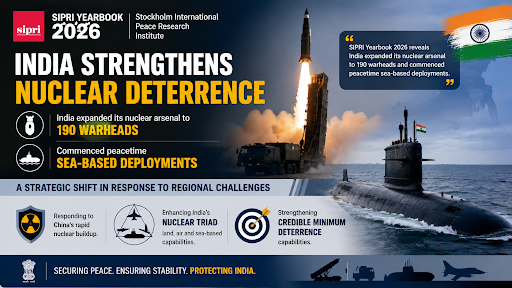
The SIPRI Yearbook 2026 reveals India expanded its nuclear arsenal to 190 warheads and commenced peacetime sea-based deployments. This strategic shift responds to China's rapid nuclear buildup, enhancing India's nuclear triad and credible minimum deterrence capabilities
Why In News?
The Stockholm International Peace Research Institute (SIPRI) Yearbook 2026 reveals India expands its nuclear arsenal.
What is SIPRI?
Established in 1966, it is an independent international organization researching conflict, armaments, arms control, and disarmament.
SIPRI provides policymakers, researchers, and the public with authoritative data and analysis based on open sources.
Key Findings of SIPRI Report 2026
Global Nuclear Expansion: The nine nuclear-armed states possess an estimated 12,187 nuclear warheads, while active military stockpiles increase to 9,745 operational warheads.
India's Arsenal Growth: India increases nuclear stockpile to 190 warheads, up from 180 warheads the previous year.
Peacetime SSBN Deployment: India shifts nuclear posture by deploying 12 operational nuclear warheads aboard a ballistic missile submarine (SSBN) during peacetime deterrence patrols.
Strategic Focus on China: India accelerates its nuclear modernization program, actively developing long-range systems like the Agni-V and Agni-VI to counter China's rapid military expansion.
Advanced MIRV Capabilities: India advances Multiple Independently Targetable Re-entry Vehicle (MIRV) technology, enabling a single missile to carry multiple nuclear warheads and overcome enemy defense systems.
Regional Nuclear Rivalry: China drives the world's fastest nuclear buildup with 620 warheads, while Pakistan maintains a growing arsenal of 170 warheads.
Erosion of Disarmament: Global disarmament slows as major powers modernize their nuclear triads and increase reliance on atomic weapons for national security.
Conclusion
India modernizes its nuclear triad and initiates sea-based peacetime deployments to maintain credible minimum deterrence against rapid regional nuclear build-ups.
Source: THEHINDU
|
PRACTICE QUESTION Q. Consider the following statements regarding the SIPRI Yearbook 2026 findings:
Which of the statements given above is/are correct? (A) 1 only (B) 1 and 2 only (C) 2 and 3 only (D) 1, 2, and 3 Answer: B Explanation: Statement 1 is correct: China is the fastest-expanding nuclear arsenal among all nine nuclear-armed states, with its stockpile growing to an estimated 620 warheads. Statement 2 is correct: India has expanded its nuclear lead over Pakistan. SIPRI estimates India's arsenal stands at 190 warheads compared to Pakistan's estimated 170 warheads. Statement 3 is incorrect: India traditionally kept its warheads separated from deployed launchers. However, SIPRI’s recent findings indicate that both India and China now "occasionally deploy a small number of warheads mounted on missiles during peacetime". |
According to the newly released SIPRI Yearbook 2026, India has expanded its nuclear arsenal to an estimated 190 warheads, widening its lead over Pakistan's static stockpile of 170.
The Stockholm International Peace Research Institute (SIPRI) is an independent, authoritative international think-tank that tracks global military expenditure, international arms transfers, and nuclear forces.
India's official nuclear doctrine centers on a strict No-First-Use (NFU) policy, committing to a Credible Minimum Deterrence posture while guaranteeing massive, destructive retaliation if struck first.
A nuclear triad is a three-pronged military force structure consisting of land-based ballistic missiles, nuclear-armed submarines, and strategic aircraft designed to guarantee second-strike survival capabilities.

© 2026 iasgyan. All right reserved