The SCO is a 10-member Eurasian alliance focused on regional security and economic cooperation. Led by the "Shanghai Spirit," it combats the "three evils": terrorism, extremism, and separatism, while serving as India's vital gateway to Central Asian energy and markets
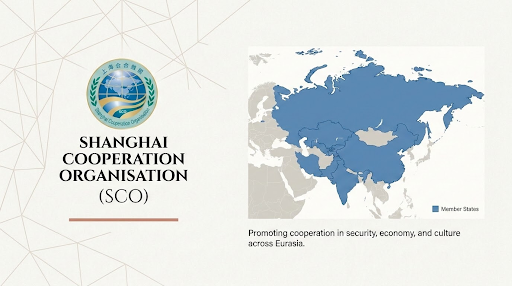
At the Shanghai Cooperation Organisation (SCO) Defence Ministers' meeting, Rajnath Singh urged unified, zero-tolerance action against terrorism.
|
Read all about: TIANJIN DECLARATION: SCO SUMMIT OUTCOMES l INDIA'S STRATEGIC AUTONOMY IN A MULTIPOLAR WORLD l INDIA-CHINA RELATIONSHIP: EXPLAINED l INDIA-SCO RELATIONS |
It is a permanent intergovernmental international organization established in 2001, in Shanghai, China.
It serves as a Eurasian political, economic, and international security alliance, originally succeeding the "Shanghai Five" mechanism formed in 1996.
Current Membership (As of April 2026)
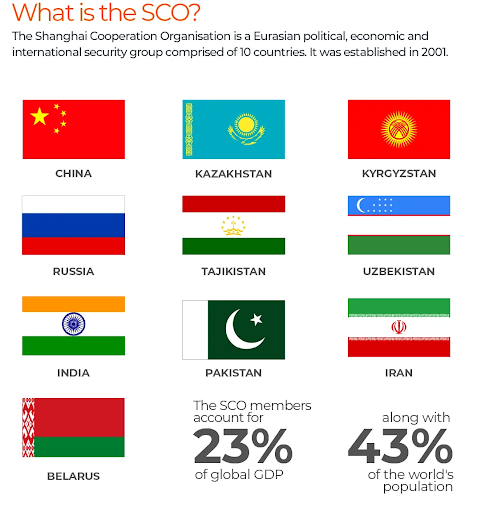
The SCO comprises 10 Member States:
Core Objectives of the SCO
According to the Charter of the Shanghai Cooperation Organisation (signed in 2002), the main goals are:
Key Permanent Bodies
Guiding Principle: The "Shanghai Spirit"
The organization operates on the "Shanghai Spirit," defined by mutual trust, mutual benefit, equality, consultation, respect for diversity of civilizations, and pursuit of common development.
Bilateral conflicts and internal fragmentation
Chinese dominance: Rising influence through the Global Security Initiative risks turning SCO into a China-centric bloc, raising fears of debt traps and loss of autonomy.
Anti-Western perception: Including Iran and deepening Russia-China ties makes the West view SCO as anti-American, challenging India's balance with US and European partners.
Execution gaps: Implementation remains poor; RATS faces enforcement hurdles against state-sponsored terrorism due to political shielding.
Sovereignty & Connectivity: India must champion sovereignty-centric alternatives to China’s BRI by fast-tracking the International North-South Transport Corridor (INSTC) and Chabahar Port for Central Asian access.
Revitalizing RATS: India should advocate for an action-oriented Regional Anti-Terrorist Structure, emphasizing a unified terror list and accountability for cross-border militancy.
Digital Diplomacy: By sharing its Digital Public Infrastructure (e.g., UPI) with SCO partners, India can build non-debt-based strategic dependencies.
Strategic Balance: Maintaining SCO membership allows India to bridge the West and East while preventing the bloc from becoming purely China-centric.
Resource Security: India should utilize SCO sidelines for bilateral deals to secure energy and minerals (Uranium, Lithium) vital for its green transition.
The SCO is a geopolitical necessity for India. Despite contradictions like Chinese dominance and Pakistani presence, it remains an essential link to Central Asia—a region critical for India's energy security and "extended neighborhood" policy.
Source: NEWSONAIR
|
PRACTICE QUESTION Q. "The Shanghai Cooperation Organisation (SCO) offers India a vital platform for continental engagement, yet internal contradictions threaten to reduce it to the trajectory of SAARC." Critically analyze. 250 words |
The SCO is a permanent intergovernmental organization established in 2001 in Shanghai, China. It focuses on regional security, counter-terrorism, and economic integration, evolving from the 1996 "Shanghai Five" mechanism.
The SCO has 10 member states: China, Russia, Kazakhstan, Kyrgyzstan, Tajikistan, Uzbekistan, India, Pakistan, Iran, and Belarus (which joined in 2024).
RATS is a permanent organ of the SCO based in Tashkent, Uzbekistan. Its primary purpose is to help member states coordinate security efforts, share intelligence, and combat the "three evils" of terrorism, separatism, and extremism.




© 2026 iasgyan. All right reserved