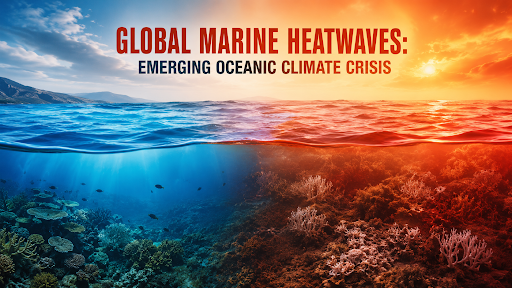
India’s environmental crisis, seen in Delhi’s chronic smog, exposes constitutional gaps. Though courts read a healthy environment into Article 21 using principles like Polluter Pays and Public Trust, weak enforcement persists. An explicit constitutional amendment would convert this implied right into a clear, enforceable fundamental guarantee, strengthening accountability and citizen protection.
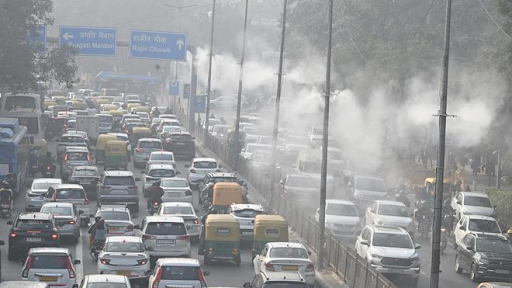
Copyright infringement not intended
Picture Courtesy: THEHINDU
The severe winter smog and poor air quality in Delhi are causing health issues, necessitating legal clarity to link environmental rights with the constitutional "right to life" and requiring clear enforcement emphasizing state responsibility to combat rising pollution.
|
Read all about: AIR POLLUTION INDIA l RIGHT TO A HEALTHY ENVIRONMENT l STUBBLE BURNING AND RIGHT TO HEALTHY ENVIRONMENT l CLEAN, HEALTHY ENVIRONMENT AS UNIVERSAL RIGHT |
It is a universal human right that entitles everyone to live in a clean, healthy, and sustainable environment.
Formally recognized by the UN General Assembly in July 2022 (Resolution 76/300), it empowers individuals and communities to hold governments and businesses accountable for environmental damage.
It is vital for India, given that serious challenges such as climate change, air and water pollution, and the loss of biodiversity pose a direct threat to the welfare of its people
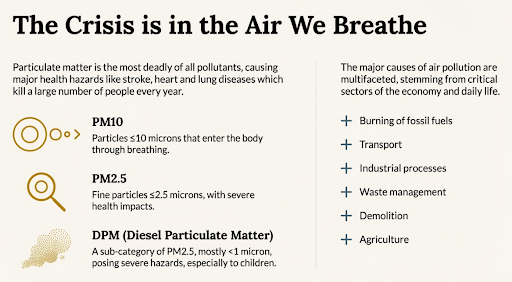
Constitutional Foundation of the Right to Healthy Environment
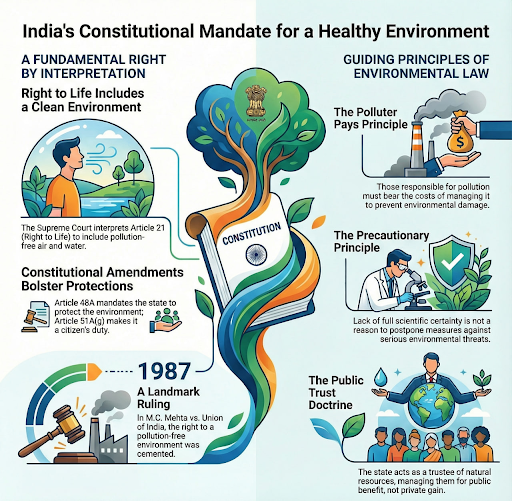
While the Indian Constitution does not explicitly grant a 'Right to a Healthy Environment,' the judiciary has interpreted it as an integral part of the Right to Life under Article 21.
The Supreme Court has consistently held that the right to life means a life of dignity, not mere animal existence, which is impossible without a clean and healthy environment.
This judicial interpretation is supported by the Directive Principles of State Policy (DPSP) and Fundamental Duties.
|
Constitutional Provision |
Nature |
Key Mandate |
|
Article 21: Right to Life and Personal Liberty |
Fundamental Right (Enforceable) |
Judicially interpreted to include the right to a clean, healthy, and pollution-free environment. This forms the bedrock of environmental jurisprudence in India. |
|
Article 48A: Protection and improvement of environment |
Directive Principle (Non-enforceable) |
Directs the State to protect and improve the environment and to safeguard the forests and wildlife of the country. (Added by the 42nd Amendment, 1976). |
|
Article 51A(g): Fundamental Duty |
Fundamental Duty (Non-enforceable) |
Imposes a duty on every citizen of India to protect and improve the natural environment including forests, lakes, rivers, and wildlife, and to have compassion for living creatures. |
Judicial activism, mainly through PILs, has filled legislative and executive gaps, establishing crucial environmental legal principles.
Development vs Environment Conflict: Infrastructure, mining, and industrial projects are often prioritized over environmental concerns, leading to weak clearances and non-compliance.
Weak Regulatory Oversight: Environmental Impact Assessment (EIA) processes are often criticized for being diluted, and post-clearance monitoring of projects is inadequate.
Poor Industrial Compliance: Many industries violate pollution norms due to a combination of weak enforcement by State Pollution Control Boards and regulatory capture. India had 83 of the 100 most polluted cities in the world. (Source: IQAir Report).
Environmental Injustice: Burden of environmental degradation, such as pollution and displacement, disproportionately affects the poor, tribal communities, and other marginalized groups.
Explicit Constitutional Recognition: Making the Right to a Healthy Environment a fundamental constitutional right would strengthen its legal status, decreasing dependence on judicial interpretation.
Strengthening Institutions: Empowering the National Green Tribunal (NGT) and State Pollution Control Boards with more financial autonomy, manpower, and authority is essential for effective monitoring and enforcement.
Integrating Sustainability: Environmental and climate resilience considerations must be integrated into the core of economic and development planning, rather than being treated as an afterthought.
Promoting Green Economy: IInvesting in renewables, circular economy, and sustainable agriculture generates green jobs, proving economic growth and environmental protection are compatible.
Public Participation: Ensuring transparency, access to information, and meaningful public participation in environmental decision-making processes can enhance accountability and lead to better outcomes.
The Right to a Healthy Environment is directly linked to the right to life, dignity, and equality. For India, formally recognizing and enforcing this right is not a barrier to development but a fundamental prerequisite for building a just, resilient, and truly sustainable future for all its citizens.
Source: THEHINDU
|
PRACTICE QUESTION Q. Examine the challenges associated with balancing development imperatives with the right to a healthy environment in India. 250 words |
While not explicitly mentioned in the Constitution as a fundamental right, the Supreme Court of India, through various judgments, has interpreted the 'Right to Life' under Article 21 to include the right to a clean and healthy environment. The 2024 M. K. Ranjitsinh case further recognised the right against the adverse effects of climate change under Articles 21 and 14.
The 'Polluter Pays Principle' is a concept in environmental law which holds that those who produce pollution should be responsible for managing it to prevent damage to human health or the environment. This includes bearing the costs of pollution prevention and compensating victims for any environmental damage caused.
The NCAP is a national-level strategy launched in 2019 to tackle air pollution. It aims to achieve a 40% reduction in Particulate Matter (PM) concentration in 131 targeted cities by 2026, using 2017 as the base year for comparison.


© 2026 iasgyan. All right reserved