Public Interest Litigation enables citizens to seek judicial redress for the marginalized. By relaxing locus standi, it strengthens the judiciary, protects fundamental rights, and drives vital social and political changes in India.
Why In News?
The Supreme Court expressed strong reservations about the current state of Public Interest Litigation (PIL).
What is Public Interest Litigation (PIL)?
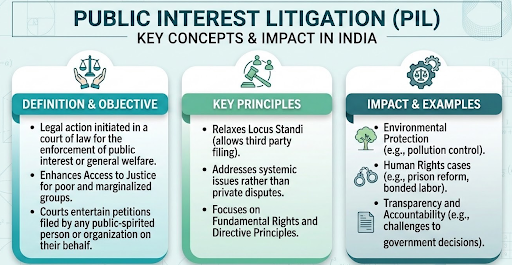
It is a legal mechanism that allows any citizen or organisation to file a case to protect the "public interest."
Unlike standard litigation, a PIL allows third parties to file cases for marginalized individuals unable to seek justice due to poverty or lack of awareness.
Core Purpose and Significance
The primary goal of a PIL is to ensure access to justice for all and to protect the fundamental rights of society at large. It is a powerful tool for:
Originating in the US in the 1960s, PIL in India lacks a specific constitutional statute, developing solely through judicial interpretation.
How did PIL evolve in the Indian judicial system?
Justice Krishna Iyer initiated the PIL framework in the 1976 Mumbai Kamagar Sabha vs Abdul Thai case by permitting an unregistered workers' association to seek judicial redress.
The first reported PIL, Hussainara Khatoon vs State of Bihar (1979), exposed the plight of under-trial prisoners. It led to the release of 40,000 inmates and established speedy justice as a fundamental right.
Justice P.N. Bhagwati in S.P. Gupta vs Union of India (1981) case ruled that any bona fide citizen could use Article 32 or 226 writ jurisdiction for those prevented from accessing courts by socio-economic barriers.
What are the Benefits of PIL?
Broadens Justice Access: PIL empowers marginalized groups to seek legal redress through NGOs or citizens when they cannot afford litigation themselves.
Drives Social Change: It acts as a tool to uphold human rights and combat social issues like exploitation, bonded labor, and environmental harm.
Expands Locus Standi: It democratizes justice by allowing third parties to litigate for those unable to do so, fostering participative legal action.
Demands Executive Accountability: It compels state bodies like police and prisons to answer for violations, enhancing transparency.
Enhances Judicial Review: It enables courts to oversee administrative duties, ensuring authorities prioritize public welfare.
What are the criticisms of PIL?
Misuse for Vested Interests: PILs are sometimes exploited for personal, corporate, or political gains by "busybodies," rather than serving genuine public causes.
Judicial Overreach: By handling complex policy issues, courts sometimes exceed their mandate, undermining the separation of powers and constitutional checks.
Court Overburdening: Frivolous PILs worsen the massive case backlog, obstructing timely justice delivery.
Competing Rights: Judicial orders, like closing polluting factories, may unintentionally strip workers of their livelihoods.
How can PIL be made more effective and credible?
Strict Scrutiny of Credentials: Courts must thoroughly verify the petitioner's background to ensure they have no personal, private, or ulterior motives before proceeding.
Imposition of Penalties: Judiciary should deter abuse by imposing heavy fines and taking strict measures against individuals who file frivolous or malicious petitions.
Adherence to Defined Categories: Courts should limit petitions to established PIL categories—such as environmental protection, bonded labor, or women's rights—while dismissing personal disputes involving service or tenancy.
Establishment of Formal Rules: Each High Court must frame clear, formal rules to support genuine public interest matters and systematically discourage those filed for extraneous motives.
Decentralizing Jurisdiction: High Courts or other competent authorities should handle petitions within their jurisdiction to avoid direct, exclusive adjudication by the Supreme Court.
Conclusion
Public Interest Litigation (PIL) is a vital tool for protecting marginalized rights, but its success relies on judicial discipline to prevent misuse and uphold the separation of powers.
Source: THEHINDU
|
PRACTICE QUESTION Q. While Public Interest Litigation (PIL) serves as an instrument of social change, its misuse has led to challenges like judicial overreach and overburdening of courts. Critically analyze. 150 words |
Public Interest Litigation (PIL) means a legal action started in a court of law for the enforcement of public or general interest, where the public or a specific class has an interest that affects their legal rights or liabilities.
Any person, citizen, or organization (such as an NGO or consumer group) can file a PIL in India, provided they are acting in good faith and in the public's interest rather than for personal gain.
Locus standi is the legal capacity to challenge an act or decision; traditionally, only directly affected persons could file a suit, but this rule was relaxed for PILs to allow public-spirited citizens to advocate for marginalized groups unable to approach the courts.





© 2026 iasgyan. All right reserved