The Supreme Court in the Pardeep Kumar @ Banu vs State of Punjab stated that prolonged pre-trial detention violates the fundamental right to liberty
|
Read all about: STATUS OF UNDERTRIALS IN INDIA l UNDERTRAILS PRISONERS l STATUS OF UNDERTRIALS IN INDIA l SUPPORT FOR POOR PRISONERS |
Undertrials are individuals detained in judicial custody during the period of investigation or trial. Unlike convicts, they have not been found guilty by a court of law.
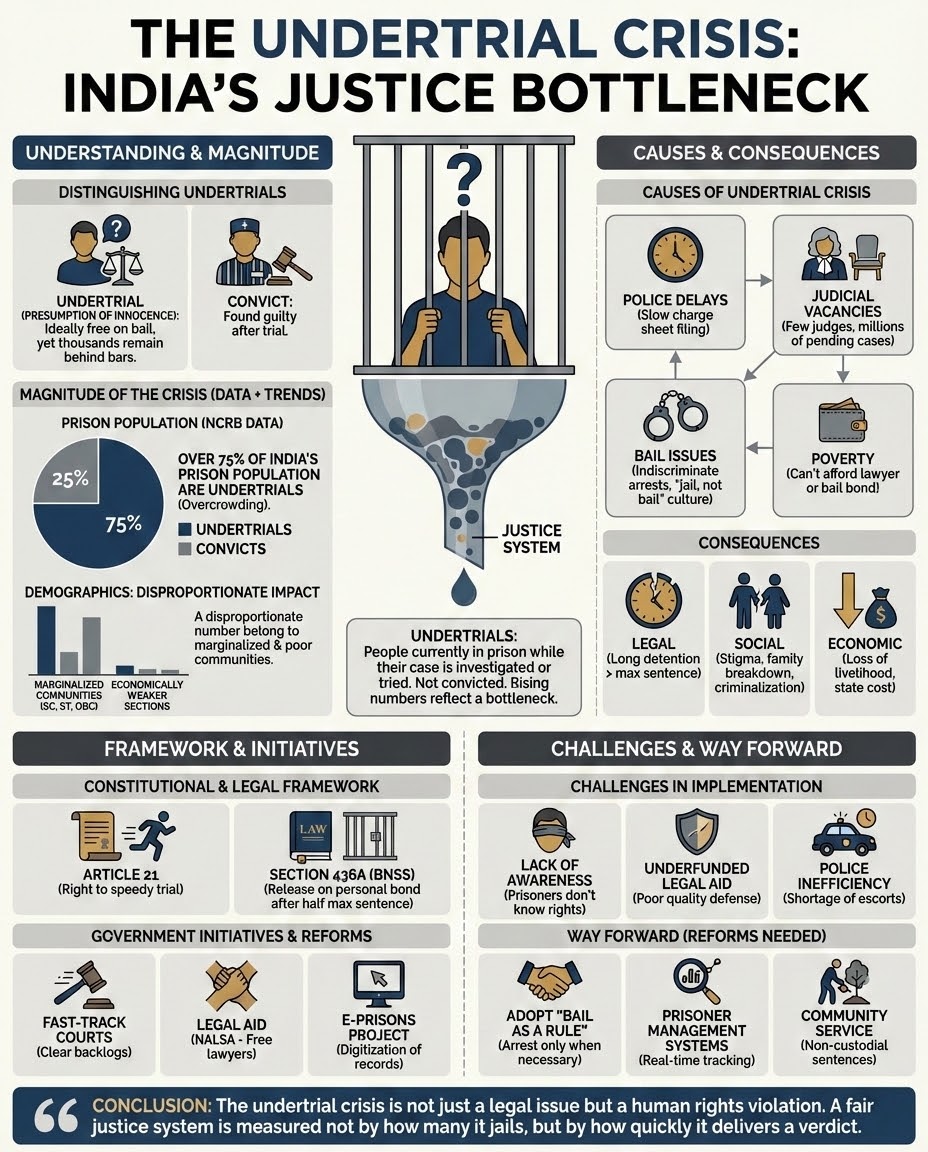 Status of the Undertrials Prisoners In India
Majority of Prisoners are Undertrial: As of the NCRB Prison Statistics India (PSI) 2022, over 75% of all prison inmates are undertrials, which means 3 out of every 4 prisoners have not been found guilty of any crime.
Long Term Detention: Pre-trial Punishment violates the constitutional guarantee of a speedy trial. Approximately 29-30% of undertrials have been detained for more than one year. (Source: NCRB).
Punishing Identity: Disproportionately affects the marginalized who lack the "capability" (money/social capital) to navigate the legal system.
Overcrowding Nexus: National prison occupancy rate is 120.8% (2023). (Source: NCRB)
Emerging Trends: About 48-49% of undertrials are young adults (18-30 years). The criminal justice system is freezing the economic potential of the country’s demographic dividend. (Source: NCRB)
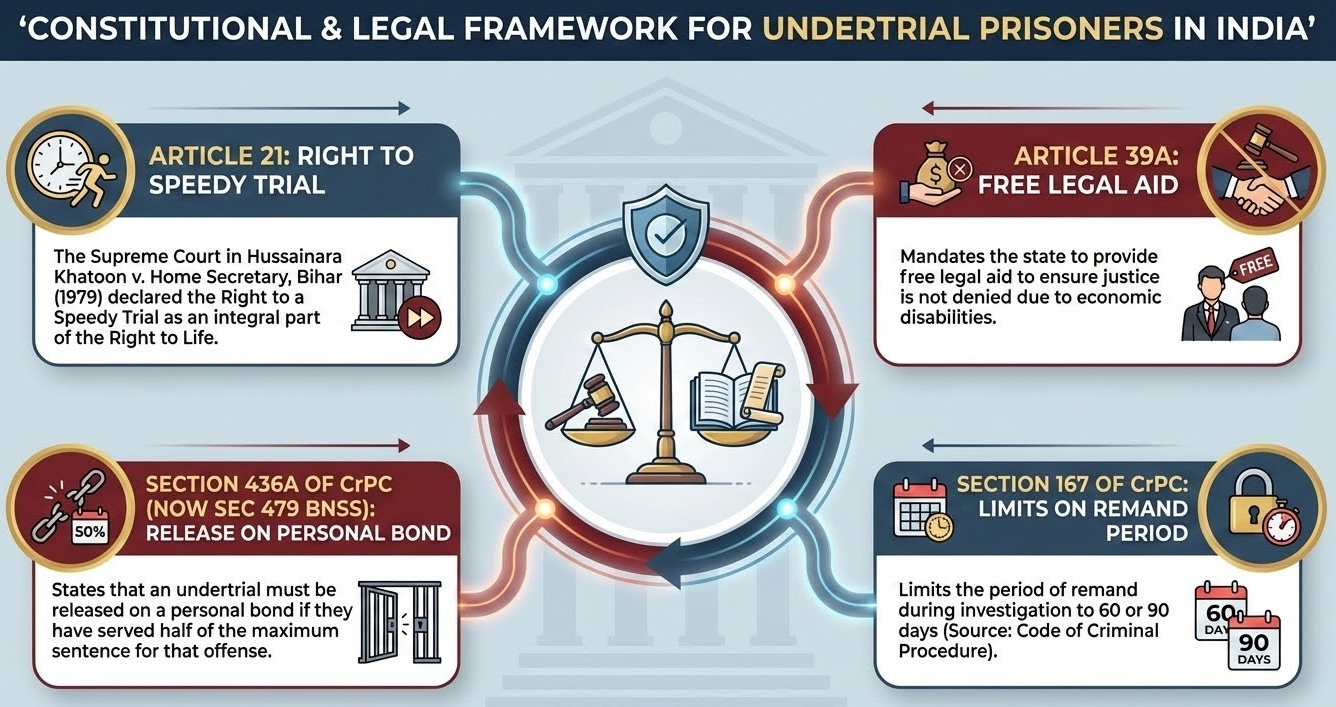
Arrest Culture
Unnecessary Arrests: The Law Commission of India in its 177th Report highlighted that up to 60% of arrests are deemed unnecessary or unjustified, consuming nearly 43.2% of jail expenditure.
Non-Compliance with Guidelines: Despite the Supreme Court's guidelines in Arnesh Kumar vs State of Bihar (checking automatic arrests for offenses with <7 years jail), compliance remains low.
Delay in Investigation: Police often fail to file charge sheets within the statutory 60/90 days, yet the accused are not automatically released on "default bail" due to lack of legal awareness.
Judicial Bottlenecks & Pendency
Adjournment Culture: Trials are frequently delayed due to the repeated seeking of adjournments by lawyers or the unavailability of judges. On average, a trial in India takes 3 to 5 years to conclude. (Source: Daksh India 'Access to Justice' Survey).
Low Judge-to-Population Ratio: India has approximately 21 judges per million people, far below the Law Commission's recommendation of 50 judges per million, leading to an unmanageable workload where bail applications languish for months.
Mechanical Remand: Magistrates mechanically authorize remand, treating jail as the default option without judicial review, as highlighted by the Supreme Court in the Satender Kumar Antil vs CBI case.
Class Factor: Bail & Poverty
Inability to Furnish Surety: Majority of undertrials remain in jail simply because they cannot afford the bail amount or find a local surety (guarantor).
Ineffective Legal Aid: While Article 39A guarantees free legal aid, the quality of state-provided lawyers is often poor due to low honorariums and high caseloads.
Administrative & Logistical Failures
Police Escort Shortages: The Justice Amitava Roy Committee identified the failure to produce prisoners in court—often due to lack of vehicles or personnel—as a primary driver of trial delays.
Institutional Fragmentation: Lack of a unified digital interface between courts, prisons, and police means authorities often miss when inmates are eligible for bail or have served half their potential sentence under Section 436A CrPC.
"Jail, Not Bail" Mindset
Despite the "Bail is the rule, jail is the exception" dictum, the lower judiciary remains risk-averse. Judges often deny bail in non-heinous cases to avoid disciplinary scrutiny or corruption allegations, choosing custody as a "safe" default.
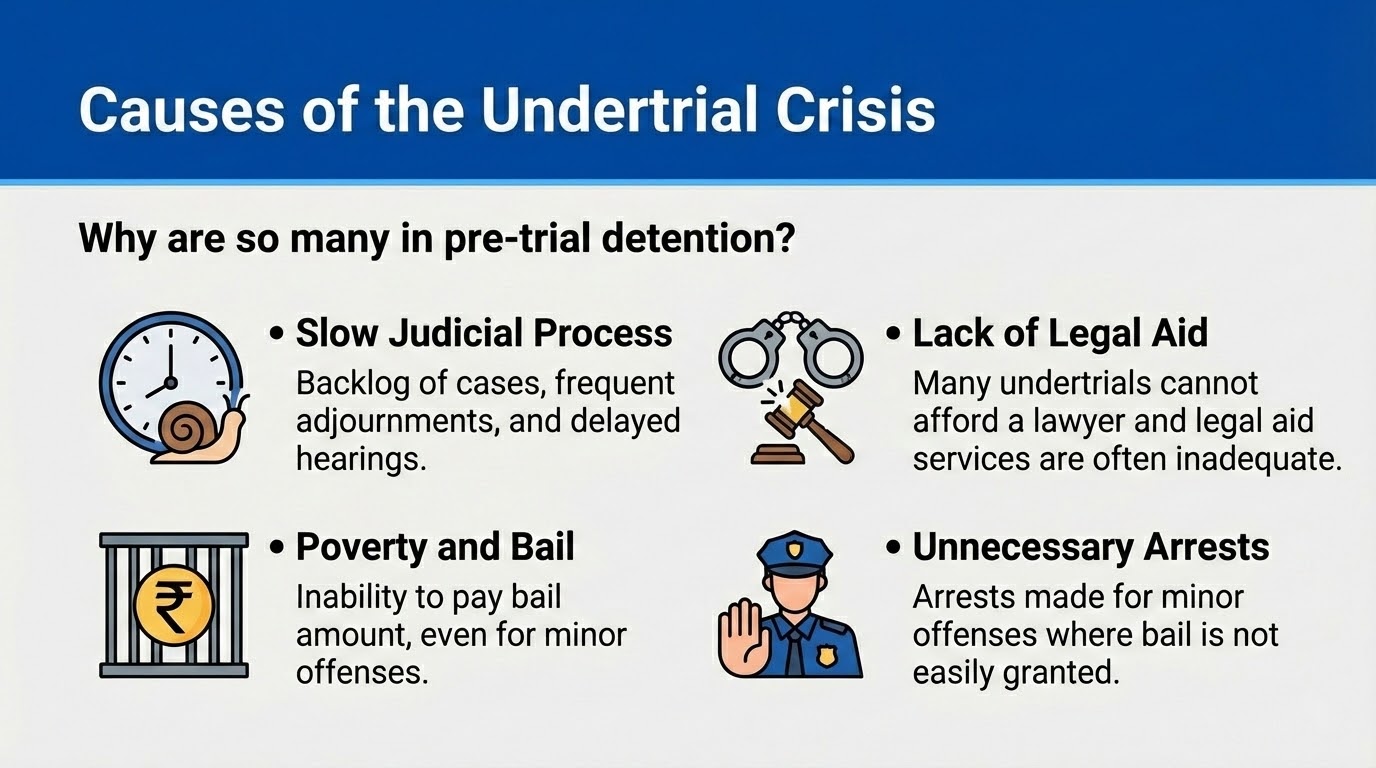 Consequences of Justice Delayed
Violation of Fundamental Rights: Prolonged detention without trial violates the Right to Life (Art. 21). It leads to the "punishment of the innocent" as many are eventually acquitted after years of jail.
Inversion of "Innocent Until Proven Guilty": Prolonged detention acts as a de facto punishment without conviction. In cases like Hussainara Khatoon vs Home Secretary, Bihar, the Supreme Court noted that the "process itself becomes the punishment".
Criminal Contamination: Prisons lack strict segregation between undertrials and hardened convicts. First-time offenders for petty crimes are often housed with professional criminals, turning prisons into "universities of crime" rather than correctional facilities.
Stigmatization: An undertrial faces "civil death" in society. Even if eventually acquitted, the label of "jail-returnee" leads to social boycott, making reintegration into the community nearly impossible.
Burden on the Public Exchequer: State spends approximately ₹40,000 to ₹55,000 per prisoner per year on food, security, and medical care (Source: India Justice Report / NCRB).
Loss of Human Capital: Approximately half of undertrials are in the 18-30 age group. Incarcerating the most productive demographic of the country leads to a significant loss in the national Demographic Dividend and GDP.
The Poverty Trap: To pay legal fees, poor families often resort to "distress sales" of assets or high-interest loans, causing permanent debt bondage.
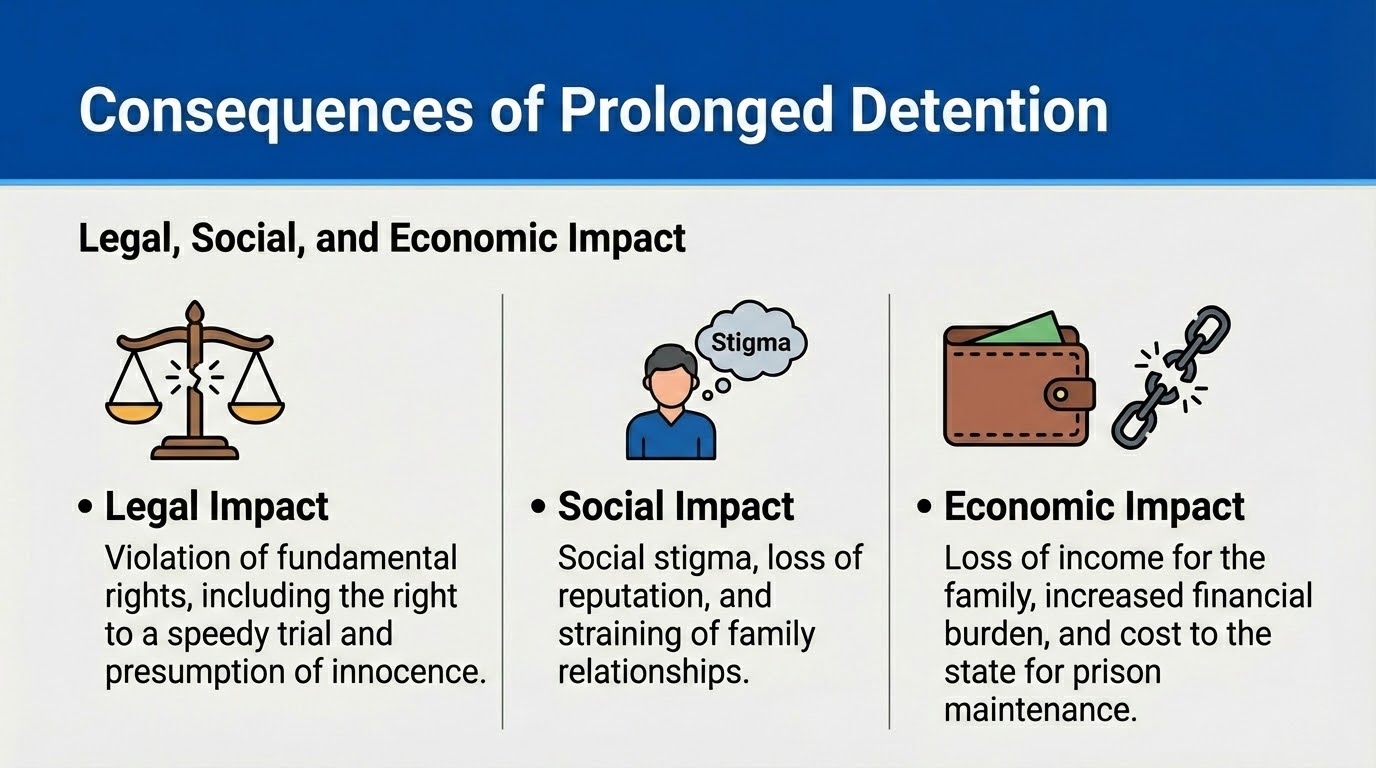 Government Initiatives & Reforms
Bharatiya Nagarik Suraksha Sanhita (BNSS) 2023 (Sec 479): Mandates that first-time offenders be released on a personal bond after serving one-third of the maximum sentence. Old CrPC (Sec 436A) required serving half the sentence.
Support for Poor Prisoners Scheme (2023): Central Government provides financial support to states to pay the bail amount or fines for "indigent" prisoners who remain in jail solely due to poverty.
E-Prisons Project: Digitizes prisoner records, automatically alerts jail authorities when an inmate becomes eligible for release under Sec 479 of BNSS.
Under Trial Review Committees (UTRCs): Established in every district, these committees (comprising the District Judge, DM, and SP) are mandated by the Supreme Court to meet quarterly and recommend the release of eligible undertrials.
Model Prisons and Correctional Services Act, 2023: Shifts the focus from "retribution" to "reformation," providing for better health, legal aid, and vocational training for undertrials.
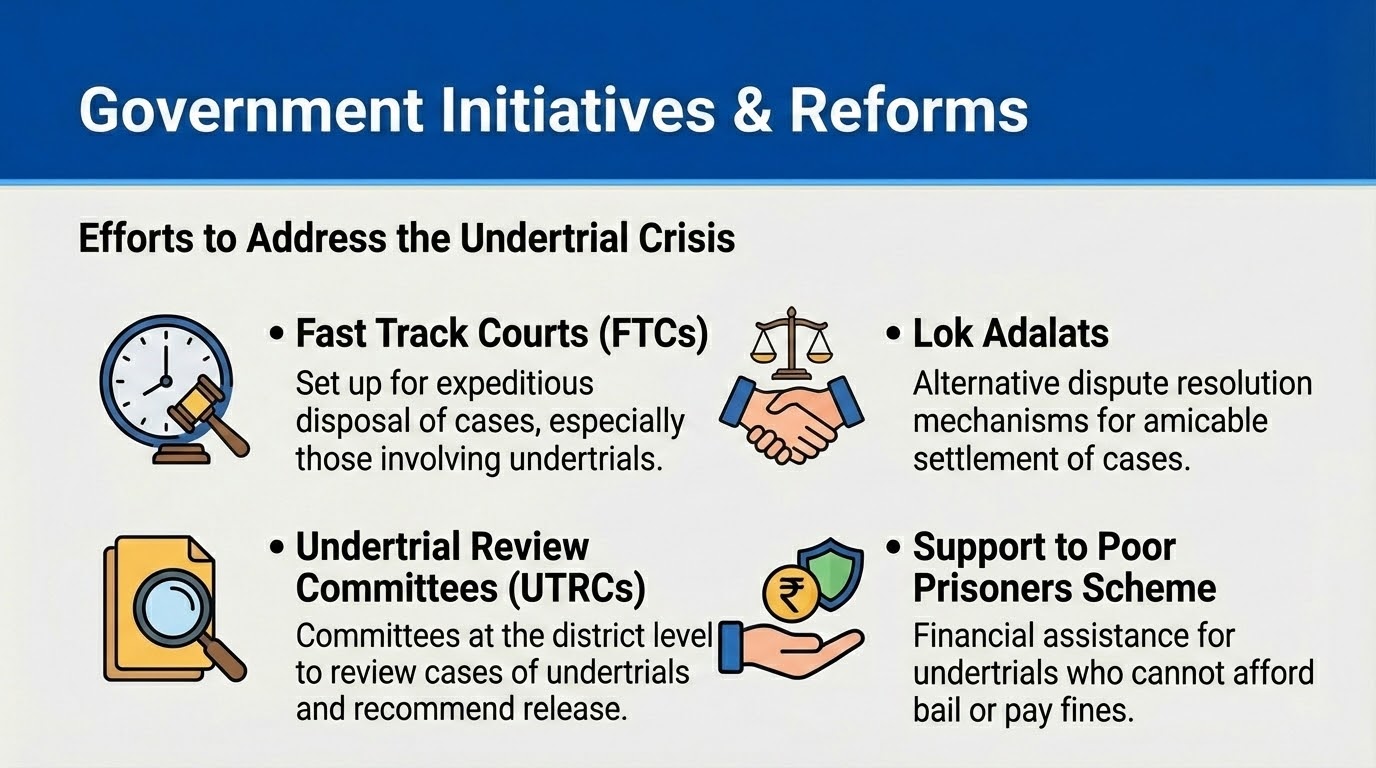 What are the challenges in Addressing Undertrial Crisis?
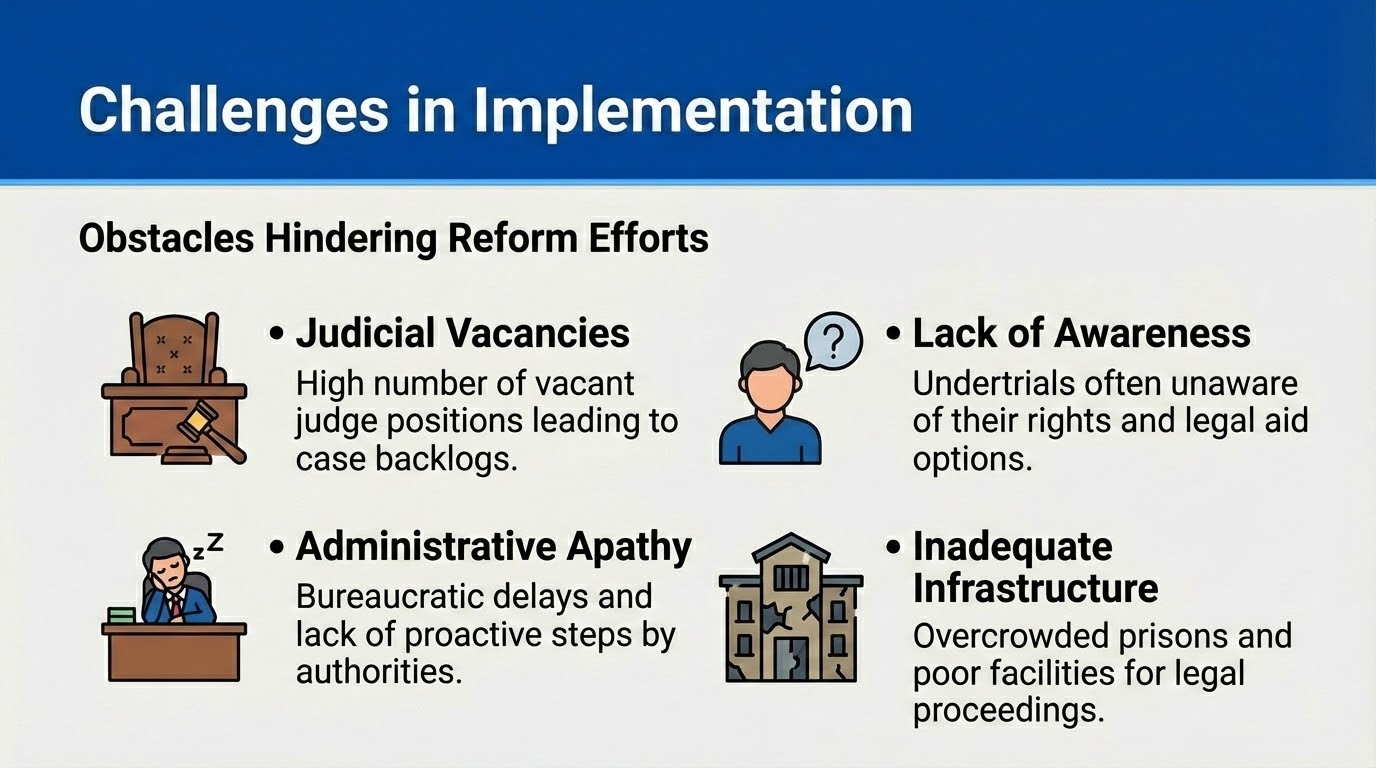
Underutilization of Funds: As of early 202S, several states had utilized less than 10% of the funds allocated under the "Support for Poor Prisoners" scheme due to complex bureaucratic verification processes at the district level. (Source: India Justice Report)
The "Surety" Barrier: Even when bail is granted, courts often demand "local sureties" (guarantors with property). For migrant workers or the landless poor (who form a large chunk of undertrials), finding a local guarantor is nearly impossible.
Institutional Inertia: UTRCs often meet irregularly. A Commonwealth Human Rights study found that in many districts, these committees only recommend release for less than 5% of the eligible population due to a lack of updated data from the police and courts.
Digital Divide: While E-Prisons is a great tool, many rural jails suffer from poor connectivity and a lack of trained staff to update records in real-time, leading to "forgotten" prisoners.
 Way Forward
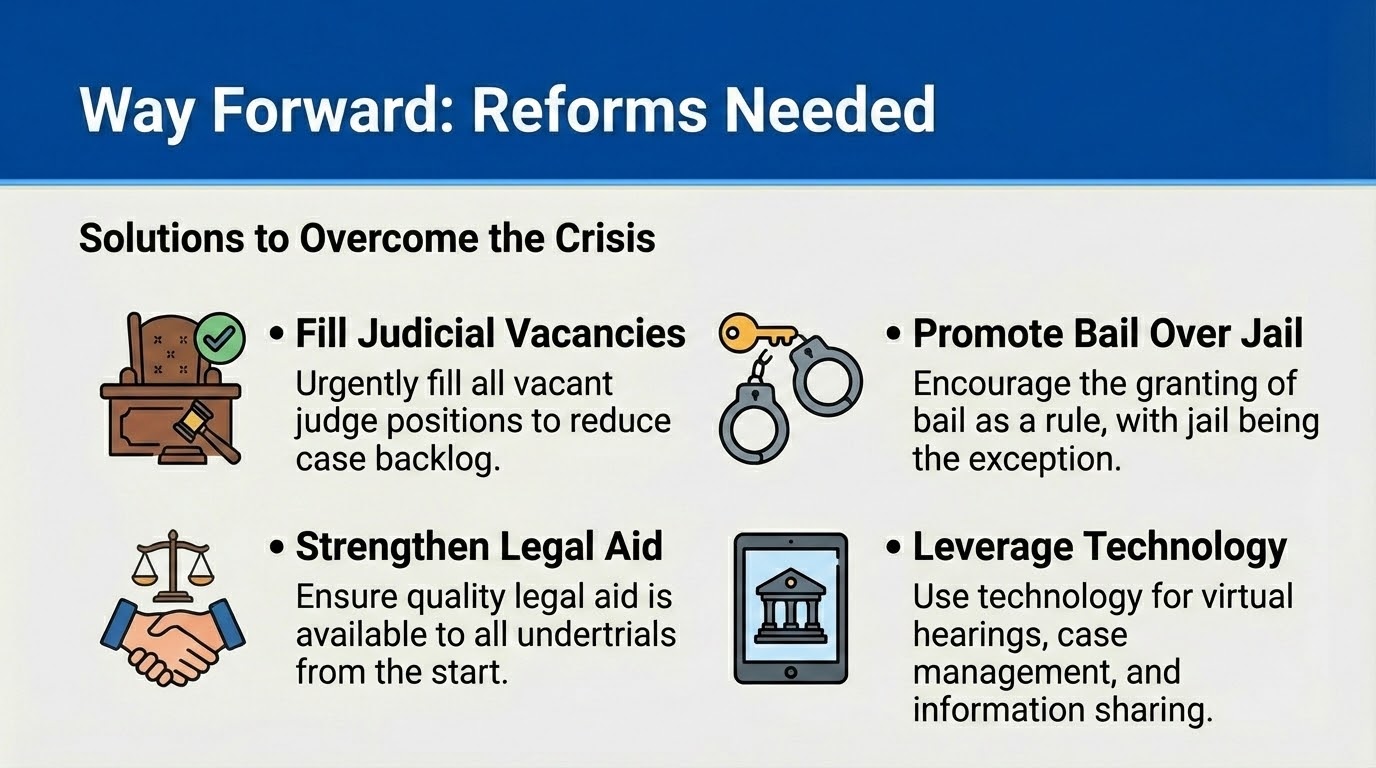
Enact a "Bail Act": As suggested by the Supreme Court in Satender Kumar Antil vs CBI (2022), India needs a separate Bail Act to reduce judicial discretion and make bail a predictable right rather than a "judicial lottery".
Shift to "Non-Monetary" Bail: For petty and first-time offenders, the system should move away from cash bail to Personal Recognizance (PR) Bonds or community service, ensuring that poverty is not a ground for incarceration, as recommended by the Justice Amitava Roy Committee
Legal Aid Clinics in Every Jail: NALSA must station full-time "Jail Lawyers" rather than visiting ones. These lawyers should have the specific mandate to file Default Bail applications (Sec 187 BNSS) the moment the 60/90 day limit for charge sheets expires, as mentioned in the NALSA Vision 2025.
Open Prisons Expansion: Following the "Rajasthan Model," India should expand Open Prisons for undertrials accused of non-violent crimes. This reduces overcrowding and prevents the "criminal contamination" that happens in closed cells.
Independent Prison Oversight: Create an independent "Prison Ombudsman" in every state to monitor human rights violations and ensure the timely production of prisoners in court via Video Conferencing (VC).
 Conclusion
Addressing the undertrial crisis by ensuring affordable legal aid and timely bail is essential to transform the justice system from a tool of "punishing poverty" into an equitable pillar of a Viksit Bharat.
Source: TELANGANATODAY
|
PRACTICE QUESTION Q. “Incarceration without trial is not just a procedural delay but a substantive violation of the social contract." Analyze. 150 words |
An undertrial prisoner is a person who is currently being held in judicial custody (jail) while their trial is pending in court. They have not yet been convicted or found guilty of the crime they are accused of.
According to the NCRB Prison Statistics India (2023), over 75% of the total prison population in India consists of undertrials. This amounts to roughly 4 lakh individuals.
The committee recommended several measures to decongest prisons, including the establishment of special fast-track courts for petty offenses pending for over five years, and the strict segregation of first-time undertrials from hardened convicts to prevent prisons from becoming recruitment centers for criminals.
© 2026 iasgyan. All right reserved