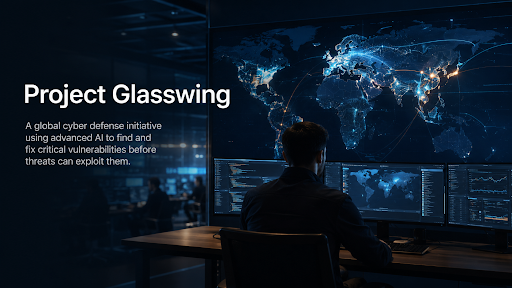
Project Glasswing is a multi-company coalition utilizing frontier AI models like Claude Mythos to autonomously detect and patch software vulnerabilities. By open-sourcing the Visa Vulnerability Agentic Harness, the initiative shifts cybersecurity focus from finding flaws to achieving machine-speed remediation with human oversight.
Why In News?
Visa launches the Visa Vulnerability Agentic Harness, as a core component of Project Glasswing.
What is Project Glasswing?
Coalition Structure: The project functions as a specialized AI coalition featuring tech giants including Anthropic, AWS, Apple, Google, and Microsoft.
Frontier AI Deployment: It utilizes unreleased, next-generation models, specifically Claude Mythos Preview, to secure global software.
Autonomous Remediation: The system detects unknown zero-day vulnerabilities and writes clean patch code at machine-speed scale.
Human-Machine Synergy: The framework overcomes human limitations by uncovering complex attack paths while maintaining an agentic control plane for audit-defensible human governance.
Financial Defense: Visa integrates the Claude Mythos model into its zero-trust architecture to test defenses against AI-speed exploitation without impacting billions of daily transactions.
Artificial Intelligence in Cybersecurity
Agentic Threat Detection: AI agents perform continuous scanning, identifying exploitable paths in minutes rather than relying on periodic manual reviews.
Intelligent Prioritization: AI filters threats to focus on the 1% of Common Vulnerabilities and Exposures (CVEs) that are actively exploited, as identified by the Cybersecurity and Infrastructure Security Agency.
Fraud Prevention: Deep learning models process massive transaction volumes to block sophisticated financial fraud in real-time.
Mean Time to Adapt (MTTA): Organizations adopt MTTA as a primary metric to measure the cycle time between AI-led exploit discovery and the deployment of a validated fix.
Security Risks Associated with AI Systems
Data Poisoning: Hackers inject corrupted data into training pipelines to force models to learn incorrect security baselines.
Prompt Injection: Attackers manipulate autonomous agents to reveal sensitive system architecture or bypass security protocols.
Adversarial Attacks: Cybercriminals design specialized malware payloads that exploit blind spots in AI detection algorithms.
Privacy and Misuse: The dual-use nature of frontier AI necessitates strict access controls, as the same capabilities that enable defense can empower automated, sophisticated cyberattacks.
AI Governance and Regulatory Concerns
Algorithmic Transparency: Regulators require explicit documentation of AI decision-making processes to prevent opaque "black box" outcomes.
Human-in-the-Loop: Project Glasswing mandates human oversight for final deployment to ensure legal and operational accountability.
Ethical Governance: Preventing the proliferation of high-capability models to rogue state actors remains a top priority.
Conclusion
Project Glasswing transforms cybersecurity by shifting the focus from manual vulnerability discovery to autonomous, AI-driven remediation, establishing a new global standard for digital resilience.
Source: CRYPTOBRIEFING
|
PRACTICE QUESTION Q. Consider the following statements regarding Project Glasswing:
Which of the statements given above is/are correct? A) 1 and 2 only B) 1 and 3 only C) 2 and 3 only D) 1, 2, and 3 Answer: B Explanation: Statement 1 is correct: Project Glasswing is a coordinated, multi-company global cybersecurity initiative launched by Anthropic. It brings together tech and finance giants (including AWS, Apple, Google, Microsoft, and JPMorganChase) to identify and fix critical software vulnerabilities across global digital infrastructure. Statement 2 is incorrect: Project Glasswing does not rely on open-source, legacy models. Instead, it explicitly centers around an unreleased, highly advanced frontier AI model—Anthropic’s Claude Mythos Preview. Access is strictly guarded and restricted to authorized coalition partners to prevent the powerful model from being weaponized by malicious actors. Statement 3 is correct: As an extension of its involvement with Project Glasswing, Visa recently developed and released the "Visa Vulnerability Agentic Harness" (VVAH) to the open-source community. It serves as an open-source reference implementation for orchestration pipelines that manage AI-powered vulnerability verification and patching. |
Project Glasswing is a specialized, restricted-access global cyber defense coalition launched by Anthropic in April 2026 that utilizes an unreleased, highly advanced model called Claude Mythos Preview to autonomously scan, identify, and patch critical vulnerabilities across global software infrastructure before malicious actors can exploit them.
Modern AI systems transform cybersecurity by automating continuous pattern-matching threat detection, instantly parsing massive log files to identify active network breaches, and autonomously running complex reverse-engineering pipelines to simulate multi-layered hacker attacks.
The primary risks include bad actors weaponizing autonomous AI models to rapidly discover zero-day software exploits, hackers utilizing hyper-targeted generative social engineering to scale phishing campaigns, and adversarial poisoning attacks designed to subtly corrupt the training data of corporate neural networks.
AI governance is absolutely vital to enforce strict accountability and defensive deployment parameters over dual-use models, mitigate structural geopolitical arms races among rogue state actors, and legally mandate robust auditing frameworks that prevent autonomous systems from inflicting systemic failure on critical public infrastructure.




© 2026 iasgyan. All right reserved