Launched in 2000, PMGSY is a nationwide program providing all-weather road connectivity to unconnected rural habitations. It targets populations of 500+ in plains and 250+ in hills. The scheme aims to reduce poverty by improving access to markets, health, and education
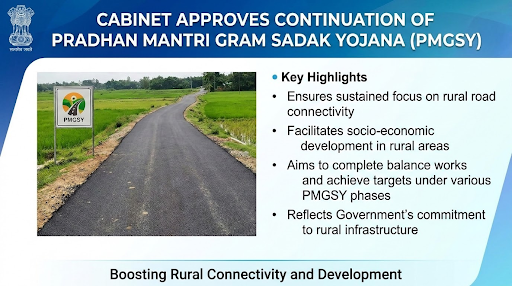
The Union Cabinet has extended the Pradhan Mantri Gram Sadak Yojana-III (PMGSY-III) from March 2025 to March 2028.
It is a centrally sponsored scheme launched on December 25, 2000, with the primary objective of providing all-weather road connectivity to eligible unconnected habitations in rural India.
Phase I (2000)
Phase II (2013)
Phase III (2019)
Phase IV (2024)
Physical Connectivity
Connected over 1.62 lakh habitations out of the targeted 1.78 lakh (approx. 99% of original targets) under PMGSY-I. (Source: Ministry of Rural Development Annual Report)
Constructed a total road length exceeding 8 lakh kilometers across the country. (Source: National Rural Infrastructure Development Agency)
Green Roads
Using green technologies like waste plastic, cold mix, and fly ash, India has built over 1.15 lakh km of eco-friendly roads. This initiative reduces the carbon footprint of rural infrastructure by repurposing industrial waste. (Source: NRIDA)
Governance
OMMAS: The Online Management, Monitoring and Accounting System is a global benchmark for real-time e-governance and financial transparency.
Meri Sadak App: Empowered citizens by providing a platform to upload photos and grievances regarding road quality, with a mandatory 60-day resolution window.
Security & Integration
Constructed thousands of kilometers in LWE (Left Wing Extremism) affected areas, breaking the isolation that fuels insurgency.
Under the Vibrant Villages Programme, connectivity to strategic border villages has been prioritized to strengthen national security.
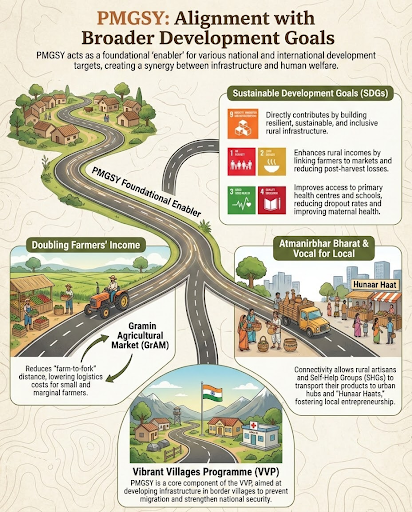
Maintenance Funding Gap: Although the Centre funds construction, routine maintenance is a state responsibility. Financial struggles at the state level often cause assets to deteriorate quickly after their 5-year guarantee.
Difficult Terrain and Climate: In the Himalayas and North-East, harsh winters and monsoons limit the working window to 4–5 months. Frequent landslides frequently damage new roads.
Land Acquisition and Forest Clearances: Securing Environmental and Forest Clearances is difficult in protected or tribal areas. Disputed titles and local compensation issues further delay land acquisition.
Security Concerns in LWE Areas: In Left Wing Extremism districts, threats to contractors and equipment increase costs and delay connectivity for marginalized communities.
Contractor Capacity: Remote regions lack contractors with the technical equipment required to uphold strict PMGSY quality standards.
Climate-Resilient Infrastructure: Future road infrastructure must integrate disaster-resilient features to maintain functionality during extreme weather, particularly in landslide-prone Himalayan areas and flood-prone coastal zones.
Expansion of the "Green" Mandate: Make Waste Plastic and Cold-Mix technology the default standard for all rural road construction to support India's Net Zero 2070 commitment.
Integrated Logistics: Aligning PMGSY with the PM Gati Shakti National Master Plan to ensure that rural roads are synchronized with railways, waterways, and highways for seamless multimodal transport.
Strengthening Maintenance Funds: Establishing a dedicated State-level Rural Road Maintenance Fund with assured revenue streams (like a portion of the State's fuel cess) to ensure roads don't fall into disrepair after the 5-year contract ends.
Focus on Tribal Saturation: Prioritizing the PM Janjatiya Unnat Gram Abhiyan to ensure the most remote tribal hamlets (even those with a population as low as 100) receive all-weather access by 2029.
PMGSY has transformed rural connectivity, but its true success lies in how effectively these roads translate into sustainable livelihoods and inclusive growth.
Source: DDNEWS
|
PRACTICE QUESTION Q. Rural road connectivity is not merely an infrastructural provision but a catalyst for socio-economic transformation. Elaborate. 150 words |
PMGSY is a Centrally Sponsored Scheme launched on December 25, 2000, by the Ministry of Rural Development. Its primary objective is to provide basic, all-weather road connectivity to unconnected rural habitations to facilitate socio-economic development.
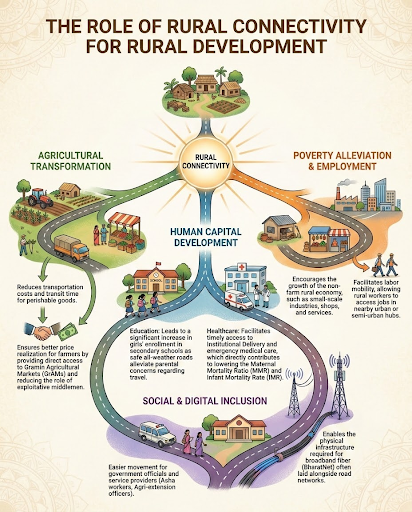
PMGSY drives inclusive growth by establishing direct market access for farmers, lowering transportation costs, enhancing access to primary healthcare centers and schools, and generating massive direct employment (expected to provide over 40 crore human-days under PMGSY-IV).
The scheme faces several hurdles, including substandard construction by local contractors, a severe maintenance deficit due to insufficient state funding and Finance Commission caps, topographical difficulties in hilly or LWE areas, and environmental degradation such as landslides caused by unplanned hill cutting.


© 2026 iasgyan. All right reserved