Reducing methane emissions from paddy fields can generate additional income for farmers through carbon markets. By shifting from continuously flooded rice fields to practices such as Alternate Wetting and Drying, methane emissions can be significantly lowered without affecting yields while also saving water. The verified reductions are converted into carbon credits that companies purchase to offset their own emissions, enabling farmers to earn extra revenue. This approach links climate mitigation, water conservation and livelihood enhancement, though it also requires reliable measurement systems and fair benefit-sharing to ensure small farmers benefit equitably.
Copyright infringement not intended
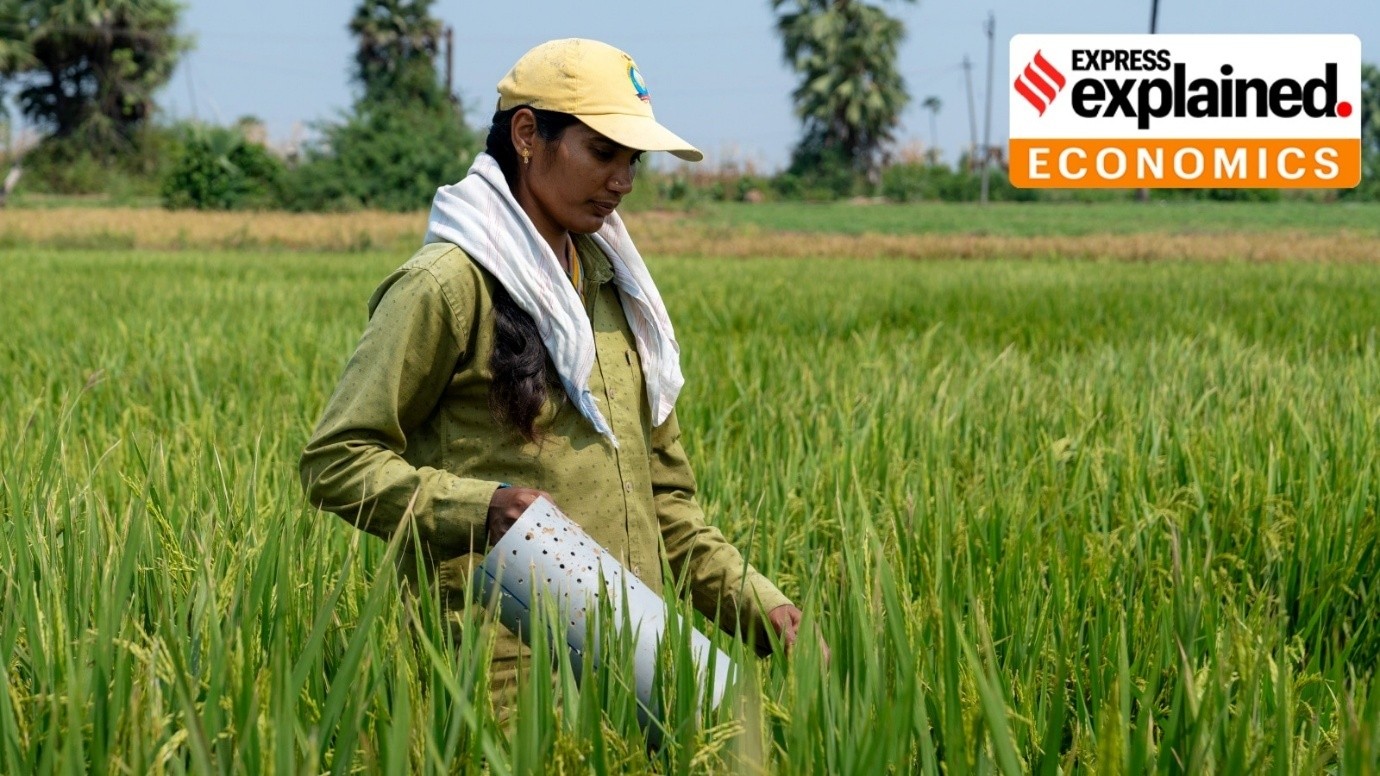
Picture Courtesy: Indian Express
Rice farmers can earn extra income by changing, their growth pattern of paddy. By reducing methane gas emissions, they can earn carbon credits and sell them for money, without losing yield and while saving water.
|
Must Read: Methane Green House Gas | GLOBAL METHANE STATUS REPORT (GMSR) 2025 | |
Production of methane from paddy field: In conventional continuously flooded paddy fields, waterlogged and oxygen-free soil encourages methanogenic microbes to decompose organic matter, and this process leads to methane emissions that are typically around 6 tonnes of CO₂-equivalent per hectare per crop season, making rice fields one of the major agricultural methane sources.
Reducing methane through Alternate Wetting and Drying (AWD): Farmers reduce methane by shifting from continuous flooding to Alternate Wetting and Drying (AWD), where fields are flooded for the initial growth stage and then allowed to dry intermittently, and this breaks anaerobic conditions, so methane emissions decline to about 3.5 tonnes of CO₂-equivalent per hectare, giving an average reduction of roughly 2.5 tonnes CO₂-equivalent per hectare per season while maintaining normal yields.
Measurement and scientific verification of reductions: These methane reductions are measured and documented through Monitoring, Reporting and Verification (MRV) systems that use perforated tubes to observe water levels, closed chambers to collect methane samples, remote sensing and geo-tagged digital records, and accredited agencies verify that the reductions are real, additional and scientifically valid.
Conversion into carbon credits: Once verified, each one tonne of CO₂-equivalent methane avoided becomes one carbon credit, and these credits are recorded in official registries under voluntary or compliance carbon market standards, converting reductions from farmers’ fields into tradable financial units.
Selling credits to companies needing emission offsets: The carbon credits generated from paddy methane reduction are purchased by sectors such as aviation, cement, oil and gas, data centres, and other high-emitting industries that require offsets to achieve net-zero or ESG commitments, and methane credits are particularly valued because methane is 28 times more potent than CO₂ over 100 years.
Farmer income generation and market value: In current carbon markets, methane-reduction credits from rice systems usually sell for $15–$25 per tonne, so a farmer reducing about 2.5 tonnes per hectare earns approximately $37–$62 per hectare per crop, which translates to around ₹3,000–₹5,000 per hectare, and after sharing revenue with project developers and verification agencies, this becomes a new supplementary income source.
Economic implications: Earning money from methane-emission reductions in paddy cultivation creates an additional income source for farmers through carbon credits of about ₹3,000–₹5,000 per hectare, strengthens rural economies, and generates new green jobs in monitoring and carbon-market services.
Environmental implications: Reducing methane from rice fields directly lowers a powerful greenhouse gas that is 28 times stronger than CO₂, slows near-term warming, saves large quantities of irrigation water through Alternate Wetting and Drying (AWD), and improves soil aeration and overall field conditions.
Agricultural implications: Farmers can reduce methane mainly through better water management without losing yields, and this promotes climate-smart agriculture, greater water-use efficiency, and practices that are better suited to future climate and groundwater stress.
Social implications: Payments for emission reductions encourage farmer participation in climate action, support household income security for small and marginal farmers, and strengthen farmer groups, awareness, and collective action around sustainable practices.
Policy and governance implications: Linking paddy methane reduction with carbon markets pushes governments and institutions to build reliable Monitoring, Reporting and Verification (MRV) systems, regulate carbon projects, and integrate agriculture more strongly into national climate strategies.
Measurement and verification challenges: Accurately measuring methane reductions is technically complex because it requires chambers, sensors, satellite data and scientific MRV systems, and small errors or missing data can prevent farmers from getting carbon credits.
High transaction and verification costs: Registration, verification and brokerage fees in carbon markets are high, meaning that small and marginal farmers often cannot participate individually and must depend on project developers who take a significant share of the revenue.
Price uncertainty in carbon markets: Carbon credit prices fluctuate widely between about $5 and $25 per tonne, so farmer income is uncertain and cannot always be relied upon as a stable or predictable revenue source.
Awareness and capacity limitations: Most farmers are not familiar with carbon markets, emission accounting or legal contracts, and the lack of awareness, digital literacy and trusted intermediaries often prevents them from fully benefiting from carbon-credit systems.
Risk of unequal benefit sharing: There is a challenge of fairness because aggregators, private companies and intermediaries may capture a large share of the benefits, and small farmers may receive only a small portion unless transparent agreements and strong institutions exist.
Government initiatives for methane emission reduction:
|
Government initiative |
Main focus area |
How it helps reduce methane emissions |
|
National Mission for Sustainable Agriculture (NMSA) |
Climate-smart agriculture |
Promotes water-saving irrigation, soil health management, and resilient crops, indirectly cutting methane from paddy fields |
|
Promotion of Alternate Wetting and Drying (AWD) & Direct Seeded Rice (DSR) |
Paddy water management |
Reduces continuous flooding duration, lowers anaerobic soil conditions, and cuts methane generation in rice fields |
|
Pradhan Mantri Krishi Sinchayee Yojana (PMKSY) |
Efficient irrigation |
Prevents prolonged waterlogging through “more crop per drop,” leading to reduced methane from flooded paddies |
|
Sub-Mission on Agricultural Mechanization (SMAM) |
Farm machinery support |
Provides tools like laser land levellers and water-control devices enabling AWD/DSR implementation and methane reduction |
|
National Livestock Mission |
Livestock productivity |
Improves feed, fodder and health, reducing enteric methane emissions from cattle and buffalo |
|
GOBAR-DHAN Scheme |
Biogas and waste-to-wealth |
Converts dung and organic waste into biogas, preventing open decomposition that emits methane |
|
SATAT Scheme (Compressed Biogas promotion) |
Renewable transport fuel |
Captures methane from organic wastes through CBG plants and uses it as fuel instead of releasing it to the atmosphere |
|
Swachh Bharat Mission (Urban & Rural) |
Solid and liquid waste management |
Promotes bio methanation plants, landfill management and sewage treatment to reduce methane from dumpsites and wastewater |
|
National Action Plan on Climate Change (NAPCC) & State Action Plans |
Climate policy framework |
Encourages low-emission agriculture, waste-to-energy projects and water conservation, collectively lowering methane |
Reducing methane emissions from paddy fields can create a rare win–win opportunity where farmers earn extra income, conserve water, and contribute to climate mitigation without sacrificing yields. By adopting practices like Alternate Wetting and Drying and linking verified emission reductions to carbon markets, paddy cultivation shifts from being a major methane source to a potential climate solution. At the same time, success will depend on strong monitoring systems, fair benefit sharing, and farmer awareness so that smallholders meaningfully benefit from this emerging “climate-smart” rice economy.
Source: Indian Express
|
Practice Question Q. Monetising methane-emission reductions from paddy cultivation through carbon markets can transform rice farming into a climate-smart and income-enhancing activity.” Discuss the mechanism involved and examine its benefits and challenges. (250 words) |
Methane is released from flooded rice fields because waterlogged soils become oxygen-free, allowing microbes to break down organic matter and produce methane gas.
Farmers can reduce methane mainly through Alternate Wetting and Drying (AWD) and Direct Seeded Rice (DSR), which avoid continuous flooding and lower anaerobic conditions in the soil.
Reduced methane emissions are measured, verified, and converted into carbon credits, and these credits are sold to companies seeking to offset their greenhouse-gas emissions.


© 2026 iasgyan. All right reserved