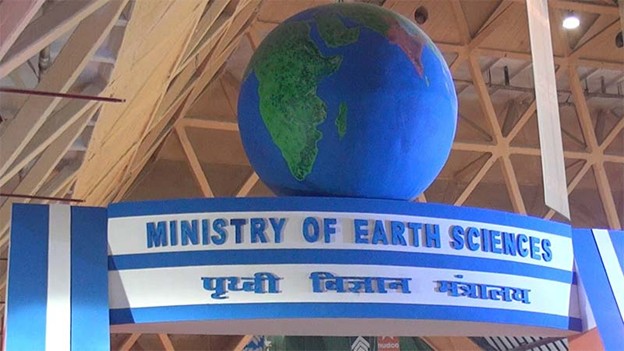
MINISTRY OF EARTH SCIENCE: YEAR-END REVIEW

The Ministry of Earth Sciences drives India’s development by delivering vital weather, ocean, and seismic services. Under PRITHVI, agencies like IMD improved cyclone forecasts, while the Deep Ocean Mission and MATSYA 6000 advance the Blue Economy. Despite connectivity and cost challenges, MoES converts science into resilience and livelihoods.
Description

MINISTRY OF EARTH SCIENCE: YEAR-END REVIEW

HTTPS://WWW.PIB.GOV.IN/PRESSRELEASEPAGE.ASPX?PRID=2207878&REG=3&LANG=1

Copyright infringement not intended

Picture Courtesy:   pibindia


Context

The Ministry of Earth Sciences (MoES) recently released the year-end review Report.


Highlights of the Year-End Review Report

The Ministry of Earth Sciences (MoES) leads weather, climate, ocean, and seismological services, which are vital for economic growth, disaster management, and resource security.


Economic & Societal Impact of Earth Sciences

Investments in meteorological services have a multiplier effect on the economy.

  • High Return on Investment: A study by the National Council of Applied Economic Research (NCAER) found that for every rupee invested in the National Monsoon Mission (NMM) and High-Performance Computing (HPC) facilities, the nation gains an economic benefit of ₹50.
  • Quantified Benefits: A ₹1,000 crore investment generated an estimated ₹50,000 crore in benefits over five years, aiding agricultural households and fisherfolk through improved planning and reduced weather-related losses.


Deep Ocean Mission

It is a multi-institutional national effort to develop deep-sea technologies for the sustainable exploration and utilization of ocean resources.


Launched in 2021, the mission is a key pillar of India's Blue Economy and aligns with the UN's "Decade of Ocean Science (2021-2030)".


Samudrayaan Mission

  • Objective: To send three humans to a depth of 6,000 meters in the ocean for deep-sea exploration and mining of rare minerals.
  • Vehicle - MATSYA 6000: An indigenously developed manned submersible vehicle with an endurance of 12 hours for normal operation and 96 hours in case of emergency.
  • Construction: The submersible features a 2.1-meter diameter personnel sphere made of 80mm thick titanium alloy, designed to withstand the immense pressure at 6,000 meters.


Deep Sea Mining Technology

  • Polymetallic Nodules: The primary target for mining are polymetallic nodules, which are rich in manganese, nickel, cobalt, and copper, crucial for clean energy technologies.
  • Vehicle - Varaha: India's deep-sea mining machine. It successfully completed deep-sea locomotion trials at a depth of 5,270 meters in the Central Indian Ocean.


Water Security

  • LTTD Technology: The National Institute of Ocean Technology (NIOT) developed indigenous Low Temperature Thermal Desalination (LTTD) technology, an eco-friendly process that uses the temperature difference between deep and surface seawater to produce potable water.
  • Plants in Lakshadweep: MoES has successfully set up eight LTTD-based desalination plants across the islands of Lakshadweep to provide clean drinking water.


Marine Research & Monitoring

  • 'Make in India' Vessels: Two advanced coastal research vessels, CRV Sagar Tara and CRV Sagar Anveshika, were commissioned to monitor India's coastal waters.
  • Capabilities: These vessels are equipped for various research missions, including bathymetric surveys, monitoring water quality and pollution, and testing underwater technologies.


Disaster Management

  • Indian Tsunami Early Warning Centre (ITEWC): Located at INCOIS, Hyderabad, it provides 24/7 monitoring of seismic activity and sea-level changes to detect tsunamigenic earthquakes and issue timely warnings.
  • Regional Responsibility: ITEWC also serves as a Tsunami Service Provider for 28 Indian Ocean Rim countries, as recognized by UNESCO-IOC.
  • Doppler Weather Radar (DWR) Network: This network is critical for tracking cyclones, thunderstorms, and other severe weather events with high precision.


Advancements in Weather Forecasting & Climate Services

  • Current Infrastructure: India's weather forecasting is powered by supercomputers 'Pratyush' (4.0 Petaflops) at the Indian Institute of Tropical Meteorology (IITM), Pune, and 'Mihir' (2.8 Petaflops) at the National Centre for Medium Range Weather Forecasting (NCMRWF), Noida.
  • Future Upgrade: India is procuring a new 30 Petaflop supercomputer to replace the existing systems, which will improve the resolution and accuracy of weather models, enabling block-level forecasts.


Key Umbrella Schemes of MoES

The Ministry's work is structured under the overarching scheme 'PRITHVI' (Prithvi Vigyan), which integrates five existing schemes to take a holistic approach to Earth System Science.

Scheme

Full Form

Core Focus Area

ACROSS

Atmosphere & Climate Research-Modelling Observing Systems & Services

Weather and climate forecasting, atmospheric research.

O-SMART

Ocean Services, Modelling, Application, Resources and Technology

Ocean observations, marine resource management, and coastal research.

PACER

Polar Science and Cryosphere Research

Research in the Arctic, Antarctic, and Himalayan regions.

SAGE

Seismology and Geosciences

Earthquake monitoring and research into geohazards.

REACHOUT

Research, Education, Training and Outreach

Developing skilled manpower and promoting awareness in Earth Sciences.


Source:  PIB


PRACTICE QUESTION

Q. Critically analyze the role of the Ministry of Earth Sciences in strengthening India's disaster resilience. 150 words.


Frequently Asked Questions (FAQs)

PRITHVI (Promoting Research in Earth Systems Science) is an overarching scheme by the Ministry of Earth Sciences (MoES) for the period 2021-26. It integrates the ministry's five main sub-schemes to provide a holistic approach to earth sciences, aiming to translate scientific knowledge into direct societal, environmental, and economic benefits.

MATSYA 6000 is a manned submersible developed under India's Deep Ocean Mission. It is designed to carry three humans to a depth of 6,000 meters. Its significance lies in enabling direct scientific exploration and observation of deep-sea resources, including polymetallic nodules, which is a major step towards harnessing India's 'Blue Economy'

The Deep Ocean Mission (DOM) is a flagship initiative of the MoES with a budget of Rs. 4,077 crore. Its primary objective is to explore and develop technologies for harnessing deep-sea resources from India's vast Exclusive Economic Zone. Key components include the development of the MATSYA 6000 submersible and technologies for deep-sea mining
Free access to e-paper and WhatsApp updates

Let's Get In Touch!