The Krishi Sakhi Initiative empowers women farmers by improving crop insurance access and digital literacy. To overcome low land ownership, experts advocate for "Cultivator Certificates" to decouple insurance from titles, ensuring credit and climate resilience for India’s growing female workforce.
Copyright infringement not intended
Picture Courtesy: PIB
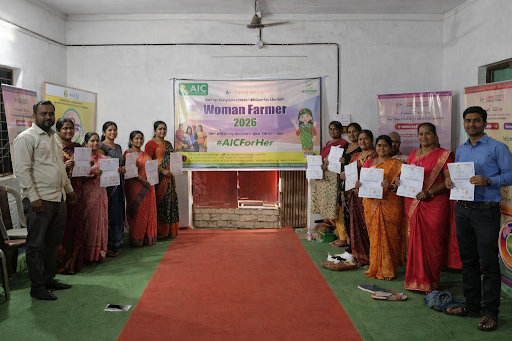
The Agriculture Insurance Company of India Limited (AICIL), a Public Sector Undertaking (CPSU) owned by the Ministry of Finance, has launched the Krishi Sakhi Initiative.
|
Read all about: Feminisation of Agriculture l Technology Empowers Women in Agriculture |
This program is designed to empower women farmers by enhancing their awareness, participation, and skills related to crop insurance, aiming to make agriculture more inclusive and resilient.
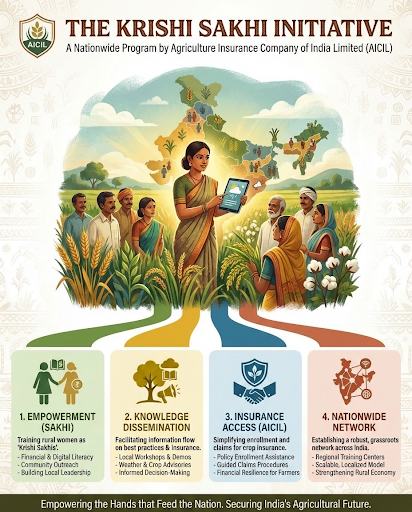
Structured Awareness Campaigns: Year-round engagement activities, including interactive videos and rural workshops, to ensure continuous learning and outreach.
Capacity Building: Ground-level training to women farmers, educating them on navigating crop insurance schemes like Pradhan Mantri Fasal Bima Yojana (PMFBY), understanding premium subsidies, and managing claim settlements.
Holistic Social Outreach: Integrates modules on crucial social issues like sanitation and menstrual hygiene, promoting overall community welfare beyond just economic concerns.
Significance of the Krishi Sakhi Initiative
The 'Feminization' of Agriculture
Women form the backbone of Indian agriculture, with over 64.4% of rural female workers employed in this sector. (Source: PLFS Annual Report)
The Paradox of Land Ownership
Despite their significant labor contribution, women own only 14% of agricultural land holdings. (Source: 11th Agricultural Census)
Low Insurance Penetration
Female farmers constitute less than 20% of the total enrollees in the Pradhan Mantri Fasal Bima Yojana (PMFBY), leaving female-headed households highly vulnerable. (Source: Parliamentary Standing Committee on Agriculture Report)
Disproportionate Climate Vulnerability
Climate-related disasters reduce the agricultural income of female-headed households by 8% more than their male-headed counterparts due to poor access to adaptive resources like insurance. (Source: FAO)
Community Leadership
The program trains local women to become 'Krishi Sakhis' (farmer friends), creating a network of grassroots female leaders.
Structural and Legal Barriers
Lack of land titles remains the biggest hurdle. Despite the Supreme Court's Vineeta Sharma vs Rakesh Sharma (2020) judgment upholding women's property rights, patriarchal norms hinder its implementation on the ground.
The Rural Digital Divide
Effective use of modern insurance portals is limited by low digital literacy. Only 25% of rural women use the internet compared to 49% of rural men, creating access barrier (Source: NFHS-5)
Policy Implementation Gaps
Key recommendations from expert bodies, like the M.S. Swaminathan Committee's suggestion for issuing joint land titles (pattas) to women, have seen inconsistent implementation by states.
Decouple Insurance from Land Ownership
Implement the Dalwai Committee's recommendation to issue "Cultivator Certificates" to women, recognizing their role as farmers regardless of land ownership.
Bridge the Digital Divide
Integrate the Krishi Sakhi network with the digital literacy modules of the Pradhan Mantri Gramin Digital Saksharta Abhiyan (PMGDISHA) to empower women to manage their insurance digitally.
Learn from Global Best Practices
|
Country |
Initiative / Model |
Key Strategy |
Impact |
|
Kenya |
ACRE Africa Initiative |
Bundled weather-index insurance with seeds and used the M-Pesa mobile payment system to bypass banking barriers for women. |
30% increase in climate-smart farm investments by women (Source: World Bank). |
|
Bangladesh |
BRAC Model |
Deployed female agricultural extension workers to train women farmers, bypassing patriarchal cultural norms. |
45% increase in adoption of resilient crop varieties (Source: IFPRI) |
True agricultural resilience requires a policy shift from mere crop protection to comprehensive cultivator empowerment, with women firmly at the center of this transformation.
Source: PIB
|
PRACTICE QUESTION Q. "The 'feminization' of Indian agriculture is a reality, yet systemic legal and technological barriers prevent women from reaping the benefits of institutional support." 150 words |
The Krishi Sakhi Initiative is a nationwide capacity-building program launched by the Agriculture Insurance Company of India Limited (AICIL). It is designed to empower women farmers by educating them on agriculture practices, crop insurance mechanisms, and claim settlements under schemes like PMFBY.
Despite women comprising over 64% of the rural agricultural workforce, they hold only 14% of land titles. This disparity limits their access to institutional credit and insurance, making female-headed agricultural households highly vulnerable to financial and climate-related shocks.
Climate-induced extreme weather events reduce the agricultural income of female-headed households by 8% more than male-headed households. This is primarily due to their lack of access to adaptive resources, credit facilities, and institutional crop insurance.




© 2026 iasgyan. All right reserved