The International Organisation for Standardisation (ISO) develops voluntary global standards to ensure product quality, safety, and interoperability. Represented by the Bureau of Indian Standards, India recently hosted the ISO space systems subcommittee, highlighting its rapidly growing space sector.
Why In News?
The Bureau of Indian Standards (BIS) meeting in New Delhi with the International Organization for Standardization (ISO) to establish international standards for space systems and operations.
About International Organisation for Standardisation (ISO)
The ISO operates as an independent, non-governmental international organization.
It develops and publishes voluntary, consensus-based international standards including almost all aspects of technology, manufacturing, food safety, and healthcare.
Background
Headquarters: Geneva, Switzerland.
Official languages: English, French, and Russian
Membership and Structure
Global network of 175 national standard bodies, strictly allowing only one member organization per country.
ISO organizes members into three categories:
The organization finances its operations through member subscriptions, project funding, and the sale of standards.
Core Functions
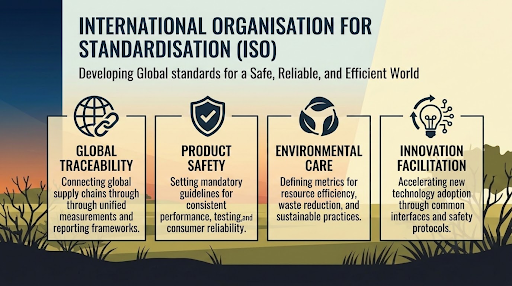
ISO facilitates global trade and innovation by unifying industrial standards across borders, removing technical barriers to trade.
Technical committees ensure interoperability by creating technical frameworks that allow systems and machines from different countries to communicate and function together.
The organization promotes consumer protection, safety, and quality by establishing internationally recognized benchmarks, such as the well-known ISO 9000 series for quality management.
Recent Events
The Bureau of Indian Standards (BIS) recently hosted the 35th Plenary of the ISO TC 20 / SC 14 ('Space Systems and Operations') subcommittee in New Delhi.
Global experts focused on emerging domains like space sustainability, debris mitigation, and mission safety.
Source: DDNEWS
|
PRACTICE QUESTION Q. Consider the following statements regarding the International Organisation for Standardisation (ISO):
Which of the statements given above is/are correct? (a) 1 only (b) 2 only (c) Both 1 and 2 (d) Neither 1 nor 2 Answer: b Explanation: Statement 1 is Incorrect: The International Organisation for Standardisation (ISO) is an independent, non-governmental international organization. Statement 2 is Correct: India is a founder member of the ISO and is represented by the Bureau of Indian Standards (BIS). |
The ISO is an independent, non-governmental international organization established in 1947 that develops and publishes voluntary, consensus-based international standards across various sectors to ensure product safety, quality, and efficiency.
India is represented at the ISO by the Bureau of Indian Standards (BIS), which is the national statutory body functioning under the Ministry of Consumer Affairs, Food & Public Distribution.
Hosted by the BIS, the 35th Plenary of the ISO TC 20 / SC 14 brought together 131 international delegates to discuss the future of space safety, interoperability, space sustainability, and debris mitigation.


© 2026 iasgyan. All right reserved