Copyright infringement not intended
Picture Courtesy: Indian Express
Context:
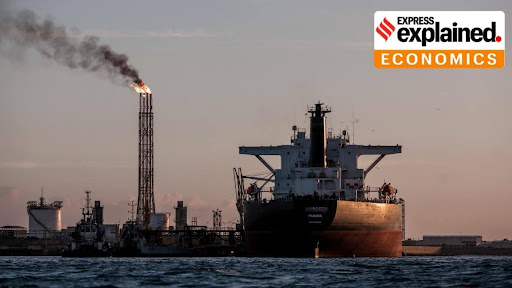
After a new trade understanding, US President Donald Trump claimed that India would stop buying Russian crude and instead increase imports from the US and Venezuela. However, the Government of India has not officially confirmed any such commitment and has reiterated that energy security for 1.4 billion people remains the top priority.
India’s approach to energy procurement:
Energy security as the primary national priority: India’s official stance is that ensuring reliable, affordable, and uninterrupted energy for 1.4 billion people is the foremost policy objective, and all sourcing decisions are guided by national interest rather than geopolitical pressure.
Diversification, but not dependence: The government is pursuing a strategy of diversified sourcing, increasing imports from multiple regions such as West Asia, the US, Africa, and Latin America to avoid overdependence on any single country or region.
Market - driven procurement: India has maintained that crude purchases are based on price competitiveness, quality suitability, and supply reliability, with refiners allowed to make commercially viable decisions to keep domestic energy costs stable.
Strategic autonomy in energy trade: India continues to emphasise strategic autonomy, meaning energy partnerships are determined by economic and security considerations, not external political pressure, while maintaining balanced relations with major powers.
Gradual adjustment, but not abrupt shifts: Rather than sudden changes, India prefers a calibrated and gradual adjustment of import sources, ensuring that any transition does not disrupt refinery operations, fuel availability, or price stability.

Strategic constraints in reducing Russian oil:
- Existing contractual commitments: Indian refiners have already booked Russian crude cargoes months in advance, and cancelling these agreements would involve financial penalties, supply disruptions, and contractual risks, making an immediate halt operationally difficult.
- Refinery level dependence: Certain refineries, especially those operated by Nayara Energy, remain heavily dependent on Russian crude due to ownership links with Rosneft and sanctions-related sourcing constraints, meaning a sudden stop could disrupt or shut down refinery operations.
- Technical compatibility constraints: Indian refineries are optimised for medium-sour crude, and a rapid shift to different grades such as lighter US crude could reduce efficiency, alter product yields, and increase processing costs.
- Cost and commercial considerations: Russian oil continues to be available at significant discounts, whereas alternative supplies involve higher freight costs and less competitive pricing, potentially raising India’s import bill and domestic fuel inflation risks.
- Limited availability of alternatives: Suppliers like the US and Venezuela face quality differences, production limitations, and logistical constraints, making it difficult to replace large Russian volumes quickly and sustainably.
- Energy security imperatives: With over 85% import dependence, India’s foremost priority is uninterrupted and affordable energy supply, which necessitates diversification rather than abrupt elimination of a major supplier.
- Strategic autonomy considerations: India’s foreign policy is guided by strategic autonomy and national interest, and maintaining some level of engagement helps balance geopolitical pressures while avoiding overdependence on any single bloc.
Implications of shifting away from Russian oil:
Pros
- Enhanced diversification and supply security: Gradually increasing imports from the United States and other suppliers’ supports India’s strategy of diversifying its crude basket across 30+ countries, reducing overdependence on Russia, whose share has already declined from 35–40% earlier to about 22% in January 2026.
- Reduced sanctions and geopolitical risk: Lower reliance on Russian oil helps India minimise exposure to secondary sanctions and financial restrictions, especially in the wake of tightening Western measures against Russian energy companies.
- Strengthening strategic and trade relations: Higher crude purchases from the US, already accounting for around 8 - 10% of India’s imports, which can deepen economic ties and support broader trade negotiations, while potential engagement with Venezuela expands India’s presence in Latin American energy markets.
- Improved bargaining power: A wider supplier base enhances India’s negotiating leverage on pricing and contract terms, enabling refiners to optimise procurement based on market conditions.
Cons
- Loss of discounted oil advantage: Russian Urals crude has been available at a discount of about $8–12 per barrel compared to Brent, and replacing these volumes with market-priced alternatives would increase India’s import bill, widen the current account deficit, and add inflationary pressure in a highly import-dependent economy.
- Higher freight and logistics costs: Crude shipments from the US involve transit times of 25–35 days and freight costs more than double those from West Asia, raising inventory requirements and working capital costs for refiners.
- Refinery compatibility constraints: Indian refineries are optimised for medium-sour crude from Russia and West Asia, whereas US crude is generally light-sweet, meaning that sudden substitution could affect refining efficiency, product yields, and margins.
- Limited replacement potential from Venezuela: Although Venezuelan crude is closer in quality to Russian grades, the country’s production remains limited to around 1 million bpd and is already committed to multiple buyers, making it only a partial and uncertain alternative.
- Structural dependence of certain refineries: Some facilities, such as those operated by Nayara Energy (capacity 400,000 bpd), remain structurally reliant on Russian supplies, making a complete transition operationally difficult.
Balanced approach to oil diversification:
- Calibrated diversification: Rather than pursuing abrupt disengagement, India should adopt a phased reduction strategy, similar to the European Union’s approach after the Russia–Ukraine conflict, where dependence on Russian oil was reduced steadily between 2022 and 2023 to avoid supply disruptions and price shocks. Such a calibrated transition would allow Indian refiners to adjust contracts, logistics, and processing configurations without operational stress.
- Building a broad and flexible supplier base: At the same time, India should continue expanding its procurement network across West Asia, the United States, Africa, and Latin America, following the example of China, which sources crude from multiple regions to minimise concentration risk. A wider supplier base would not only enhance energy resilience but also strengthen India’s bargaining power in securing competitive prices.
- Enhancing refinery flexibility: To support diversification, investments in refinery modernisation are essential so that facilities can efficiently process a wider range of crude grades. Countries such as South Korea and Singapore have developed highly complex refineries that can quickly switch between crude types based on market conditions, a capability that would improve India’s operational flexibility and cost efficiency.
- Strengthening strategic petroleum reserves: In addition, expanding India’s Strategic Petroleum Reserves would provide a critical cushion against global supply disruptions and price volatility. The United States, for instance, utilised its strategic reserves during the 2022 energy crisis to stabilise domestic markets, demonstrating the importance of maintaining adequate emergency stocks.
- Ensuring market - driven and cost - efficient procurement: While diversifying sources, India must ensure that procurement decisions remain commercially driven, prioritising price competitiveness and supply reliability, much like Japan and South Korea, as higher-cost imports could increase the import bill, widen the current account deficit, and fuel inflation in an economy that imports nearly 85–88% of its crude needs.
- Balancing geopolitics with strategic autonomy: At the strategic level, India should continue its long-standing policy of multi-alignment and strategic autonomy, maintaining energy relationships with a wide range of partners rather than aligning exclusively with any geopolitical bloc, thereby preserving policy flexibility in an increasingly polarised global energy market.
- Accelerating structural reduction in oil dependence: Over the longer term, the most sustainable solution lies in reducing overall oil dependence by accelerating the energy transition through renewable expansion, electric mobility, ethanol blending, and green hydrogen initiatives. With a target of 500 GW of non - fossil capacity by 2030 and 20% ethanol blending, India is already moving in this direction, similar to the structural shifts being pursued by major economies such as China and Norway.
Conclusion:
India’s approach to crude sourcing must carefully balance the competing priorities of energy security, affordability, and strategic autonomy in a highly volatile global environment. While diversifying away from excessive dependence on any single supplier is necessary to reduce geopolitical and sanctions-related risks, a rapid shift away from discounted and technically suitable Russian crude could increase import costs, strain refinery operations, and create macroeconomic pressures. Therefore, the most viable path lies in a calibrated and market-driven diversification strategy, supported by investments in refinery flexibility, expansion of Strategic Petroleum Reserves, and a broader supplier base. In the long run, strengthening domestic production and accelerating the transition toward renewable energy, alternative fuels, and electrification will be critical to reducing structural import dependence and building a resilient, sustainable, and strategically autonomous energy system for India.
Source: Indian Express
|
Practice Question
Q. India’s efforts to diversify its crude oil imports reflect the need to balance energy security, economic considerations, and strategic autonomy. Discuss. (250 words)
|
Frequently Asked Questions (FAQs)
India increased Russian oil imports after the Ukraine conflict because Russian crude was available at significant discounts ($8–12 per barrel below Brent), helping reduce the import bill and control domestic fuel inflation in a country that imports 85–88% of its crude needs.
A sudden halt is difficult due to long-term supply contracts, refinery dependence on medium-sour crude, discounted pricing advantages, and structural reliance of facilities such as Nayara Energy.
India maintains that its oil purchases are market-driven and guided by energy security, affordability, and availability, while also upholding its principle of strategic autonomy.