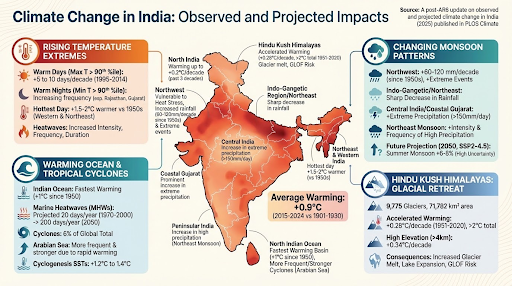
The 2025 climate assessment shows India’s land has warmed by 0.9°C, with sharper extremes. Scientists report a “Wet Desert” trend in the northwest, drying Gangetic plains, rising warm nights, marine heatwaves, and stronger Arabian Sea cyclones. They warn about compound events and urge region-specific adaptation measures.
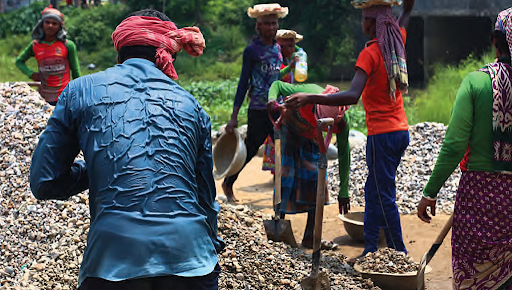
Copyright infringement not intended
Picture Courtesy: DOWNTOEARTH
Context
The State of India's Environment (SOE) 2026 report by the Centre for Science and Environment (CSE) offers India-specific updates on climate change, detailing unique regional warming patterns, monsoon shifts, and coastal threats that necessitate tailored policy responses.
What are the Highlights of the State of India's Environment (SOE) 2026 report?
Uneven Temperature Rise Across India
India's average landmass warmed by 0.9°C in the last decade (2015-2024), but this warming is uneven. The main threat is the intensification of extreme heat and regional variations.
The International Labour Organization (ILO) projects India could lose 5.8% of working hours and 34 million full-time jobs by 2030 due to heat stress, linking climate change directly to economic productivity and public health.
Shifts in Monsoon and Precipitation Patterns
Climate change is making the Indian Summer Monsoon (ISM), the lifeline of agriculture and economy, more erratic and unpredictable.
|
Phenomenon |
Affected Region |
Key Trend & Impact |
|
The "Wet Desert" Paradox |
Northwest India (Rajasthan, Gujarat) |
Experiencing a sharp increase in rainfall (60-120 mm per decade). This leads to unprecedented floods in arid regions, requiring a policy shift from drought management to flood control. |
|
Drying of Food Bowls |
Indo-Gangetic Plains & Northeast India |
Observing decrease in rainfall, threatening the food security of the rice-wheat belt. |
|
Extreme Precipitation Events |
Central India & Peninsular Region |
Witnessing a rise in short, intense rainfall events (over 150 mm/day), leading to urban and flash floods. |
Future Projection: Indian summer monsoon rainfall is projected to increase by 6-8% by 2050 under a moderate emissions scenario.
The Hindu Kush Himalayas (HKH): A Warming "Third Pole"
The HKH region is warming much faster than the national average, creating a severe risk of glacial disasters.
The Indian Ocean: A Driver of Climate Extremes
The Tropical Indian Ocean is warming faster than any other ocean basin, altering India's coastal climate.
The Emerging Threat of "Compound Events"
A "Compound Event" is where multiple climate disasters occur simultaneously or in quick succession, amplifying their total impact. The IPCC AR6 report warns this will be the dominant risk in South Asia.
Recommendations Made in the Report
The report confirms India is moving from an era of "global warming" to one of "regional boiling." This requires a paradigm shift from generic, nationwide policies to localized, data-driven adaptation strategies.
Regionally Tailored Adaptation: Policies must be area-specific. For example, building "Sponge Cities" for flood management in arid but flood-prone Northwest India, while promoting drought-resistant millets (Shree Anna) in the drying Indo-Gangetic plains.
Resilient Urban Planning: All major cities must implement Heat Action Plans (HAPs), modeled on the successful Ahmedabad plan, which focuses on early warnings, public cooling centers, and "cool roof" technology.
Integrated Coastal Defense: Accelerate the National Coastal Mission by combining hard infrastructure (sea walls) with soft, nature-based solutions like mangrove restoration under the MISHTI scheme.
Global Leadership: India must use platforms like the Coalition for Disaster Resilient Infrastructure (CDRI) to drive global research and investment in modeling and preparing for "Compound Events."
Context
Climate-proofing India's infrastructure, agriculture, and cities is no longer an option but a prerequisite for sustaining a high economic growth trajectory.
Source: DOWNTOEARTH
|
PRACTICE QUESTION Q. The term "Compound Events" was recently seen in news regarding climate change. It best refers to: A) The impact of climate change on GDP and inflation simultaneously. B) The combination of El Nino and La Nina occurring in the same year. C) Multiple climate extremes occurring simultaneously or sequentially, amplifying damage. D) The melting of glaciers causing a rise in sea levels. Answer: C Explanation: Compound events are defined by the IPCC as the combination of multiple climate drivers or hazards that contribute to societal or environmental risk. These events are more impactful than individual weather events because they occur simultaneously (e.g., a concurrent heatwave and drought) or sequentially (e.g., a flood followed by a heatwave), leading to amplified damage that exceeds the sum of their parts. |
The report finds that the Indian landmass has warmed by approximately 0.9°C on average during 2015-2024 compared to the early 20th century, with the Himalayan region and North India warming at a faster rate.
This refers to the changing rainfall pattern where arid regions like Rajasthan and Gujarat are witnessing a significant increase in rainfall (60-120 mm per decade increase), leading to floods in historically drought-prone areas.
"Warm nights" prevent the human body from cooling down and recovering from daytime heat. This thermal stress significantly increases the risk of heat stroke and cardiovascular issues, particularly affecting the workforce and increasing mortality risks.



© 2026 iasgyan. All right reserved