Prime Minister Modi’s 2026 Israel visit upgraded ties to a Special Strategic Partnership, expanding cooperation in critical technologies and linking UPI with MASAV. India pursues strategic multialignment, balancing Israel ties with Arab interests. Reviving I2U2 and IMEC remains vital to protect diaspora and regional stability.
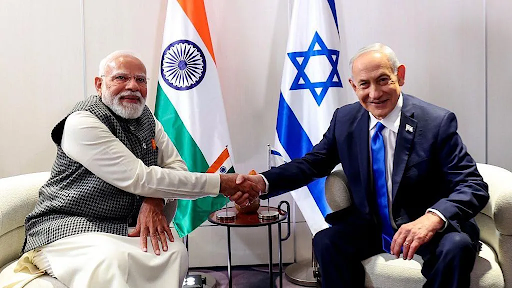
Copyright infringement not intended
Picture Courtesy: bbc
Context
India and Israel elevated their bilateral relationship to a "Special Strategic Partnership for Peace, Innovation & Prosperity" during the Indian PM's February 2026 state visit to Israel.
|
Read all about: India-Israel Relations l India-Israel Bilateral Investment Treaty l Israel Hamas, Israel Palestine Conflict l Two-State Solution For Israel And Palestine |
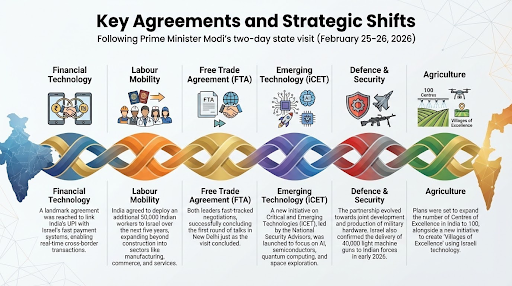
What are the key Outcomes of the Indian PM Visit to Israel?
Strategic & Technology Cooperation
Economic & Labour Mobility
Agriculture & Water Management
Counter-Terrorism
Both nations issued a strong joint condemnation of recent terror attacks, including the October 2023 attacks in Israel and the Pahalgam attack in India (2025).
How Does This Visit Reflect India’s "De-Hyphenation" Policy?
India's foreign policy has traditionally practiced "de-hyphenation"—engaging with Israel and Palestine as separate, independent relationships. This visit highlights a nuanced evolution of this policy:
What is the "Arab Factor" in India-Israel Relation?
The "Arab Factor" refers to the historical influence of Arab nations on India's foreign policy, which for decades delayed formal diplomatic ties with Israel in favour of a pro-Arab and pro-Palestinian stance.
India recognized Israel in 1950 but avoided full diplomatic relations until 1992. This "Arab Factor" was driven by:
Evolution to De-hyphenation: Since 1992, and especially under the Modi government, India has adopted a "De-hyphenation Policy," treating relationships with Israel and the Arab world (and Palestine) as independent and based on separate merits.
While strengthening ties with Israel, India cannot afford to alienate the Arab world, particularly the Gulf Cooperation Council (GCC), due to asymmetric stakes in energy, trade, and diaspora.
|
Arab World (GCC) |
Israel |
|
|
Annual Trade |
Approx. $3.75 billion (Source: IBEF) |
Over $178.5 billion (Source: Ministry of Commerce,) |
|
Energy Security |
Primary source of crude oil and natural gas. |
Negligible for energy. |
|
Defense & Security |
Growing counter-terrorism and intelligence sharing. |
Top strategic partner; provides advanced technology (drones, missiles) and critical support during wars. |
|
Economic Interests |
Vital for remittances from over 9 million expatriates and large-scale trade. |
Focused on high-tech, R&D, agriculture, and water management. |
|
Diplomatic Balance |
Requires careful navigation to maintain stability and protect the diaspora. |
A "natural ally" in tech and counter-terrorism; provides unconditional support on issues like Kashmir. |
|
Strategic Projects |
Partners in regional corridors like IMEC. |
Key partner in I2U2 (India-Israel-UAE-USA) for food and energy security. |
While the Arab world remains indispensable for resource and human capital security, Israel is a critical partner for technological and military modernization.
What are the Risks and Challenges of the New Agreements?
Safety of Indian Workers: Sending 50,000 workers to a conflict zone is a serious security risk. The Standing Committee on External Affairs (2023) has called for robust evacuation and insurance protocols.
Regional Polarization: India's partnership with Israel risks complicating ties with Iran (Chabahar Port) and undermining its soft power in the pro-Palestine Arab world.
Stalled Multilateral Projects: The conflict jeopardizes vital initiatives like the India-Middle East-Europe Economic Corridor (IMEC), a key project to counter China's BRI, which requires regional stability.
|
Case Study: Success in Agricultural Diplomacy
|
Way Forward
India's "Strategic Multialignment" foreign policy seeks global engagement while avoiding aligning with specific power blocs. A key challenge for this policy is managing the potential conflict between its partnership with Israel and its relationships with the Arab world.
India's "Vishwamitra" (friend of the world) strategy should focus on regional prosperity and peace, emphasizing key initiatives like advocating for Palestinian aid and a Two-State Solution, strengthening economic connections through forums like I2U2, and safeguarding the Indian diaspora's interests.
Source: THEHINDU
|
PRACTICE QUESTION Q. "India’s West Asia policy is a test of 'Strategic Multialignment' rather than simple 'De-hyphenation'." Discuss this statement in light of the India-Israel ties and the ongoing regional instability. (250 words) |
It is a new strategic foresight initiative agreed upon in 2026 where India and Israel will use data analytics and Artificial Intelligence to identify and prepare for emerging global geopolitical and technological trends.
Linking India's Unified Payments Interface (UPI) with Israel's MASAV system reduces the cost and time of cross-border transactions, facilitating smoother trade and easier remittances for the growing Indian workforce in Israel.
It marks an elevation from a standard strategic partnership to one focused on specific pillars like innovation, peace, and prosperity, institutionalizing cooperation in high-tech sectors like AI, quantum computing, and defense.


© 2026 iasgyan. All right reserved