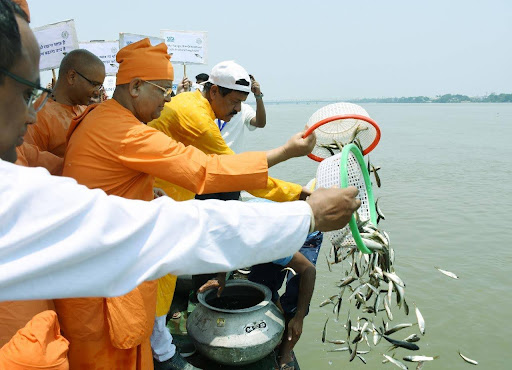
River Ranching is a scientific fisheries management initiative implemented under the Pradhan Mantri Matsya Sampada Yojana (PMMSY) to restore depleted fish populations in India’s rivers. The programme involves releasing hatchery-reared fingerlings of native species into natural water bodies to enhance fish production, conserve riverine biodiversity, and strengthen ecological balance. Implemented by the Department of Fisheries with the National Fisheries Development Board (NFDB) as the nodal agency, it covers major river basins such as the Ganga, Brahmaputra, and Mahanadi. The initiative also supports sustainable inland fisheries, improves food security, and enhances the livelihoods of river-dependent communities while contributing to the broader goal of sustainable river ecosystem management.
Copyright infringement not intended
Picture Courtesy: PIB
Context:
Under the flagship Namami Gange Programme, the Government of India has launched a large-scale ecological restoration initiative known as River Ranching to revive the declining aquatic biodiversity of the Ganga. As part of this effort, scientists have released more than 2 crore native fish fingerlings into the river system to restore its natural fish population and ecological balance. Strengthening inland fisheries through such measures has also contributed to India emerging as a global leader in inland fish production, surpassing several major countries.
|
Must Read: WHY RIVER GANGA IS DRYING FASTER THAN EVER | CHITALA | |
What is River Ranching?
River Ranching is a scientific stock enhancement technique aimed at rebuilding natural fish populations. Native species are first bred under controlled and hygienic hatchery conditions to ensure high survival and genetic quality. Instead of releasing fragile larvae, the fish are allowed to grow until they reach a size of approximately 10–15 cm, which improves their ability to escape predators and adapt to natural conditions. These healthy juveniles are then released into the river, where they mature, reproduce, and contribute to restoring the aquatic ecosystem.
Need for ecological intervention in the Ganga:
Obstruction of natural migration:
Declining water quality:
Loss of spawning and habitat areas:
Overfishing and unsustainable practices:
Weak Natural Regeneration: The combined impact of habitat loss, pollution, migration barriers, and overexploitation reduced the river’s natural ability to replenish fish stocks, leading to a sharp decline in biodiversity and fish abundance.
Key species linked to the river’s ecological health:
Implications on the ground:
|
River Ranching Programme: River ranching is a scientific fisheries management practice in which fish are bred and reared in controlled hatchery conditions during the early stages of their life. Once the juveniles (fingerlings) grow to a suitable size, they are released into natural river systems, where they mature and are later harvested as adults. This approach helps restore natural fish populations while supporting sustainable fisheries. Institutional framework: The River Ranching initiative has been introduced as a special intervention under the Pradhan Mantri Matsya Sampada Yojana (PMMSY). The Department of Fisheries has designated the National Fisheries Development Board (NFDB), Hyderabad as the nodal agency for planning, coordination, and implementation. The programme is implemented under the Central Sector component of PMMSY to expand river ranching activities across the country. Objectives of the programme: The initiative aims to conserve and sustain riverine biodiversity by replenishing depleted fish stocks. It focuses on the regular stocking of fingerlings, particularly cultivable carp species, to enhance river productivity. The programme also seeks to increase overall fish production while improving income and livelihood opportunities for communities that depend on inland fisheries. Implementation timeline: The River Ranching component was initially implemented for a two-year period from FY 2020–21 to FY 2021–22 as part of the early phase of PMMSY interventions. Geographical coverage: During Phase I (2020–21), the programme was implemented across three major river basins:
The initiative covered eight states: Uttar Pradesh, Bihar, Chhattisgarh, West Bengal, Uttarakhand, Odisha, Assam, and Tripura, focusing on regions with significant dependence on river-based fisheries. |
Conclusion:
River ranching represents a sustainable and science-based approach to restoring depleted fish populations while maintaining the ecological balance of river systems. By replenishing native species, enhancing fish production, and supporting the livelihoods of river-dependent communities, the programme contributes to both biodiversity conservation and economic development. In the long run, effective implementation and continuous monitoring can make river ranching a key tool for achieving sustainable inland fisheries and healthy river ecosystems.
Source: PIB
|
Practice Question Q. River Ranching has emerged as an important strategy for restoring riverine biodiversity and strengthening inland fisheries in India. Discuss. (250 words) |
River ranching is a scientific fisheries management practice in which hatchery-reared juvenile fish are released into natural rivers to restore depleted fish populations and enhance fish production.
The programme aims to conserve riverine biodiversity, replenish declining fish stocks, increase inland fish production, and improve the livelihoods of communities dependent on river fisheries.
By releasing native fish species into rivers, the programme restores ecological balance, strengthens food chains, and improves the overall health of the river ecosystem.


© 2026 iasgyan. All right reserved