

Prime Minister Narendra Modi visits the UAE to secure energy agreements on Strategic Petroleum Reserves (SPR).
|
Read all about: INDIA-UAE RELATIONS: SIGNIFICANCE, CHALLENGES, WAY FORWARD |
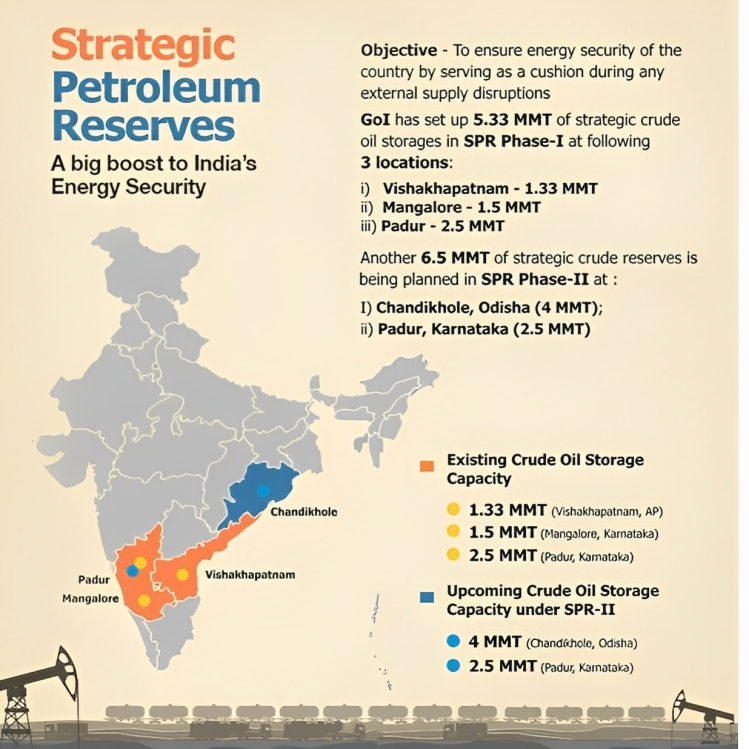
The Government of India initiated the Strategic Petroleum Reserve (SPR) Programme in 2004 to maintain emergency crude oil stockpiles during global supply disruptions.
The Indian Strategic Petroleum Reserves Limited (ISPRL), a special purpose vehicle, manages and commercializes these strategic reserves.
Why does India need SPR?
High import dependence: India import over 85% of crude oil demand to meet growing energy requirements; vulnerable to supply shocks
Geopolitical shocks and Strait of Hormuz vulnerability: India needs strategic buffers to safeguard energy supply chain against regional instability and blockades in chokepoints like the Strait of Hormuz.
Price volatility: SPR serves as a strategic tool for international price stabilization, reducing the domestic economy's vulnerability to global oil price fluctuations.
India's Current SPR Capacity
Existing storage facilities (Phase-I): India built a 5.33 Million Metric Tonnes (MMT) storage capacity across three underground locations: Visakhapatnam, Mangalore, and Padur.
Days of reserve coverage: The ISPRL currently provides 9.5 days of strategic coverage, while oil marketing companies maintain commercial storage, bringing India's total national supply cushion to 74 days.
Planned expansion (Phase-II): The Government approved two commercial-cum-strategic facilities to add 6.5 MMT capacity at Chandikhol (4 MMT) in Odisha and Padur (2.5 MMT) in Karnataka, which will provide an additional 11 days of coverage.
 India-UAE Strategic Petroleum Reserves Partnership
The UAE is the first foreign entity to store crude oil in India's strategic reserves. Under a 2018 agreement, the Abu Dhabi National Oil Company (ADNOC) secured permission to store over 5 million barrels of crude oil in ISPRL's Mangalore cavern.
This partnership grants India first-right access to the entire crude oil stockpile during emergencies while allowing the UAE to commercialize a portion of the storage.
Investments in Abu Dhabi oil blocks
Proposed LPG + SPR agreements: The UAE and India to elevate their energy diplomacy by finalizing pacts on Liquefied Petroleum Gas (LPG) and expansions to the Strategic Petroleum Reserves during the Indian Prime Minister's visit.
Economic factors
Stable supplier: The UAE supplies nearly 11% of India's crude oil as the 4th largest source globally, and fulfills nearly 40% of LPG requirements.
Long-term agreements: ADNOC Gas commits to a 10-year supply agreement of 0.5 million tonnes per annum (MMTPA) of LNG to Hindustan Petroleum Corporation Limited (HPCL) starting in 2028.
Strategic factors
Diversification beyond traditional suppliers: India secures energy flows through direct bilateral agreements, bypassing volatile multilateral frameworks.
Reliable partner amid crises: The UAE demonstrates strong consistency in honoring energy supplies despite regional disruptions like Strait of Hormuz attacks.
Geographic advantage
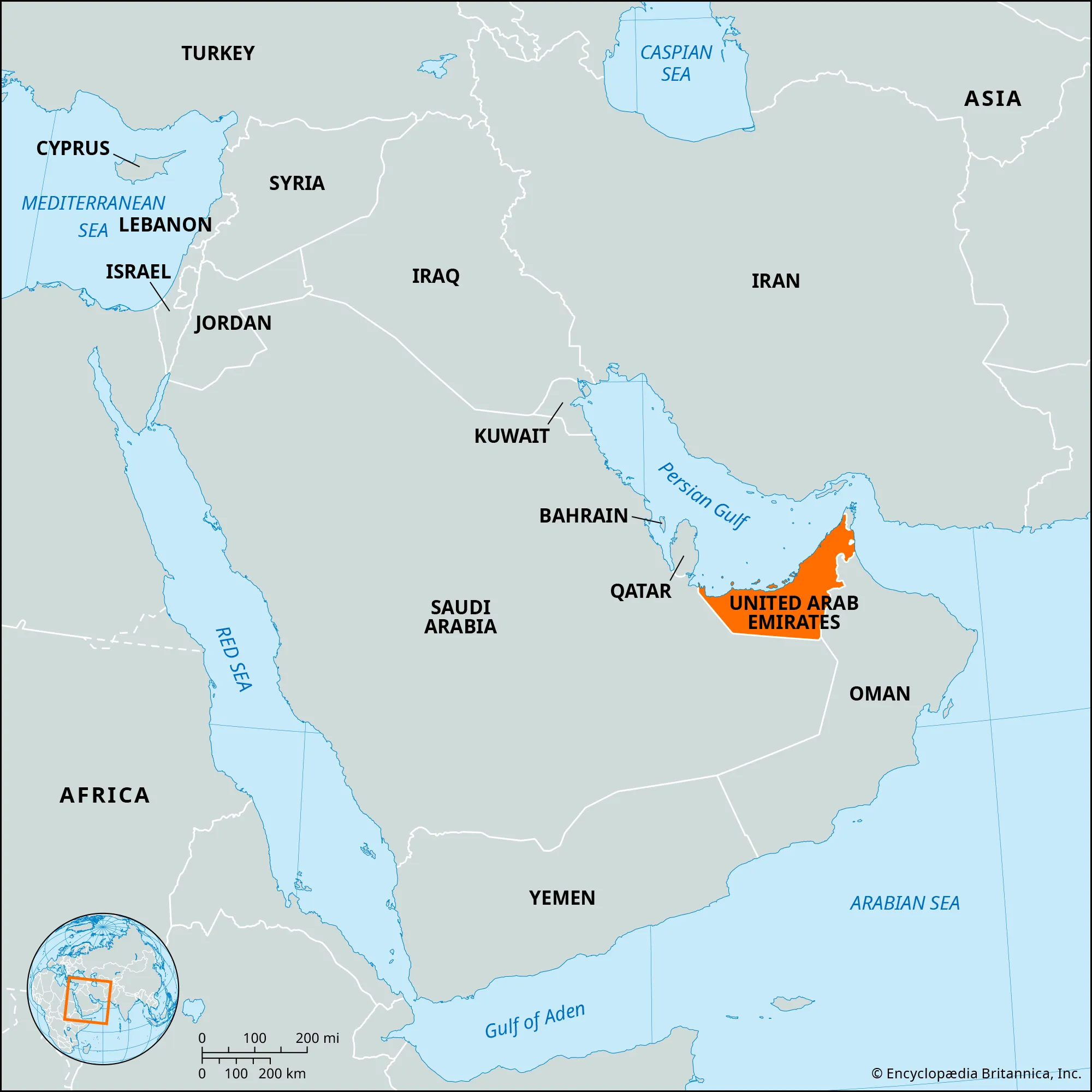
Proximity to India: The geographical closeness across the Arabian Sea reduces shipping times and lowers transit costs for crude oil.
 What opportunities does deeper India-UAE energy cooperation create?
Energy security
Deep integration into Gulf region fortifies long-term resilience for India's expanding economy.
Investment opportunities
Emirati companies invest heavily in India's refining sectors, petrochemicals, and strategic infrastructure.
Renewable energy cooperation
Masdar (the Abu Dhabi Future Energy Company) and the Indian Renewable Energy Development Agency (IREDA) co-develop clean energy projects like solar and wind power.
Green hydrogen prospects
Both nations explore future collaborations in green hydrogen, carbon capture, and clean technological innovation.
IMEC connectivity
The India-Middle East-Europe Economic Corridor integrates logistics networks end-to-end, which bypasses traditional supply chokepoints.
Strategic autonomy
Stronger bilateral ties reduce reliance on volatile global markets and external power interventions.
Geopolitical instability
Shifting alliances and maritime security threats in the Gulf disrupt fragile energy corridors.
Dependence on external suppliers
Over-reliance on Gulf imports exposes the Indian economy to severe supply shocks during Middle Eastern conflicts.
Energy transition toward renewables
Global decarbonization goals threaten the long-term viability of conventional fossil fuel trade between the two nations.
Infrastructure constraints
Bureaucratic hurdles and land acquisition problems delay crucial capacity-building projects like the Phase-II Chandikhol SPR facility.
Market volatility
Severe fluctuations in international crude oil prices strain long-term economic planning and bilateral energy budgets.
Expand SPR capacity
The government must accelerate Phase-II SPR construction at Chandikhol (4 MMT) and Padur (2.5 MMT) to build adequate buffers.
Diversify import sources
India needs to pursue alternative international suppliers alongside the UAE to mitigate geographic concentration risks.
Increase renewable energy
Both nations must fast-track joint investments in solar, wind, and advanced nuclear technologies under frameworks like the new SHANTI law.
Strengthen overseas energy assets
ONGC Videsh Limited (OVL) should acquire more upstream equity stakes in foreign oil basins to ensure direct equity oil supply.
Deepen strategic partnerships
India must leverage multilateral platforms like I2U2 and IMEC to institutionalize economic integration and safeguard maritime trade routes.
Improve domestic production
State governments must incentivize indigenous production and infrastructure modernization through initiatives like 'Make in India' to lower overall import dependency.
The India-UAE Strategic Petroleum Reserves partnership reflects India's transition from reactive energy management to proactive energy diplomacy, where energy security becomes an integral component of national security.
Source: INDIANEXPRESS
|
PRACTICE QUESTION Q. In the context of India's Strategic Petroleum Reserves (SPR) Programme, which of the following locations is part of the established Phase-I storage capacity? (a) Chandikhol (b) Padur (c) Bikaner (d) Rajkot Answer: b Explanation: Under Phase-I of India's Strategic Petroleum Reserves (SPR) Programme, the Indian Strategic Petroleum Reserves Limited (ISPRL) built underground rock cavern storage facilities with a total capacity of 5.33 Million Metric Tonnes (MMT) across three locations: Visakhapatnam (Andhra Pradesh), Mangaluru (Karnataka), and Padur (Karnataka). |
Bilateral trade reached US100 billion in FY 2024−25, and the two nations aim to double this figure to target US 200 billion by 2032.
The UAE was the 4th largest source of crude oil for India last year, meeting nearly 11% of the country's requirement, and it is the largest source of LPG, fulfilling nearly 40% of its needs.
The UAE and India collaborate in the I2U2 minilateral grouping alongside Israel and the United States, focusing on realpolitik and joint investments in areas like food security, water, energy, and space.
© 2026 iasgyan. All right reserved
