The India-Nordic Summit transforms historical cultural ties into a robust strategic alliance focusing on green technology, the blue economy, and Arctic security. This partnership offers India crucial clean innovation, sovereign investments, and supply chain resilience in a multipolar world.
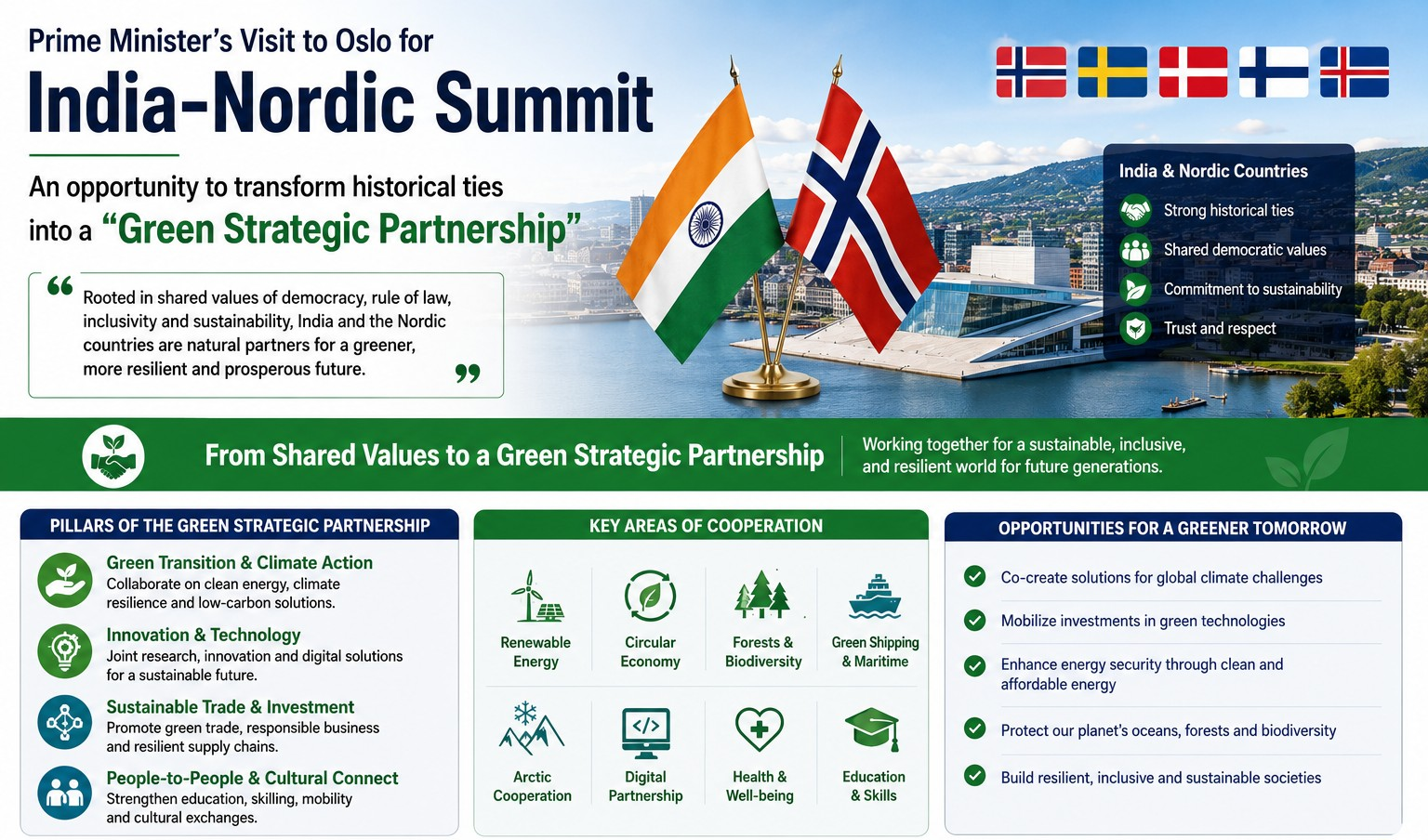
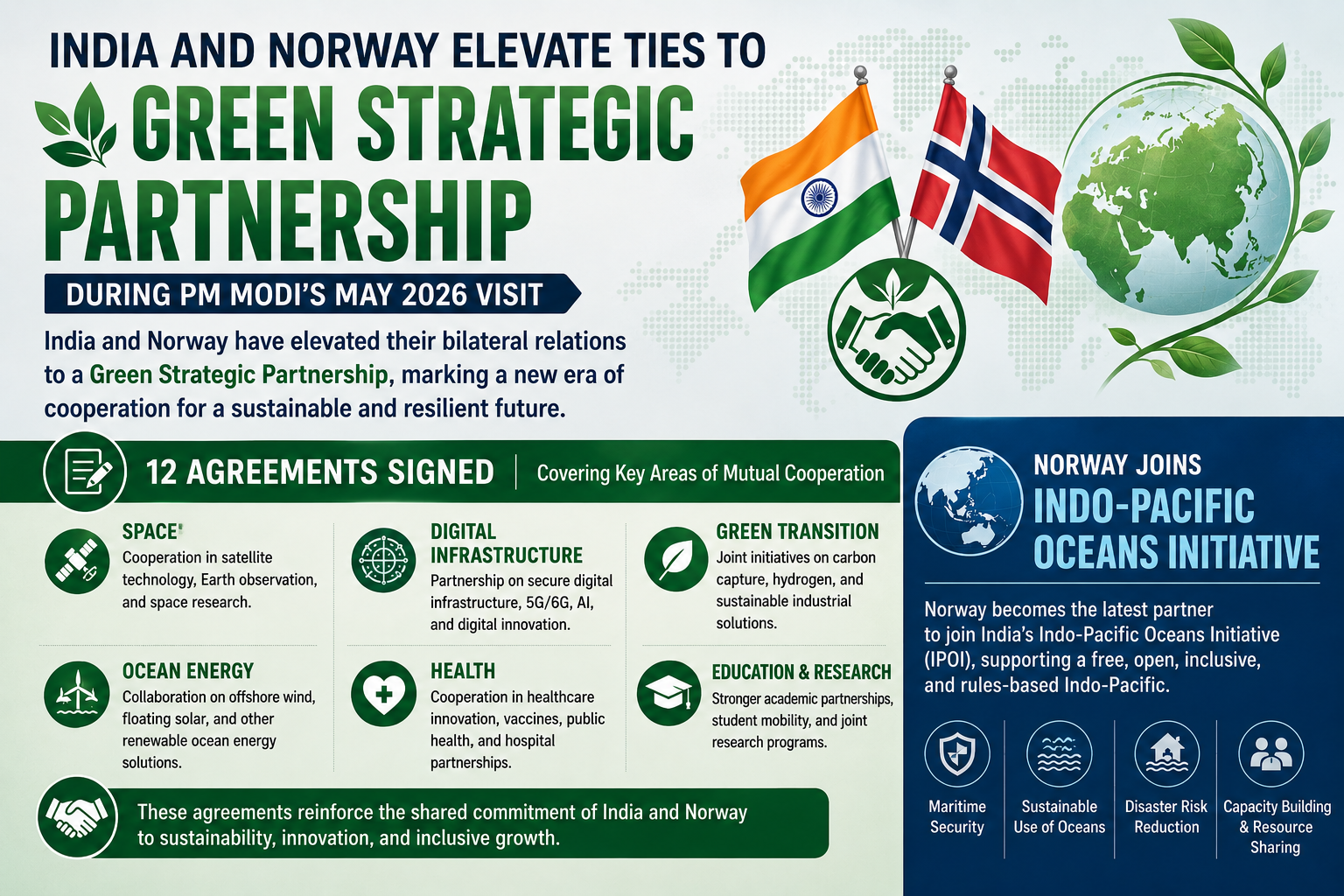
The Prime Minister's visit to Oslo for the India-Nordic Summit is an opportunity to transform historical ties into a "Green Strategic Partnership".
What is the India-Nordic Summit?
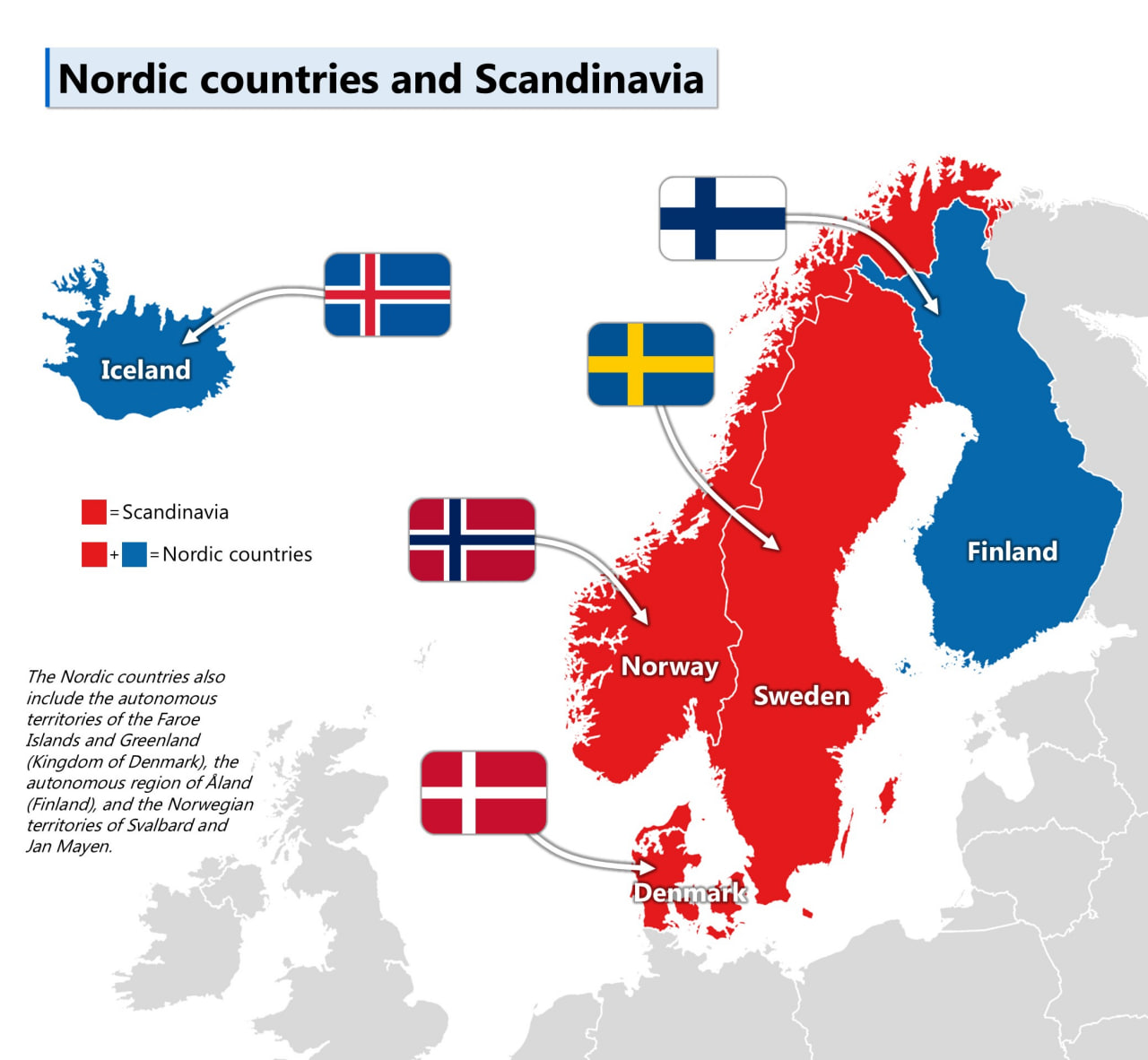
The India-Nordic Summit brings together India and the five Nordic nations—Denmark, Finland, Iceland, Norway, and Sweden—for collective, high-level strategic discussions.
 India stands as the only nation outside the United States to engage the Nordic countries at a comprehensive summit level.
The summits occur systematically—starting in Stockholm (2018), followed by Copenhagen (2022), and moving to Oslo (2026).
Significance
Focuses on Five Core Pillars: The leadership targets cooperation in green partnerships, technology and innovation, trade and investment, sustainable development, and Arctic region security.
Drives the Green Transition: The platform translates climate ambitions into actionable projects, including green shipping corridors, offshore wind energy, smart grids, and circular economy initiatives.
Counters Global Turbulence: As the world faces supply chain disruptions and geopolitical fragmentation, the summit reinforces a shared commitment to multilateralism, multipolarity, and a rules-based international order.
Unlocks Economic Capital: Support historic trade deals like the EFTA-India Trade and Economic Partnership Agreement (TEPA), which commits to injecting $100 billion in investments into India over the next 15 years.
Economic Growth & Investment
The Nordic region deploys sovereign wealth and pension funds into India, supplying the stable, long-term capital required for India's infrastructure and green transition.
Bilateral trade reaches US$ 19 billion, supporting India's “China+1” supply chain diversification strategy.
Blue Economy & Maritime Trade
Norway leads collaborative task forces on ocean energy, marine spatial planning, and deep-sea research.
Iceland shares world-class expertise in quota-based sustainable fisheries management.
Technology & Digitalization
Finland and Sweden partner with India to advance 6G telecommunications, Artificial Intelligence (AI), quantum computing, and secure Digital Public Infrastructure (DPI).
Green Energy & Climate Action
Denmark anchors the Green Strategic Partnership, bringing modern capabilities in green hydrogen, methanol, and offshore wind power. The region serves as a global laboratory for decarbonization.
Geopolitics & Arctic Policy
The Nordic nations comprise 62% of all Arctic states. They provide a crucial foothold for India's Arctic Policy, linking polar climate research directly to Indian monsoon forecasting and climate security.
Global Governance & Multilateralism
The Nordics champion democratic norms and back India's bid for a permanent seat at the UN Security Council, helping India balance the emerging US-China bipolar rivalry.
Defense & High-Tech Manufacturing
The bloc collaborates on dual-use technologies, aerospace components, clean manufacturing, and ice-class shipbuilding (Finland), aligning with the Make in India initiative
Regulatory Hurdles and Bureaucracy
Red tape, complex public procurement practices, and angular trade policies create friction for Nordic investors. Disparities in standards of quality and regulatory compliance delay collaborative projects.
Geopolitical and Strategic Divergences
Russia-Ukraine conflict exposes contrasting priorities; Nordic nations take a strong stance against Russia and deepen their NATO alignment (with Finland and Sweden joining), while India maintains its strategic autonomy and close ties with Moscow.
Persistent Trade Barriers
High tariffs, Non-Tariff Barriers (NTBs), and strict European regulatory frameworks restrict deeper economic integration and limit market access.
Implementation Delays and Capacity Gaps
High-tech and green-energy initiatives suffer from long gestation periods and require complex regulatory harmonisation.
India lacks sufficient domestic capacity in advanced marine technologies and R&D to fully absorb Nordic ocean expertise.
Institute Multi-Level Policy Dialogues
Institutionalize regular high-level ministerial discussions and establish annual technology and climate dialogues that involve both state governments and private sectors to address bureaucratic bottlenecks.
Foster Localized, High-Impact Partnerships
Promote direct state-level partnerships (focusing on coastal states like Kerala, Gujarat, and Tamil Nadu) to absorb Nordic expertise in green shipping, offshore wind energy, and sustainable fisheries.
Launch Dedicated Climate Financing
Create India-Nordic Green Investment and Blue Economy Fund to channel long-term patient capital from Nordic pension and sovereign wealth funds into Indian infrastructure.
Advance Joint Research and Knowledge Diplomacy
Fund collaborative research in marine biotechnology, sustainable aquaculture, and Arctic science.
Establish a startup bridge and promote academic exchanges between Indian Institutes of Technology (IITs) and Nordic universities to strengthen technological sovereignty.
Diversify Strategic Technologies
Expand cooperation in AI ethics, 6G telecommunications, quantum computing, and semiconductors to build resilient supply chains and protect against global tech-nationalism.
The India-Nordic partnership represents a shift from historical cultural ties to a transformative strategic alliance, leveraging shared democratic values, clean technology, and resilient supply chains to stabilize the evolving multipolar world order.
Source: INDIANEXPRESS
|
PRACTICE QUESTION Q. Consider the following countries:
How many of the above are formally recognized as the sovereign states that constitute the Nordic region in the context of the India-Nordic Summit? A) Only three B) Only four C) Only five D) All six Answer: C Explanation: The India-Nordic Summit brings together India and the five sovereign Nordic nations—Denmark, Finland, Iceland, Norway, and Sweden. Greenland is an autonomous territory of Denmark, not an independent sovereign state at the summit. |
The India-Nordic Summit is an exclusive, high-level diplomatic platform bringing together India and the five Nordic nations (Denmark, Finland, Iceland, Norway, and Sweden) to discuss strategic cooperation, green energy, technology, and global security.
Nordic countries are global leaders in innovation, sustainability, and clean technology. They provide India with massive investments via sovereign wealth funds, expertise in the blue economy, offshore wind energy, and critical support for India's Arctic Policy.
The Trade and Economic Partnership Agreement (TEPA) is a economic deal between India and the European Free Trade Association (which includes Iceland and Norway). It commits to injecting $100 billion in investments into India over the next 15 years, creating widespread employment.


© 2026 iasgyan. All right reserved