India-Kenya trade hit $4.31 billion, signaling a strategic shift toward digital infrastructure and maritime security. Balancing trade through local currency settlements and B2B investments is vital for this Global South alliance.
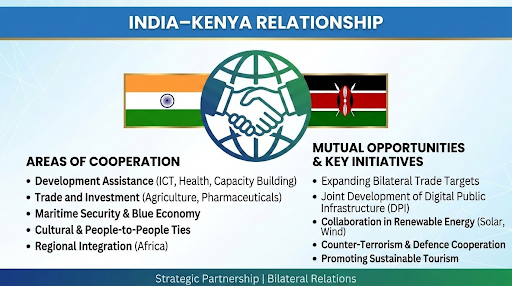
The 10th Session of the India–Kenya Joint Trade Committee (JTC) was held in Nairobi, Kenya, to review and strengthen bilateral trade and economic cooperation between the two countries.
Ancient & Colonial Era (Pre-1947)
Relations date back centuries with the monsoon-driven trade in spices and textiles across the Indian Ocean. The Periplus of the Erythraean Sea (c. 60 AD) documents these early links.
In the late 19th century, thousands of Indians were brought to Kenya by the British to build the Mombasa-Uganda Railway, forming the foundation of the modern Indian diaspora.
Post-Independence Solidarity (1948–1990s)
India established its diplomatic office in Nairobi in 1948, well before Kenya's independence in 1963, to support the anti-colonial struggle.
Both nations were founding members of the Non-Aligned Movement (NAM), cooperating closely against apartheid and colonialism.
Strategic Partnership (2016–Present)
2016 Turning Point: PM Narendra Modi’s visit elevated the relationship, resulting in 7 MoUs including defense cooperation and the gifting of a cancer therapy machine (Bhabhatron II).
2023 Milestone: President William Ruto’s visit to India led to a Joint Vision Statement on Maritime Cooperation (BAHARI), focusing on the blue economy and security.
2026 Economic Surge: In April 2026, the 10th Joint Trade Committee (JTC) meeting highlighted a 24.9% surge in bilateral trade for FY 2025-26, cementing India’s role as a key economic partner.
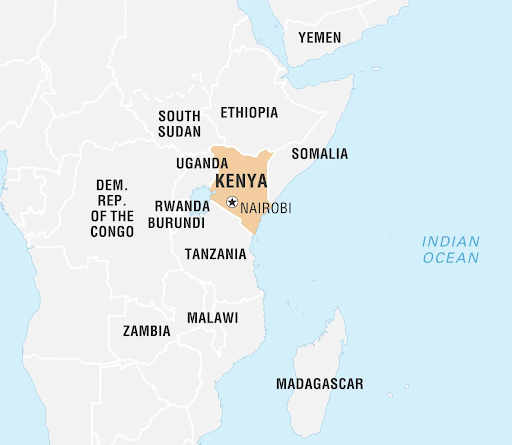
Kenya serves as India's "Gateway to East Africa", playing a significant role in Indian Ocean strategy and economic diplomacy.
Geopolitical & Maritime Security
Indian Ocean Sentinel: Kenya is central to India’s SAGAR (Security and Growth for All in the Region) vision. Both nations conduct joint naval exercises and share intelligence to combat piracy and terrorism in the Western Indian Ocean.
Defense Exports: India sees Kenya as a key market for its defense industry, recently gifting INSAS rifles and medical equipment to the Kenya Defence Forces to boost capacity.
Economic Powerhouse
Trade Hub: Bilateral trade hit $4.31 billion in 2025-26, with India being a top source of essential goods like pharmaceuticals, steel, and machinery. (Source: Press Information Bureau)
Investment Destination: Over 60 major Indian companies (e.g., Tata, Airtel, Bank of Baroda) operate in Kenya, using it as a regional hub for East Africa.
Diaspora & Cultural Bridge
Kenya is home to approximately 80,000 people of Indian origin. In 2017, the Kenyan government officially recognized them as the country's 44th tribe, granting them a unique political and social status.
Healthcare & Capacity Building
"Pharmacy of the World": India is the primary source of affordable generic medicines for Kenya’s healthcare system.
Skill Development: India provides hundreds of scholarships annually under the Indian Technical and Economic Cooperation (ITEC) program, training Kenyan professionals in fields ranging from agriculture to defense.
Trade and Economy: Bilateral trade reached a historic high of $4.31 billion in FY 2025–26, marking a 24.9% growth year-on-year.
Maritime Security (BAHARI): Under the Joint Vision Statement on Maritime Cooperation (BAHARI), both nations collaborate on counter-piracy, hydrography, and the blue economy in the Western Indian Ocean.
Healthcare and Pharmaceuticals: India is the largest supplier of affordable generic medicines to Kenya and has provided critical medical infrastructure, including the Bhabhatron II cancer therapy machine.
Defense Partnerships: Beyond training via the ITEC program, India has extended a $250 million Line of Credit for the modernization of Kenya’s agricultural and defense sectors. (Source: PIB)
Digital and Fintech: Efforts are underway to integrate the Unified Payments Interface (UPI) with Kenya’s M-Pesa to facilitate seamless cross-border remittances.
Trade Imbalance: Trade is heavily skewed in favor of India. For example, in 2025-26, India's exports to Kenya were valued at $4.02 billion, while Kenya's exports to India were only $0.29 billion. (Source: PIB)
China’s Economic Dominance: Kenya is a major participant in China's Belt and Road Initiative (BRI), leading to heavy debt and Chinese influence in infrastructure projects that often outcompete Indian firms.
Security Threats: Both nations face shared threats from maritime piracy and regional terrorism, specifically from the Al-Shabaab militant group, which hampers stable economic investments in the region.
Infrastructure Connectivity: Despite being maritime neighbors, direct shipping connectivity and logistics costs remain high, making Indian goods less competitive compared to those from East Asian neighbors.
Strategic Trade Diversification: To reduce the trade imbalance, both nations must move beyond traditional commodities.
Operationalizing "BAHARI": The maritime vision is actionable through a 5-year roadmap (Feb 2026) targeting joint hydrography, defense co-production (Goa and Kenya Shipyards), and anti-piracy efforts.
Digital Public Infrastructure (DPI) Integration: 2026 pilots integrate India's UPI with Kenya's M-Pesa and Maisha Namba to enable instant remittances and establish Kenya as East Africa's digital hub.
Healthcare & Capacity: India to launch a telemedicine network and utilize the ITEC program to train Kenyans in cyber security and renewable energy.
The India-Kenya relationship is transforming from a historical link into a modern strategic alliance. By integrating digital economies, securing maritime zones via the SAGAR vision, and adopting local currency settlements, both nations are establishing a premier South-South cooperation model for the 21st century.
Source: PIB
|
PRACTICE QUESTION Q. "Kenya represents India's geostrategic gateway to East Africa and is critical for maritime security in the Indian Ocean Region." Analyze. 150 words |
Kenya acts as a geostrategic gateway to the East African Community (EAC), providing access to a regional market of over 300 million people. It is also an indispensable partner for India's maritime security in the Indian Ocean (under the SAGAR vision) and hosts a highly influential Indian diaspora.
As of FY 2025-26, bilateral trade reached a historic high of USD 4.31 billion. India primarily exports refined petroleum, pharmaceuticals, and machinery, while importing tea, coffee, and soda ash from Kenya.
The primary challenges include a severe trade imbalance that heavily favors India, bureaucratic delays in executing Indian Line of Credit (LoC) projects on the ground, and the massive economic and debt-driven footprint of China's Belt and Road Initiative (BRI) in the region.

© 2026 iasgyan. All right reserved