To counter oil-driven inflation and rupee depreciation amid conflict, India targets settling 80% of GCC oil trade in rupees via SRVAs. Success requires navigating U.S. tariff threats and the "Rupee Trap" by enhancing the currency's global investability and balancing geopolitics.
Why In News?
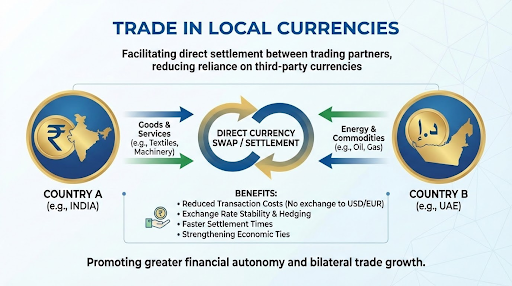
India is exploring trade with West Asian nations in local currencies to bypass dollar volatility and oil price surges.
What is De-dollarization?
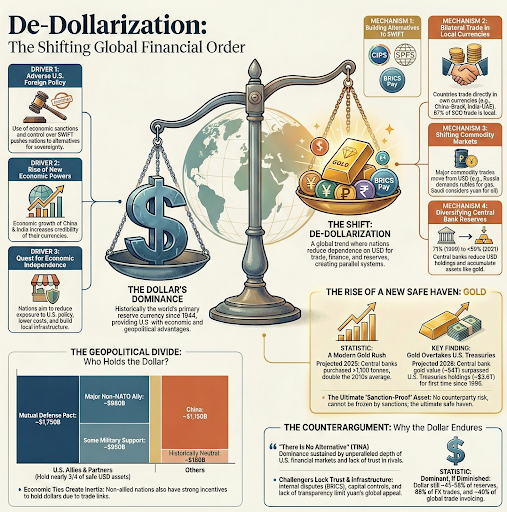
De-dollarisation is the strategic process where nations reduce their reliance on the United States Dollar (USD) as the dominant reserve currency, medium of international trade, and unit of account.
The movement is driven by several structural and geopolitical factors:
Why India is Pursuing Local Currency Payments
Economic Security
Geopolitical Strategy
Protecting Forex Reserves
West Asia Crisis Push (March 2026)
Government officials confirmed "experiments" to settle oil trade with Gulf Cooperation Council (GCC) nations in local currencies to mitigate the fiscal impact of crude price volatility.
|
The Mechanism: How It Works The ecosystem relies on two main pillars:
|
Major Roadblocks and Geopolitical Risks
|
Risk Category |
Details |
Example/Case Study |
|
Geopolitical Risk |
A large-scale shift away from the dollar could provoke retaliatory measures from the United States, which sees de-dollarization as a threat to its global economic influence. |
President Donald Trump threatened a 100% tariff on goods from any country attempting to undermine the dollar's dominance, which could severely impact India's exports to the U.S. |
|
Economic Risk ("Rupee Trap") |
India has a large trade deficit with GCC countries. This means GCC nations would accumulate vast sums of Indian Rupees in their Vostro accounts with limited avenues to spend them, as they import less from India than they export. |
Russia faced this exact issue, accumulating an estimated $40 billion equivalent in Rupees in its Vostro accounts. Unable to use this balance, Russia halted Rupee trade and demanded payment in Chinese Yuan or UAE Dirhams. |
|
Financial Risk |
Most GCC currencies are pegged to the stable U.S. Dollar. Gulf central banks are hesitant to hold large reserves of the Indian Rupee, which they view as a more volatile and depreciating asset. |
The Rupee's recent depreciation to ₹94.1/$ makes it an unattractive store of value for countries whose monetary policy is anchored to the dollar. |
Way Forward for India
Strategic Multialignment: "Pro-Rupee, Not Anti-Dollar"
Preventing the "Rupee Trap": Creating Yield
To prevent partners from holding "dead" Rupee balances (as seen in the Russia-India oil trade), India must offer high-quality investment avenues.
Strengthening the Domestic "Anchor"
Learn Lessons from the "China Model"
India can adapt successful elements of China’s internationalization strategy while maintaining its own democratic values:
Conclusion
Pursuing local currency payments is India's roadmap to "Internationalizing the Rupee." While it is not an immediate replacement for the Dollar, it acts as a vital "financial airbag" against global geopolitical shocks.
Source: thehindu
|
PRACTICE QUESTION Q. “While trade in local currencies offers a pathway to financial sovereignty, structural bottlenecks limit its efficacy.” Discuss the challenges faced by the Indian Rupee in this context and suggest measures to enhance its global acceptance. 250 Words |
Trading in local currencies, like the Rupee and Dirham, shields the Indian economy from Dollar fluctuations and eliminates multi-stage currency conversion costs. This systemic efficiency saves India approximately 5-6% of the total transaction value.
An SRVA is an account that domestic authorized dealer banks in India open for correspondent banks of partner countries. It allows Indian importers to pay for goods in Rupees, which the partner country can then hold and use to buy Indian exports or invest in Indian securities.
The "Rupee Trap" happens when India has a large trade deficit with a partner country (like the GCC or Russia) that accepts Rupees for trade. Because the partner exports more to India than it imports, it accumulates a massive surplus of Rupees but struggles to find enough Indian goods or investment avenues to spend them.


© 2026 iasgyan. All right reserved