India's critical national infrastructure, encompassing power grids, nuclear facilities, and financial systems, faces severe cyber threats from state-sponsored actors and AI-driven malware. Strengthening resilience requires strict NCIIPC guidelines, Zero-Trust Architecture, and comprehensive threat reporting frameworks.
Why In News?
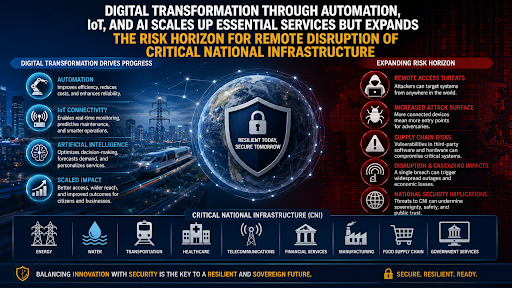
Digital transformation through automation, IoT, and AI scales up essential services but expands the risk horizon for remote disruption of Critical National Infrastructure.
What is Critical National Infrastructure (CNI)?
They refer to the assets, systems, and networks—whether physical or virtual—that are essential for the functioning of a society and economy.
egal Definition: Under the Information Technology Act 2000, Critical Information Infrastructure (CII) includes any "computer resource, the incapacitation or destruction of which shall have a debilitating impact on national security, economy, public health, or safety."
The IT-OT-IoT Triad: Modern CNI relies on a convergence of Information Technology (IT), Operational Technology (OT) (machinery/industrial automation), and the Internet of Things (IoT) which connects physical sensors to digital systems.
Interdependence: A significant characteristic of CNI is the intricate interdependence between sectors. A failure in one (e.g., Power) can quickly cascade across others (e.g., Telecom, Banking, Transport).
India’s Critical National Infrastructure
Power and Energy: Includes the National Power Grid, Regional and State Load Despatch Centres (SLDCs), refineries, and fuel transportation networks.
Transportation: The Indian Railways (4th largest in the world), Metro Rail systems, and the Regional Rapid Transit System (RRTS).
Banking, Financial Services, and Insurance (BFSI): Supports the Digital Public Infrastructure (DPI), including UPI and digital payment switches.
Nuclear Establishments: Both civilian (e.g., Kudankulam Nuclear Power Plant) and military nuclear systems, including Nuclear Command, Control, and Communications (NC3).
Strategic and Space: Infrastructure managed by ISRO and defense-related portals like SPARSH.
Public Utilities: Water supply, healthcare (e.g., AIIMS), and government governance portals.
Why Is India’s Critical Infrastructure Vulnerable?
Cybersecurity incidents in India nearly doubled between 2022 and 2024, rising from 10.29 lakh to 22.68 lakh, highlighting the expanding scale of digital threats. (Source: PIB)
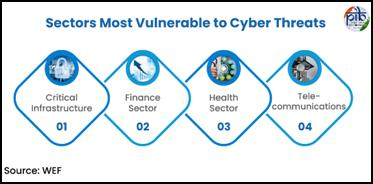
Geopolitical Targeting: Groups like RedEcho, TAG-38, and APT36 (often linked to the China-Pakistan axis) conduct "Grey Zone" warfare. This involves pre-positioning malware for future "contingency operations" rather than immediate espionage.
Legacy Systems: Many sectors, particularly railways and power, operate on outdated industrial control systems not designed with modern security in mind, making them difficult to patch.
Supply Chain Contamination: Reliance on imported hardware and IoT devices (often from China) introduces "hidden vulnerabilities" or embedded Trojans. Unverified e-locks, GPS trackers, and cameras act as potential backdoors.
IT-OT Convergence: Connecting previously isolated OT systems (like SCADA) to the internet for "centralized monitoring" allows attackers to bridge the gap from the digital world to physical destruction.
The Quantum Threat: The "Harvest Now, Decrypt Later" (HNDL) strategy involves adversaries stealing encrypted data today to decrypt it later using future Cryptographically Relevant Quantum Computers (CRQCs).
Human Fallibility: Social engineering (e.g., phishing) and insider threats remain primary entry points. For example, attackers socially engineered help desk staff to breach Marks & Spencer systems via a third-party vendor.
Critical Infrastructure Protection Framework in India
National Critical Information Infrastructure Protection Centre (NCIIPC): The national nodal agency for CII protection; identifies critical sectors and issues security guidelines.
Indian Computer Emergency Response Team (CERT-In): Handles incident response, issues advisories, and coordinates crisis management across the country.
CSIRT-Fin (Computer Security Incident Response Team-Finance Sector): A sectoral incident response team dedicated specifically to the financial sector.
Indian Cybercrime Coordination Centre (I4C): The Indian Cyber Crime Coordination Centre; manages the Citizen Financial Cyber Fraud Reporting System.
Digital Personal Data Protection Act, 2023: Transitions data privacy to a mandatory corporate pillar with penalties up to ₹250 crore for non-compliance.
IT Rules 2026: Mandates 3-hour takedown window for "unlawful" synthetic content (Deepfakes) to eliminate virality.
What Are the Key Challenges in Securing Critical Infrastructure?
Autonomous AI Attacks: Adversaries use AI to detect vulnerabilities and chain "zero-day" exploits at machine speed, far outpacing human-led defense.
Attribution Deficit: Identifying the true origin of a cyberattack is nearly impossible due to the use of proxy hacktivist groups and complex routing, providing attackers with plausible deniability.
Skill Gap Paradox: While an IT superpower, India faces a shortage of high-end professionals in AI-forensics, Quantum Cryptography, and Red Teaming.
Siloed Intelligence: Critical information is trapped within different agencies (CERT-In, NCIIPC, I4C), leading to delayed responses during multi-vector attacks.
Deepfake and Cognitive Warfare: AI-generated misinformation targets public opinion and social cohesion rather than just servers, as seen in fraudulent videos of high-ranking government officials.
What Should Be India’s Strategy for Building Resilient Critical Infrastructure?
Unified Cyber Command: Establish a centralized apex body to integrate threat intelligence into a singular tactical dashboard for real-time response.
Silicon Sovereignty: Replace high-risk foreign hardware in telecom and defense with trusted, domestically manufactured microprocessors and components.
Zero-Trust Architecture (ZTA): Adopt a "never trust, always verify" model. This ensures that even if a perimeter is breached, lateral movement by the attacker is restricted through micro-segmentation.
Active Cyber Deterrence: Develop calibrated offensive digital capabilities to conduct proportional counter-strikes, altering the risk calculus for state-sponsored adversaries.
Sovereign Cloud Infrastructure: Anchor sensitive data within domestic borders on hyperscale cloud networks to prevent extraterritorial surveillance and ensure judicial access.
Quantum-Safe Transition: Integrating Post-Quantum Cryptography (PQC) and Symmetric Key Encryption with high entropy to future-proof data against quantum attacks.
Collaborative Cyber Defense: Foster Public-Private Partnerships (PPP) to share real-world threat intelligence and establish national cybersecurity benchmarks.
Conclusion
Securing India’s critical infrastructure is no longer a technical choice but a foundational requirement for national sovereignty, economic stability, and public safety in an era of AI-driven warfare.
Source: THEHINDU
|
PRACTICE QUESTION Q. "The weaponization of Artificial Intelligence has transformed cybersecurity from a technical challenge into a critical pillar of national sovereignty." Discuss. 150 words |
Under the Information Technology Act 2000, CII refers to a computer resource whose incapacitation or destruction would have a debilitating impact on national security, economy, public health, or safety, including power grids, financial systems, and nuclear facilities.
The National Critical Information Infrastructure Protection Centre (NCIIPC) was designated by the Government of India in 2014 as the national nodal agency for taking all necessary measures to protect CIIs.
It is a security model where no device or user is trusted by default, regardless of whether they are inside or outside the network perimeter. It involves continuous identity verification and micro-segmentation to restrict the lateral movement of threat actors.

© 2026 iasgyan. All right reserved