Context:
National Handicrafts Week observed annually from 8–14 December. It promotes traditional skills, honours craft communities, and reinforces policy commitment to strengthening this decentralised sector.
What are handicrafts?
Handicrafts are largely handmade products—sometimes aided by simple tools—adorned with aesthetic, cultural, and ethnic value. Unlike machine-mass-produced goods, each handcrafted item embodies local skill, creativity, and identity, making India a major global supplier of authentic handmade products in an era where sustainability and authenticity matter.
Current Status of handicraft sector:
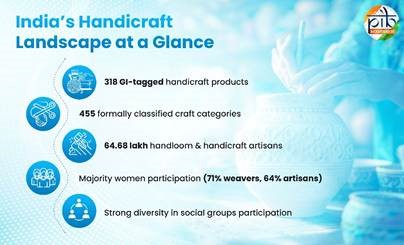
- India’s handicraft sector supports around 64.66 lakh artisans, with women forming a dominant share, 64% of all artisans and 71% of handloom weavers, highlighting significant female participation. (Source: PIB)
- Handicrafts exports grew to ₹33,122.79 crore in 2024–25, indicating rising international interest in Indian craft traditions. (Source: PIB)
- The domestic handicrafts market in India was valued at USD 4,565.0 million (USD 4.57 billion) in 2024 and this market is expected to grow to around USD 8,198.5 million (USD 8.20 billion) by 2033. (Source: The Hindu)

Picture Courtesy: PIB
Importance of handicraft sector in India:
- Source of employment: India has 66 lakh handloom & handicraft artisans, predominantly living in rural and semi-urban regions.
- Instrument for Inclusive growth: A majority of artisans belong to SC, ST and OBC communities, demonstrating the sector’s role in social justice. Handicrafts provide supplementary incomes during agricultural lean seasons, stabilising rural cash flows.
- Preserves India’s Cultural Heritage: India has 318 GI-tagged handicraft products, from Pashmina (J&K) to Madhubani paintings (Bihar) and Blue Pottery (Rajasthan).
These represent artistic legacy and local knowledge systems that carry history, belief patterns and community identity.
- Strong contribution to exports: Handicraft exports (excluding carpets) reached ₹33,122.79 crore in 2024–25, up from ₹20,082.53 crore in 2014–15. USA alone accounts for 37% of Indian handicraft imports, signalling strong global demand.
- Labour-Intensive sector: Handicrafts require little machinery and small capital, yet generate high value addition. For example: Block-printing units of Bagru (Rajasthan) operate from households with low investment but their textiles command premium markets in Europe and Japan.
Factors driving the growth of India’s handicraft sector:
- Rising global demand for sustainable and handmade products: Consumers worldwide increasingly value ethical, eco-friendly, authentic products. Indian handicrafts use natural fibres, recycled materials, and traditional designs which align with this demand.
- Market Integration: Crafts are increasingly integrated into national and global value chains. One District One Product, GI tagging, exhibitions, e-Haats and trade fairs promote regional craft identity.
- Digital Marketplaces: Online platforms enable artisans to reach urban and global buyers without middlemen. Portals like Amazon Karigar, Flipkart Samarth, Tribes India, and government-linked Indie Haat have enhanced market reach.
- Tourism Expansion: Cultural tourism boosts craft demand. States like Rajasthan, Gujarat, Kerala and Kashmir see tourists directly purchasing craft ware.
- Skill Development: To meet contemporary market tastes, design and skill-upgrade programmes are growing. Guru–Shishya programmes, National Skills Qualification Framework (NSQF) training, tool-kit upgrades, and design workshops increase productivity and value addition.
What are the challenges associated with handicraft sector in India?
- Fragmented production structure: The sector remains largely decentralised and home-based, resulting in low production volumes, inconsistent quality and limited ability to scale operations.
- Market access and middlemen dependence: Artisans struggle to reach buyers directly, forcing them to rely on intermediaries who capture a disproportionate share of profits and weaken their bargaining power. Madhubani artisans who depended solely on mythological themes saw declining sales until NGOs introduced modern motifs for lifestyle products.
- Design and innovation gaps: Limited exposure to changing consumer preferences and global design trends restricts product diversification and reduces competitiveness in premium markets.
- Raw material constraints: Fluctuating availability and rising costs of natural inputs such as bamboo, clay, wool or dyes increase production costs and affect timely delivery. Kashmir Pashmina artisans report falling goat wool availability due to climatic shocks, leading to cost escalation.
- Slow technology adoption: Inadequate access to modern tools, digital platforms and production technologies keeps productivity low and prevents artisans from tapping into e-commerce opportunities.
- Limited access to finance: A lack of collateral, financial literacy and formal documentation prevents artisans from securing institutional credit, compelling many to depend on informal lenders.
What are the government initiatives for handicrafts in India?
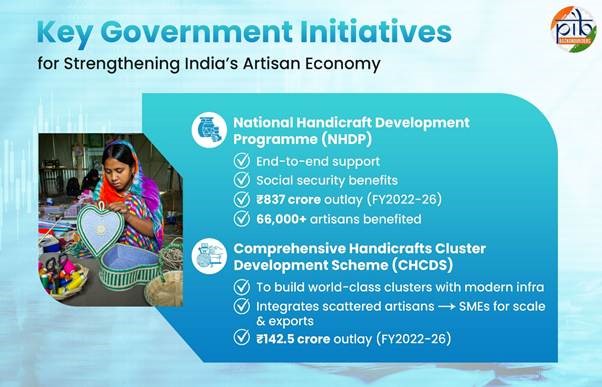
National Handicraft Development Programme (NHDP): The NHDP strengthens artisan livelihoods by providing infrastructure support, skill development, market linkages, social security and cluster-based interventions to uplift handicraft communities.
Comprehensive Handicrafts Cluster Development Scheme (CHCDS): CHCDS develops world-class craft clusters by improving workspace, technology access, training facilities and business services to enhance productivity and global competitiveness.
Pehchan Artisan Identification Programme: The Pehchan ID card formalises artisans, enabling them to access welfare schemes, credit, training and social security benefits while improving data-based policy planning.
Scheme of Fund for Regeneration of Traditional Industries (SFURTI): SFURTI promotes traditional industries by forming clusters, building infrastructure, supporting producer groups and converting artisans into self-governing entrepreneurs.
Ambedkar Hastshilp Vikas Yojana (AHVY): AHVY fosters producer cooperatives, community participation and grassroots market linkages to integrate artisans into mainstream financing and marketing systems.
One District One Product (ODOP) Initiative: ODOP highlights unique district-specific craft products, improving branding, market reach and value-addition for regional craft economies.
Picture Courtesy: PIB
Conclusion:
India’s handicraft sector stands at the intersection of culture and livelihood, nurturing heritage while sustaining millions of rural and women artisans. With rising global demand for handmade, sustainable products and sustained government support, the sector holds strong potential for inclusive growth. Strengthening design innovation, market access, social security and skill development can further transform traditional craftsmanship into a thriving creative economy, ensuring that India’s cultural legacy evolves as a driver of economic progress.
Source: PIB
|
Practice Question
Q. “The handicraft sector in India is both a cultural custodian and a rural economic lifeline.”
Discuss. (150 words)
|
Frequently Asked Questions (FAQs)
It provides livelihoods to millions, preserves cultural heritage, promotes women’s empowerment, boosts exports, and supports rural development.
Around 64.66 lakh handloom and handicraft artisans are estimated to be engaged, mostly in rural and semi-urban areas.
Uttar Pradesh, Rajasthan, Assam, Odisha, West Bengal, Tamil Nadu, Jammu & Kashmir and Gujarat are key craft-producing regions.