On June 15, Goa hosted the Global Wind Day 2026 Conference themed "Wind Energy: From Ambition to Acceleration." The event focused on India's 100 GW target by 2030, domestic manufacturing, and grid readiness.
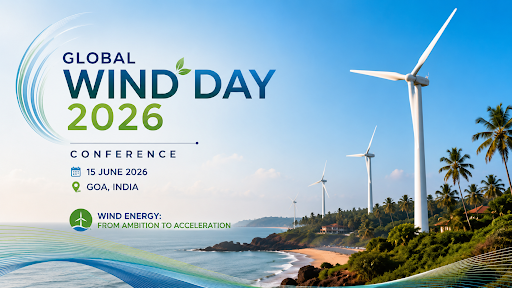
India hosted the Global Wind Day 2026 Conference on 15 June 2026 in Goa, under the theme "Wind Energy: From Ambition to Acceleration".
WindEurope and the Global Wind Energy Council (GWEC) lead this annual initiative to promote clean electricity and sustainable energy solutions.
The event was first launched in 2007 as European Wind Day by the European Wind Energy Association (EWEA) to promote the benefits of wind energy across Europe.
In 2009, the EWEA partnered with the Global Wind Energy Council (GWEC) to transform it into a global observance.
The official 2026 global theme for the campaign is "Our wind, our community".
Global Standing: India ranks 4th globally in total installed wind power capacity.
Capacity Growth: The nation increased its installed capacity by 2.66 times, rising from 21.04 GW in March 2014 to 56.09 GW in March 2026.
Annual Achievement: India added a record 6.05 GW of wind capacity during FY 2025-26.
Resource Potential: The country maps a gross wind potential of 1,163.9 GW at 150 metres above ground level, with Rajasthan leading at 284.2 GW.
Offshore Wind Development
Policy Framework: The National Offshore Wind Energy Policy (2015) regulates development within the 200-nautical-mile Exclusive Economic Zone (EEZ).
Financial Support: The government sanctions a Rs 74.53 billion Viability Gap Funding (VGF) scheme to support 1 GW of capacity and port infrastructure.
Strategic Locations: The National Institute of Wind Energy (NIWE) identifies the Gulf of Khambhat (Gujarat) and the Tamil Nadu coast as primary sites for initial offshore projects.
|
Wind Energy and Climate Commitments Net-Zero Goal: Wind power serves as the backbone for India’s Net-Zero emissions by 2070 target. Nationally Determined Contributions (NDCs) Targets: India aims for 500 GW of non-fossil fuel electricity capacity by 2030, having already achieved 50% of its capacity from non-fossil sources in June 2025. |
Source: PIB
|
PRACTICE QUESTION Q. Evaluate the ecological impact of rapid renewable energy expansion in ecologically sensitive zones. 150 words |
Global Wind Day is a coordinated international event celebrated annually on June 15 to discover wind energy, its power, and the mainstream possibilities it holds to completely reshape our global energy systems.
Wind power acts as an indispensable, infinite green energy source that generates zero carbon emissions during operation, lowers electricity generation costs, and helps nations rapidly decouple from fossil fuels.
Gujarat, Tamil Nadu, Karnataka, and Rajasthan firmly lead the country by holding the highest cumulative installed onshore wind capacities due to their vast, high-velocity coastal and desert wind corridors.
The sector faces hurdles including high upfront capital costs for offshore installations, lengthy land acquisition delays, fluctuating seasonal wind speeds, and inadequate high-voltage transmission grid connectivity in remote generation zones.

© 2026 iasgyan. All right reserved