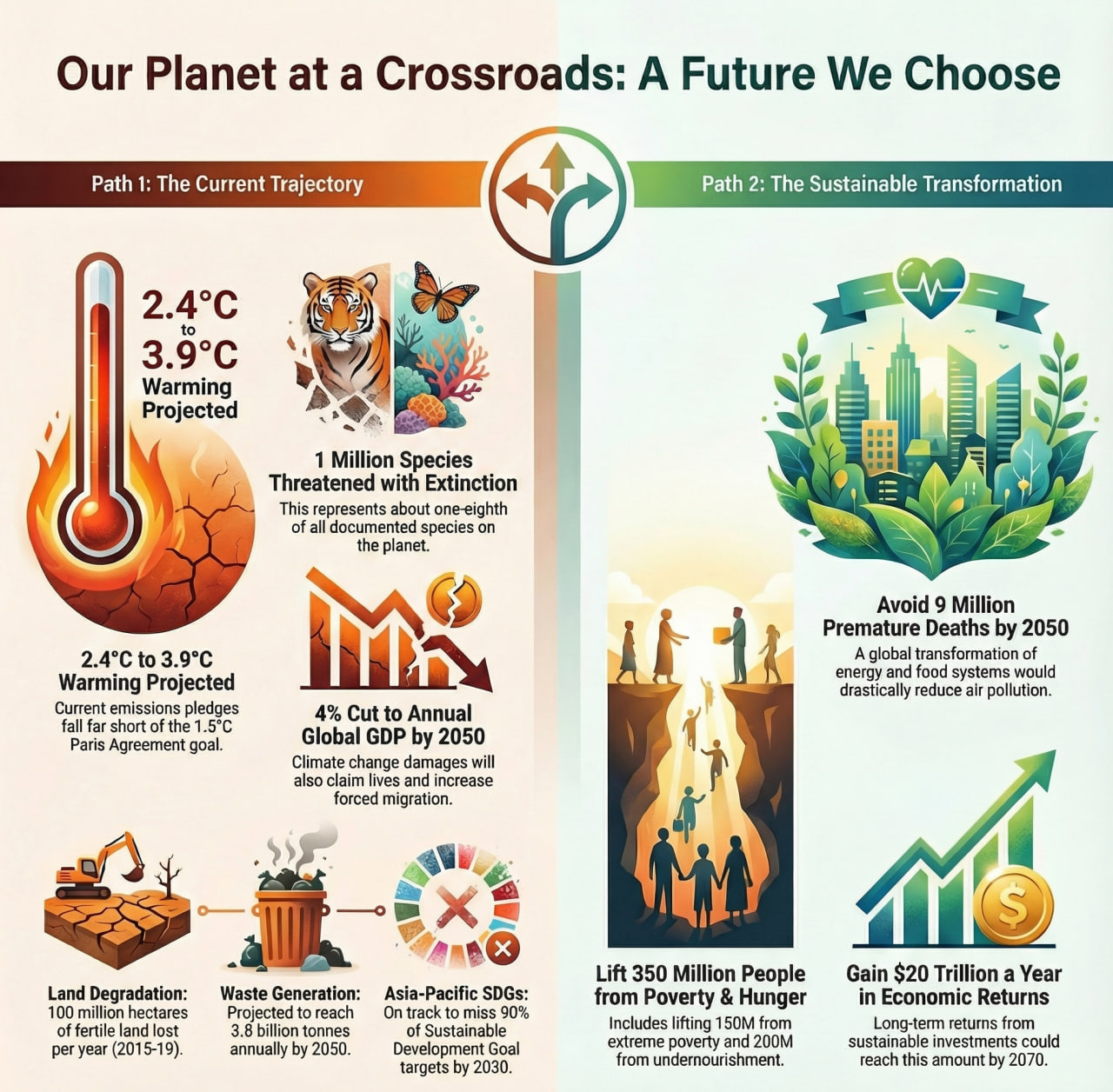
The UNEP's seventh Global Environment Outlook (GEO-7) report presents a dire warning, projecting global temperature rise between 2.4°C and 3.9°C this century, far exceeding Paris Agreement goals. It highlights an interconnected "polycrisis" of accelerated climate change, catastrophic biodiversity loss, widespread land degradation, and escalating pollution.
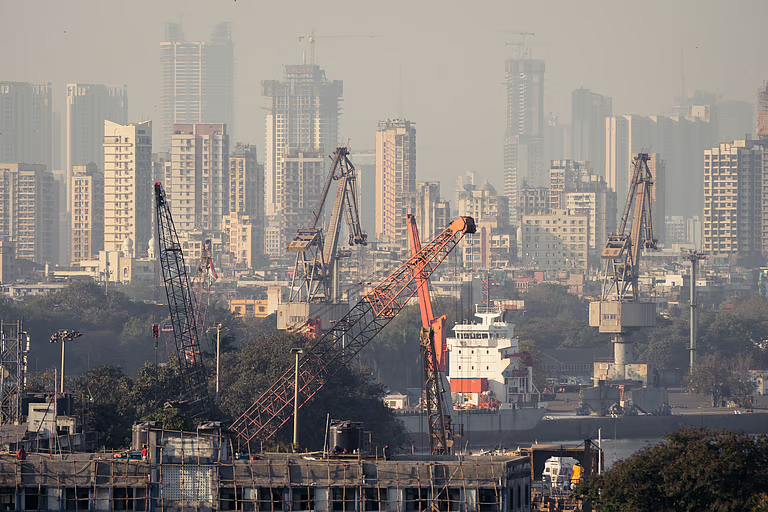
Copyright infringement not intended
Picture Courtesy: DOWNTOEARTH
The United Nations Environment Programme (UNEP) released the “Global Environment Outlook (GEO-7) report, "A Future We Choose," which warns that the planet has entered "uncharted territory."
It is an environmental assessment series that provides a comprehensive, science-based review of the state and direction of the global environment.
UNEP has published seven comprehensive GEO reports since 1997, with the most recent, GEO-7, launched in December 2025.
Purpose and Goals
Assess the environment by tracking environmental state and trends at global and regional scales.
Evaluate policy effectiveness, analyzing how well existing policies address environmental challenges.
Provide guidance for decision-making, offering policy options and potential pathways to achieve internationally agreed environmental goals, such as the Sustainable Development Goals (SDGs).
Bridge the science-policy interface, ensuring that the best available scientific knowledge informs national and international environmental law and policy.
The planet is facing a 'polycrisis' where climate change, biodiversity loss, and pollution are deeply interlinked and mutually reinforcing. Current global efforts are insufficient to meet established environmental goals.
Accelerated Climate Change: Global mean temperatures are projected to rise 2.4°C to 3.9°C above pre-industrial levels this century, exceeding the Paris Agreement's 1.5°C target.
Massive Biodiversity Loss: An estimated 1 million animal and plant species are now threatened with extinction, many within decades.
Widespread Land Degradation: Up to 40% of the world's land is degraded, directly affecting half of humanity, food security and ecosystem stability.
Escalating Pollution & Waste: Global annual municipal solid waste generation is projected to increase from 2.01 billion tonnes in 2016 to 3.40 billion tonnes by 2050.
|
What is Polycrisis?
|
Socio-Economic Implications
Asia-Pacific's Vulnerability
SDG Progress Lag: The region has achieved only 17% of the necessary progress towards the Sustainable Development Goals (SDGs).
Delayed Targets: At its current pace, the Asia-Pacific region is projected to achieve the SDGs only by 2062, a 32-year delay from the 2030 target.
Urgent Priorities: Key priorities for the region include building climate resilience, tackling pollution, and transitioning to sustainable land-use practices.
 Implications for India
India is highly vulnerable to climate change, posing serious risks to the economy, public health, and national security..
India’s Strategy for a Sustainable Future
The creation of the Ministry of Cooperation aims to strengthen cooperative movements, which can play a vital role in community-led environmental projects.
Under the Bonn Challenge, India has pledged to restore 26 million hectares of degraded and deforested land by 2030.
The Plastic Waste Management (Amendment) Rules, 2022, prohibited specific single-use plastic items. The framework emphasizes Extended Producer Responsibility (EPR), making producers responsible for the environmental management of their products until the end of their life cycle.
NITI Aayog is leading discussions on a "Just Transition" policy for coal-dependent regions. The goal is to ensure that the shift to a green economy does not negatively impact the livelihoods of millions dependent on the fossil fuel industry.
An Inter-Ministerial Committee has recommended focusing on economic diversification, skill development, and social security nets for communities in coal-rich states like Jharkhand, Chhattisgarh, and Odisha to facilitate a smooth and equitable transition to green jobs.
Source: DOWNTOEARTH
|
PRACTICE QUESTION Q. With reference to the UNEP GEO-7 report, consider the following statements: 1. It projects that current commitments will limit global temperature rise to well below 2°C, in line with the Paris Agreement. 2. It highlights the interconnectedness of climate change, biodiversity loss, land degradation, and pollution, terming it a "polycrisis". 3. The report suggests that a systemic transformation towards sustainability could yield long-term economic returns. Which of the statements given above is/are correct? A) 1 and 2 only B) 2 and 3 only C) 3 only D) 1, 2 and 3 Answer: B Explanation: Statement 1 is incorrect: The report states that current commitments and policies are insufficient to meet the Paris Agreement goals. It projects that global temperature increases are likely to exceed 1.5°C in the early 2030s and 2.0°C by the 2040s under a business-as-usual scenario, a path that falls far short of limiting warming to "well below 2°C". Statement 2 is correct: The report highlights the interconnected nature of climate change, biodiversity loss, land degradation, and pollution, and emphasizes that these must be addressed in an integrated manner, often referred to as a "polycrisis" in related discussions and reports. Statement 3 is correct: The report suggests that a systemic transformation towards sustainability, while having upfront costs, could yield significant long-term economic benefits, with annual global gains projected to reach approximately $20 trillion by 2070. |
The GEO-7 is a comprehensive assessment by the United Nations Environment Programme (UNEP), compiled by hundreds of scientists. It evaluates the state of the global environment and provides projections on climate change, biodiversity, pollution, and land degradation, offering policy guidance for governments.
The term "polycrisis" refers to the interconnected nature of the world's major environmental challenges—climate change, biodiversity loss, land degradation, and pollution. The report emphasizes that these are not isolated issues but crises that reinforce and worsen one another.
It is a policy framework recommended by an Inter-Ministerial Committee under NITI Aayog. Its goal is to manage the socio-economic impact of transitioning away from fossil fuels, particularly coal. The policy would focus on reskilling workers and creating new economic opportunities in green sectors for communities in coal-dependent states like Jharkhand, Odisha, and Chhattisgarh.

© 2026 iasgyan. All right reserved