Grid India and the Ministry of Power are relying on gas-based power plants and proposing SYNCON conversions to manage peak summer demand and stabilise the grid against renewable energy fluctuations.
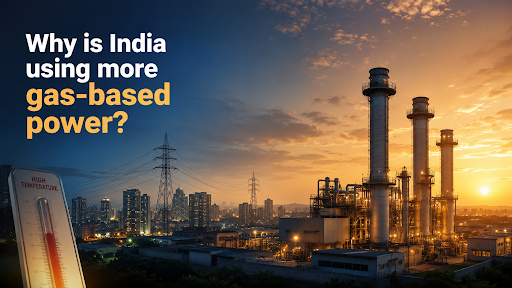
Why In News?
The Ministry of Power invokes Section 11 of the Electricity Act, 2003 to mandate that all gas-based power plants operate at maximum capacity during heatwaves to ensure national energy security.
What is Gas-Based Power Generation?
Natural Gas Power Plants: These facilities combust natural gas to spin turbines, producing 50% less carbon dioxide and zero particulate matter compared to coal-fired plants.
Combined Cycle Gas Turbines (CCGT): These systems capture hot exhaust gases from primary turbines to drive secondary steam turbines, achieving thermal efficiencies exceeding 60%.
Peaking Power Plants: Operators ramp these units up or down within minutes, allowing them to match sudden evening spikes in grid demand that inflexible coal plants cannot handle.
Why is Grid India Increasing Gas-Based Power?
Balancing Renewable Energy: Gas plants act as shock absorbers during "non-solar hours," filling the generation gap when solar energy drops off the grid.
Managing Peak Demand: Gas generation provides high-capacity bursts to satisfy urban air-conditioning loads when baseload coal plants reach their generation limits.
Faster Start-Up Time: Gas turbines synchronize with the grid almost instantaneously, providing dynamic frequency control and correcting voltage drops.
Grid Reliability: Grid India identifies 9 underutilized thermal units (1.8 GW) across 5 states for conversion into Synchronous Condensers (SYNCONs), which supply pure inertia and reactive power to stabilize the network.
Advantages of Gas-Based Power
Lower Emissions: Natural gas eliminates toxic sulfur dioxide and reduces greenhouse gases, aligning with India’s climate targets.
Operational Flexibility: Precise load-following capabilities allow operators to adjust output to accommodate the erratic nature of wind and solar power.
Grid Stability: Gas units inject critical reactive power, preventing cascading blackouts like the 16.5 GW load loss event caused by the Champa-Kurukshetra HVDC link trip.
Challenges
Dependence on Imported LNG: Geopolitical tensions cause spot-market price volatility, making imports expensive for distribution companies.
Fuel Supply Constraints: Many domestic plants remain stranded, contributing only 1-2% of India's total generation mix due to a lack of affordable, locally sourced gas.
High Generation Costs: Electricity from imported LNG exceeds the cost of subsidized coal or solar tariffs, leading state utilities to avoid purchasing it without emergency mandates.
Infrastructure Bottlenecks: Insufficient pipeline connectivity prevents the transport of regasified LNG from coastal terminals to hinterland power plants.
Role in India's Energy Transition
Supporting Solar and Wind: Gas power serves as dispatchable backup, guaranteeing electricity when weather conditions halt renewable generation.
Achieving Net-Zero Goals: Natural gas functions as a "bridge fuel," enabling a phased reduction of coal while the nation builds grid-scale battery infrastructure for the 2070 Net-Zero target.
Energy Security: Maintaining 10 GW of active gas capacity prevents over-reliance on coal, especially during the monsoon when flooded mines disrupt logistics.
Coal Gasification Synergy: The Ministry of Coal promotes the conversion of coal into syngas to displace raw coal in the DRI (Direct Reduced Iron) and fertilizer sectors.
Government Initiatives
National Electricity Plan: The Central Electricity Authority (CEA) projects an additional 817 GW of capacity by 2030, balancing 500 GW of non-fossil capacity with gas and pumped hydro.
Green Energy Corridor: Grid India integrates gas plants at critical nodes within high-capacity transmission lines to inject mechanical inertia.
Energy Storage Systems: The Ministry of Power subsidizes Battery Energy Storage Systems (BESS) to create a hybrid, dual-layered grid balancing mechanism.
National Coal Gasification Mission: The government targets the gasification of 100 million tonnes of high-ash domestic coal by 2030 to reduce LNG import dependence.
Way Forward
Expanding Domestic Gas Production: Auctions deepwater exploration blocks to incentivize upstream companies and reduce import dependency.
Battery Energy Storage: Launch Production Linked Incentive (PLI) schemes for grid-scale BESS to replace expensive gas peaking plants.
Smart Grid Development: Integrates Artificial Intelligence (AI) predictive analytics into regional load dispatch centers to forecast renewable drops and automate gas plant dispatch.
Synchronous Condenser Conversion: Executes the conversion of idle units into SYNCONs to provide emission-free mechanical inertia to the grid.
Conclusion
Gas-based power provides a stabilizing bridge for energy transition, balancing renewable volatility and securing energy supply during climate-driven disruptions.
Source: INDIANEXPRESS
|
PRACTICE QUESTION Q. Consider the following statements regarding grid stability and power generation in India: 1. The Electricity Act, 2003, the government can compel generating companies to operate and maintain power stations during extraordinary circumstances. 2. Synchronous Condensers (SYNCONs) generate electricity to boost the baseload power supply of the national grid. 3. Natural gas power plants have slower start-up times compared to coal-fired power plants, making them unsuitable for managing evening peak demands. Which of the statements given above is/are correct? (a) 1 only (b) 1 and 2 only (c) 2 and 3 only (d) 1, 2, and 3 Answer: (a) Explanation: Statement 1 is correct: Under the The Electricity Act, 2003, the government and Appropriate Commissions have the authority to issue directions to generating companies and licensees. During extraordinary circumstances (such as grid emergencies, national crises, or severe capacity shortages), the government can compel generating companies to operate and maintain their power stations to ensure grid stability and essential supply. Statement 2 is incorrect: Synchronous Condensers (SYNCONs) do not generate electricity. They are essentially large electric motors connected to the grid that spin freely to provide reactive power, grid inertia, and voltage support. They help keep the grid stable and shock-absorbent, but they do not boost the active baseload power supply. Statement 3 is incorrect: Natural gas power plants have much faster start-up and ramp-up times compared to conventional coal-fired power plants. Because of this agility, open-cycle and fast-response natural gas plants are ideal for managing rapid load fluctuations and peak evening demands. |
India is maximizing gas-based power generation to meet unprecedented peak summer electricity demands, prevent widespread regional grid collapses, and bridge the immediate generation deficit caused by delayed coal logistics and surging economic activity.
Gas-based generation supports renewables by providing ultra-fast ramping capabilities, allowing turbines to fire up or shut down within minutes to seamlessly offset the sharp drop-offs in solar output after sunset or sudden drops in wind velocity.
Peaking power plants are specialized, high-responsiveness electricity generation facilities designed to operate exclusively during hours of maximum grid demand, rather than running continuously to supply baseline electrical loads.
The primary bottlenecks include an acute shortage of affordable domestic natural gas production, a high reliance on volatile and expensive imported Liquefied Natural Gas (LNG), and underutilized pipeline infrastructure that keeps over half of India's gas power capacity structurally stranded.


© 2026 iasgyan. All right reserved