The Durand Line, drawn in 1893 between British India and Afghanistan, remains a deeply contested boundary due to questions of legitimacy, ethnic divisions and competing territorial claims. Pakistan treats it as its formal international border, while Afghanistan—under successive regimes—refuses to recognise it. This unresolved dispute fuels cross-border militancy, strains Af-Pak relations, and contributes to wider regional instability, with implications for India’s security and strategic engagement in Afghanistan and Central Asia.
Copyright infringement not intended
Picture Courtesy: The Hindu
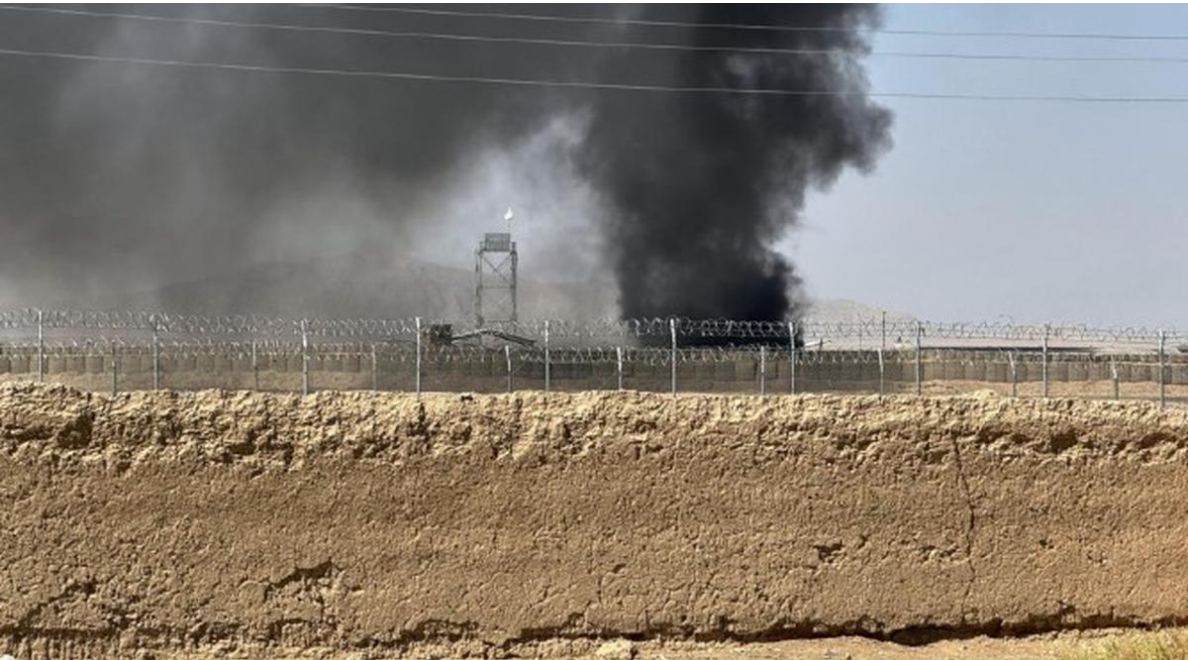
Fresh tensions surfaced after Taliban authorities accused Pakistan of conducting air strikes. The episode brought global attention back to the Durand Line, a colonial-era demarcation that Afghanistan has never formally recognised, making it one of the world’s most volatile borders.
|
Must Read: Durand Line | Afghanistan and Central Asia | |
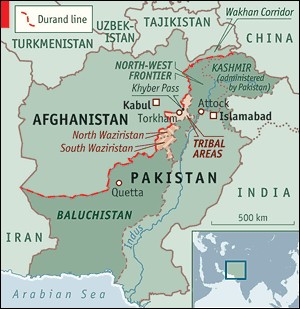
The Durand Line is the 2,640-kilometer (1,640-mile) international border that separates Afghanistan and Pakistan. It was established in 1893 by Sir Mortimer Durand, a British diplomat, and Amir Abdur Rahman Khan, the ruler of Afghanistan, to delineate their respective spheres of influence during the "Great Game" rivalry between the British and Russian Empires.
|
Other border Line: McMahon Line: The McMahon Line, named after British official Sir Arthur Henry McMahon, was proposed at the 1914 Shimla Convention as the boundary between British India, Tibet and China. It follows the Himalayan crest from eastern Bhutan to the point where the Brahmaputra River descends into the Assam Valley, and was accepted by British India and Tibetan authorities. India recognises this line as its lawful border, but China disputes it on the grounds that Tibet lacked the sovereignty to sign such agreements. Radcliffe Line: The Radcliffe Line, drawn in 1947 under the chairmanship of Sir Cyril Radcliffe, partitioned British India into India and Pakistan by defining boundaries in both the western and eastern parts of the subcontinent. Its western segment became the India–Pakistan border, while its eastern segment later evolved into the India–Bangladesh boundary, and it continues to serve as the primary political divide created during Partition. |
Picture Courtesy: The Economist
The Great Game and British strategic calculus: During the nineteenth century, Afghanistan occupied a pivotal position in the geopolitical competition between Tsarist Russia and the British Empire, commonly termed the Great Game.
In order to prevent the southward advance of Russian influence towards the Indian subcontinent, the British undertook two major military interventions in Afghanistan—the First Anglo-Afghan War (1839) and the Second Anglo-Afghan War (1878–80).
Following the latter conflict, the Treaty of Gandamak (1879) compelled Afghanistan to surrender control over its external affairs to the British, thereby making Afghan foreign policy subordinate to British strategic interests.
Durand Agreement, 1893: In 1893, Sir Henry Mortimer Durand, the Foreign Secretary of British India, negotiated with Emir Abdur Rahman Khan to delineate a boundary separating British India from Afghanistan.
The agreement, comprising only seven clauses, laid the foundation for what became known as the Durand Line.
Subsequently, a joint Anglo–Afghan survey (1894–96) demarcated a frontier of approximately 2,600 km, extending from the Iranian border in the west to the frontier with China in the east.
Post-1919 Developments and Afghan independence: With the conclusion of the Third Anglo-Afghan War (1919), the Treaty of Rawalpindi restored Afghanistan’s autonomy in foreign affairs.
Although the treaty did not explicitly renegotiate the frontier, it implicitly upheld earlier boundary arrangements, including the Durand Line, as the basis for relations between the two states.
1947 Partition and Pakistan’s succession claim: After the partition of India in 1947, Pakistan inherited the Durand Line under the principle of state succession to the treaties and borders of British India.
Afghanistan, however, rejected both the legitimacy and the finality of the Durand Line, arguing that the 1893 agreement was imposed under coercive colonial circumstances.
Kabul also supported demands for an independent Pashtunistan, reflecting ethnic and territorial claims over areas now within Pakistan.
Notably, Afghanistan became the only state to vote against Pakistan’s admission to the United Nations in 1947, signalling the depth of its opposition to the inherited frontier.
Sovereignty concerns: Afghanistan maintains that the 1893 Durand Agreement lacked legitimacy, arguing that it was concluded under unequal colonial circumstances and, therefore, cannot bind a sovereign Afghan state; moreover, Kabul asserts that any obligations stemming from the accord expired after Afghanistan regained full control over its foreign affairs in 1919, rendering the boundary legally non-binding in the post-colonial era.
Ethno-Tribal issues: Afghanistan opposes the Durand Line because it divides the historically contiguous Pashtun heartland, separating tribe, kinship and economic networks that long predate modern territorial boundaries; consequently, Kabul views Pakistan’s administration of these areas as an artificial colonial construct that disrupts traditional patterns of mobility, identity and communal cohesion.
Territorial aspirations: Afghanistan’s rejection also stems from its symbolic and strategic claims over Pashtun-majority regions and parts of Balochistan, with successive Afghan regimes invoking these claims both for domestic political legitimacy and to counter what they perceive as Pakistan’s strategic advantage along the frontier, thereby ensuring that the boundary remains a persistent source of bilateral friction.
Strategic space in Afghanistan: The sharpening Pakistan–Taliban rift marginally widens diplomatic room for India to reassert its developmental presence in Afghanistan, particularly as New Delhi has already invested over USD 3 billion in major projects such as the Salma Dam, the Zaranj–Delaram Highway, and the Afghan Parliament. However, this potential advantage remains constrained because the persistent instability along the Durand Line disrupts regional corridors, slowing progress on initiatives like Chabahar Port and its link to the International North–South Transport Corridor (INSTC), where repeated security setbacks have delayed India’s plans for seamless access to Central Asia. As a result, India’s strategic leverage expands selectively but cannot translate into comprehensive engagement without a stable Afghan–Pak frontier.
Regional security: The continued volatility along the Durand Line strengthens extremist safe havens, a trend underscored by the 40% rise in TTP attacks inside Pakistan in 2023–24 (UN Monitoring Report), which in turn increases the likelihood of militant flows toward Jammu & Kashmir, Ladakh, and even the Central Asian republics. Since India has historically witnessed spikes in infiltration during periods of Afghan turmoil
Geopolitical shifts: As the Pakistan–Afghanistan frontier becomes more unstable, China has moved to consolidate its role by deepening strategic cooperation with Pakistan and exploring extensions of China Pakistan Economic Corridor (CPEC) into Afghanistan, thereby tightening a Beijing-led connectivity network across the region. This shift reduces India’s ability to pursue overland access to Eurasia and strengthens China’s footprint through the Wakhan Corridor, where reports of joint China–Taliban patrols since 2022 highlight Beijing’s effort to secure a direct passage to Central Asia.
Impact on India’s Western neighbourhood stability: The continued conflict also weakens Pakistan internally, as its defence spending rising 15.5% in 2024–25, diverts resources from an already fragile economy marked by 38% inflation in 2023 and repeated IMF bailouts. This economic stress feeds domestic radicalisation and political volatility, creating a Pakistan that is simultaneously insecure, unpredictable, and prone to externalising its internal crises through heightened rhetoric or proxy activities against India. The cumulative effect is a less stable western neighbourhood for New Delhi, where strategic decisions must increasingly account for Pakistan’s internal fragility and the fluid power dynamics of the Afghan-Pak region.
Institutionalising border management: A more predictable security environment along the Durand Line can emerge only through formalised mechanisms such as joint border patrols, real-time communication hotlines and structured intelligence-sharing, which together reduce the risk of accidental escalation and help both sides respond more effectively to cross-border incidents.
Tribal and community participation: Given that the frontier cuts through long-standing Pashtun tribal networks, any sustainable stabilisation effort must incorporate tribal elders, jirga systems and local community institutions into formal conflict-resolution processes.
International mediation and facilitated dialogue: Stability along the frontier may also be strengthened through non-binding mediation platforms provided by neutral actors such as Qatar, United Nations Assistance Mission in Afghanistan (UNAMA) or the Organisation of Islamic Cooperation (OIC), which have already facilitated ceasefire-related conversations in the past. Such third-party engagement does not impose external solutions but creates diplomatic space for incremental confidence-building, especially at times when bilateral channels become politically constrained.
Counter-terrorism cooperation: The most consequential step towards stabilisation remains a joint, verifiable approach to tackling the Tehreek-e-Taliban Pakistan (TTP) and other transnational militant groups that operate across the frontier, since their presence is the central driver of mistrust between Kabul and Islamabad.
The Durand Line remains a deeply contested frontier, shaped by colonial legacies, ethnic divides and competing strategic interests. Its non-recognition by Afghanistan and strict enforcement by Pakistan create a cycle of mistrust, cross-border militancy and periodic escalation. Unless both sides adopt cooperative border, management and address underlying political and tribal grievances, the Durand Line will continue to destabilise not only bilateral relations but also the broader security architecture of South Asia.
Source: The Hindu
|
Practice Question Q. Why does the Durand Line continue to be a source of tensions between Pakistan and Afghanistan? (150 words) |
It is a 2,600-km boundary drawn in 1893 between British India and Afghanistan, negotiated by Sir Henry Mortimer Durand and Emir Abdur Rahman Khan.
Afghanistan argues the 1893 agreement was imposed under colonial pressure and became invalid after it regained sovereignty in 1919, while Pakistan views it as a legally inherited international border.
It cuts through the Pashtun tribal belt and parts of Balochistan, splitting ethnic communities and traditional mobility routes.


© 2026 iasgyan. All right reserved