The Supreme Court is examining Section 44(3) of the DPDP Act, 2023, which amends the RTI Act by replacing a public interest-based exemption with a blanket bar on personal information disclosure. The case weighs privacy under Puttaswamy against transparency, corruption risks, and global standards like GDPR.

Copyright infringement not intended
Picture Courtesy: THEHINDU
Context
A Constitution Bench of the Supreme Court is hearing petitions challenging Section 44(3) of the DPDP Act, 2023, which is argued to create a "blanket exemption" for personal information and weaken the RTI Act.
What are the Core Legal Challenges: DPDP Act vs RTI Act?
The tension between the right to privacy and the right to information has evolved through key legal and legislative milestones:
|
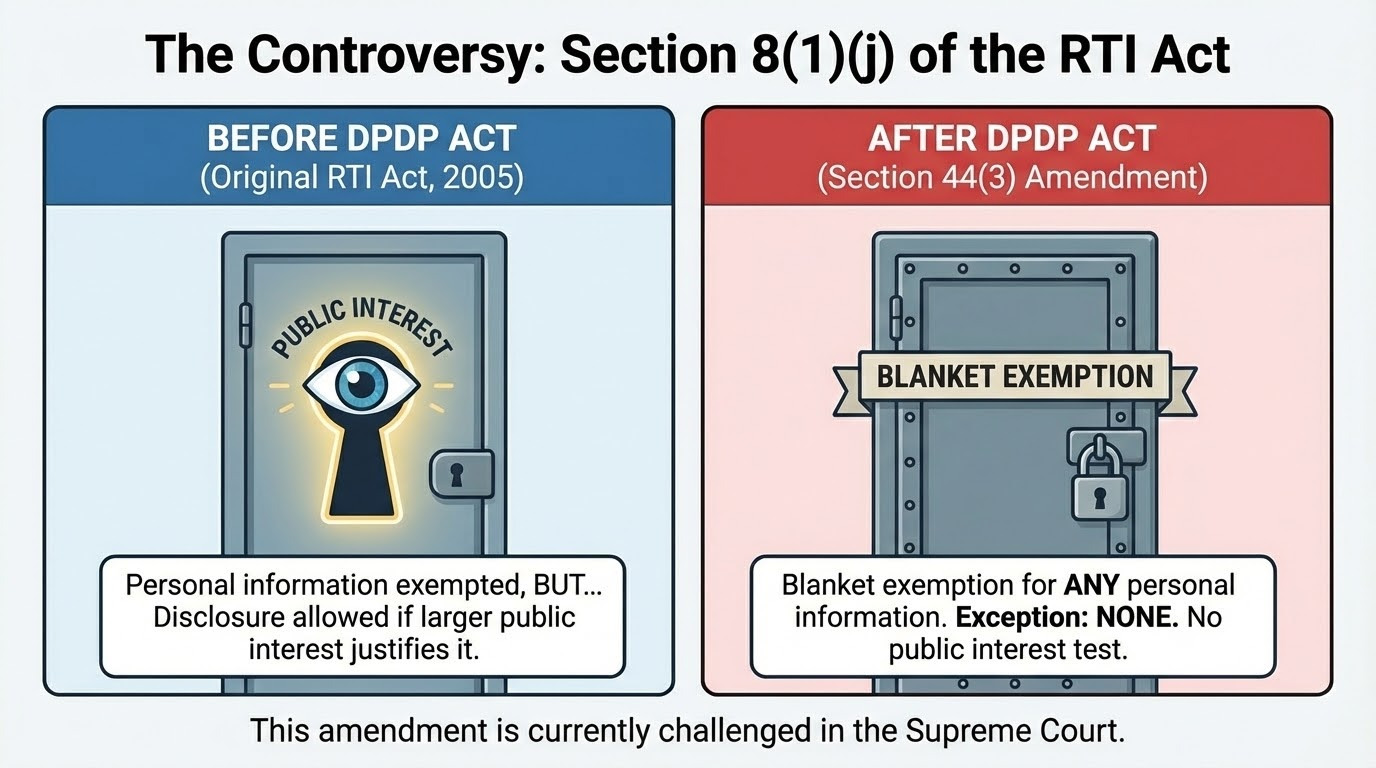
Original RTI Act (Section 8(1)(j)) |
Amended by DPDP Act (2023) |
|
|
Exemption Nature |
Qualified Exemption: Personal information could be denied unless its disclosure served a larger public interest. |
Blanket Exemption: All "information which relates to personal information" is now exempt from disclosure. |
|
The "Proviso" |
Contained a crucial safeguard: Information that cannot be denied to Parliament or a State Legislature cannot be denied to a citizen. |
This Proviso has been deleted, removing a key check on official secrecy. |
|
Public Interest Test |
The Public Information Officer (PIO) had the power to weigh if public interest in disclosure overrode privacy concerns. |
This test has been removed. The PIO no longer has the discretion to release personal information based on public interest. |
What are the Implications of the "Blanket Exemption" of Personal Information under DPDP Act?
Shielding Corruption and Reducing Accountability
Creating Opacity in Public Procurement and Funds
Eroding Social Audit Mechanisms
What is the Government’s Argument about "Blanket Exemption" of Personal Information under DPDP Act?
Harmonization with Puttaswamy Judgment: Government claims the change is necessary to align the RTI Act with the fundamental right to privacy and prevent misuse of personal data of officials.
Continued Existence of Section 8(2): Officials argue that Section 8(2) of the RTI Act still allows for disclosure if the public interest outweighs the harm.
Way Forward
Narrowly Define "Personal Information": The definition must be clarified to exclude information related to public duties, government expenditure, and official functions.
Restore the Public Interest Test: The Supreme Court could "read down" the amendment to reinstate the PIO's discretionary power to disclose information when a larger public interest is at stake.
Uphold the S.P. Gupta Principle: The judiciary should be guided by the S.P. Gupta vs Union of India (1981) case, which held that citizens, as the masters in a democracy, have a right to know how their government operates.
Learn from Global Best Practices: Balancing Privacy and Access
Conclusion
The central conflict in the dispute is the tension between state accountability and citizen privacy in a modern democracy. A data protection law should primarily focus on protecting citizens from state surveillance, not on shielding the state from citizen oversight.
Source: THEHINDU
|
PRACTICE QUESTION Q. "The Right to Privacy and the Right to Information are two sides of the same coin in a democracy, yet often find themselves in conflict." Critically Analyze. 150 words |
The main conflict lies in the amendment of Section 8(1)(j) of the RTI Act. Previously, personal information could be disclosed if it served a larger public interest. The DPDP Act changes this to a "blanket exemption," meaning any personal information can be denied without considering public interest.
The government argues that Section 8(2) of the RTI Act still allows disclosure if public interest outweighs protected interests. However, legal experts argue that the specific removal of the public interest test from Section 8(1)(j) makes it much harder for officials to invoke Section 8(2).
The Committee recommended that if there is a conflict between data protection and the Right to Information, the RTI Act should prevail, especially in matters involving public interest. The final DPDP Act went against this recommendation.



© 2026 iasgyan. All right reserved