The NAMASTE Scheme aims to eliminate hazardous manual scavenging through mechanization, empowering workers as ‘Sanipreneurs’ with financial and health support. However, legal gaps, subcontracting issues, and weak implementation hinder progress, requiring stronger accountability and recognition of sanitation workers as dignified professionals.
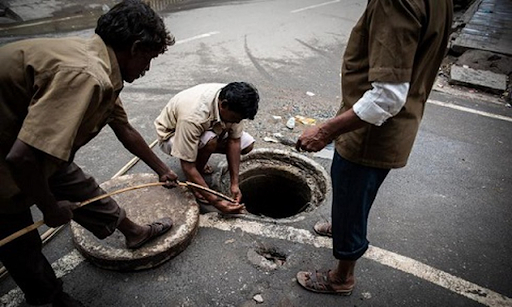
Copyright infringement not intended
Picture Courtesy: ddindia
Context
The Minister of State for Social Justice and Empowerment stated that 89,114 Sewer and Septic Tank Workers (SSWs) were validated under the NAMASTE scheme as of December 31, 2025.
What is the NAMASTE Scheme?
The National Action for Mechanized Sanitation Ecosystem (NAMASTE) scheme designed to eradicate hazardous cleaning of sewers and septic tanks, prevent fatalities of sanitation workers, and provide them with dignified, alternative livelihoods.
It replaces the previous Self-Employment Scheme for the Rehabilitation of Manual Scavengers (SRMS).
The scheme is a joint initiative of the Ministry of Social Justice and Empowerment (MoSJE) and the Ministry of Housing and Urban Affairs (MoHUA).
Significance of the NAMASTE Scheme
Eradicating Fatalities and Health Hazards
Workers are exposed to toxic gases like hydrogen sulfide and methane, leading to asphyxiation, disease, and death.
Breaking the Caste-Occupation Nexus
Manual scavenging has historically been a caste-based occupation forced upon marginalized Dalit communities.
Enforcing Supreme Court Directives: In the Safai Karamchari Andolan vs Union of India case (2023), the Supreme Court mandated the complete eradication of hazardous cleaning and increased the compensation for sewer deaths from ₹10 lakh to ₹30 lakh.
Core Interventions of the Scheme
Profiling and Formalization
The scheme aims to create a national database by digitally profiling all Sewer and Septic Tank Workers (SSWs) across more than 4,800 Urban Local Bodies (ULBs).
Capital Subsidies for 'Sanipreneurs': It empowers workers by providing an upfront capital subsidy of up to ₹5 lakh and interest subvention to procure mechanized cleaning equipment.
Comprehensive Welfare Net: All identified SSWs and their families are covered under the Ayushman Bharat Pradhan Mantri Jan Arogya Yojana (AB-PMJAY), providing them with a health insurance safety net.
Expansion to Waste Pickers: The scheme's scope was expanded in 2024 to include waste pickers involved in Solid Waste Management.
Emergency Response Sanitation Units (ERSUs): ERSUs are being established at the municipal level. These are professionally equipped units that respond to sanitation emergencies, ensuring that only trained personnel with proper machinery handle hazardous cleaning tasks.
|
Case Study: The 'Bandicoot' Robot
|
Implementation Challenges
Legal Loophole of "Hazardous Cleaning"
The government reports zero deaths using PEMSR (Prohibition of Employment as Manual Scavengers and their Rehabilitation) Act 2013 definition, but fatalities during “hazardous cleaning” persist, creating gaps in recognition, compensation, and rehabilitation of manual scavengers.
Sub-contracting and Lack of Accountability
ULBs frequently outsource sanitation work to unregulated private contractors who bypass safety protocols and force unequipped laborers into manholes to cut costs.
Financial Constraints of Municipalities
The scheme's budget is ₹349.73 crore (FY 2023-26). However, smaller Tier-2 and Tier-3 cities lack the matching funds needed to procure and maintain expensive mechanized equipment like jetting machines and robots.
Slow Pace of Welfare Distribution
A Parliamentary Standing Committee report noted that while digital profiling is progressing, the actual distribution of PPE kits and livelihood training remains alarmingly slow, leaving workers vulnerable.
Way Forward
Strict Enforcement: Invoking the PEMSR Act, 2013 to impose criminal liability on municipal officials and private contractors who violate safety protocols.
Dedicated Funding: The government should recommend tied grants for municipalities specifically for procuring and maintaining mechanized sanitation infrastructure.
Societal Shift: Promoting behavioral change to recognize sanitation workers as skilled professionals who are indispensable to India's public health and urban resilience.
Learn lessons from Global Best Practices
|
Country |
Model |
Key Learning for India |
|
Malaysia |
Indah Water Konsortium (IWK): A centralized, state-owned company managing 100% of the nation's desludging and wastewater treatment with full mechanization. |
Centralize sanitation accountability under a single municipal or state body instead of relying on fragmented and unaccountable private sub-contractors. |
|
Japan |
Johkasou System: Highly mechanized, decentralized on-site wastewater treatment units that require zero manual intervention for cleaning. |
Adopt decentralized, mechanized technology for peri-urban and rural areas where creating extensive underground sewerage networks is not feasible. |
Conclusion
The NAMASTE Scheme is a visionary step towards achieving Sustainable Development Goals (SDG) 3 (Good Health), 6 (Clean Water and Sanitation), 8 (Decent Work), and 10 (Reduced Inequalities). However, successful implementation requires more than just technology and subsidies.
Source: PIB
|
PRACTICE QUESTION Q. With reference to the NAMASTE Scheme, consider the following statements: 1. It replaces the Self-Employment Scheme for the Rehabilitation of Manual Scavengers (SRMS). 2. It provides capital subsidies to sanitation workers to procure mechanized cleaning vehicles. 3. It aims to completely digitize the profiling of Sewer and Septic Tank Workers across India. Which of the statements given above are correct? a) 1 and 2 only b) 2 and 3 only c) 1 and 3 only d) 1, 2, and 3 Answer: d Explanation: Statement 1 is correct: The NAMASTE (National Action for Mechanised Sanitation Ecosystem) scheme has replaced/subsumed the Self-Employment Scheme for the Rehabilitation of Manual Scavengers (SRMS). Statement 2 is correct: One of the core components of the scheme is providing an upfront capital subsidy to sanitation workers (often referred to as "Sanipreneurs") to help them procure mechanized cleaning vehicles and equipment. Statement 3 is correct: The scheme aims to digitally profile Sewer and Septic Tank Workers (SSWs) across India to ensure they are identified and validated to receive benefits like health insurance and training. |
NAMASTE stands for National Action for Mechanized Sanitation Ecosystem. Its primary objective is to achieve zero sanitation fatalities and eliminate hazardous manual scavenging by enforcing 100% mechanization of sewer and septic tank cleaning operations.
The scheme offers capital subsidies up to ₹5 lakh and interest subventions, enabling sanitation workers to purchase mechanized cleaning vehicles (like desludging machines) and transition from vulnerable daily wage laborers to independent "Sanipreneurs."
ERSUs are specialized municipal-level units mandated by the NAMASTE scheme. They are designed to deploy skilled teams and mechanized equipment for any sanitation emergency, strictly prohibiting untrained individuals from entering sewers.


© 2026 iasgyan. All right reserved