After Article 370’s abrogation, Ladakh faces demands for statehood, Sixth Schedule status, and greater representation due to governance and identity concerns. A balanced solution lies in Article 371 protections and stronger devolution to Hill Councils while addressing strategic and administrative challenges.
Copyright infringement not intended
Picture Courtesy: THEHINDU
Context
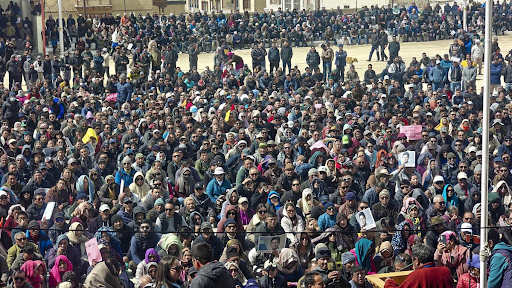
Protest rallies organised in Leh and Kargil to demand full statehood for Ladakh and its inclusion in the Sixth Schedule of the Constitution to protect local land, jobs, and tribal identity.
|
Read all about: LADAKH DEMANDS FOR STATEHOOD AND SIXTH SCHEDULE l HIGH-POWERED LADAKH COMMITTEE |
Ladakh's Demand for Statehood & Sixth Schedule Status
Protests have intensified in Leh and Kargil, jointly organised by the Leh Apex Body (LAB) and the Kargil Democratic Alliance (KDA).
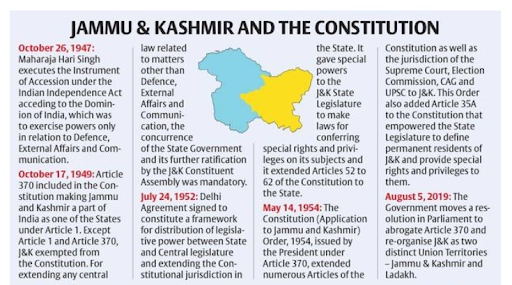
The core demands aim to secure Ladakh's unique identity, democratic rights, and control over its resources following its reorganisation as a Union Territory without a legislature in 2019.
Core Demands of the Protestors
Rationale Behind the Demands
The demands are rooted in concerns over political representation, cultural preservation, economic opportunities, and ecological fragility.
Restoring Democratic Representation
Safeguarding Tribal Identity and Resources:
Ensuring Economic Autonomy and Jobs
Strengthening National Security through Local Trust
What is Sixth Schedule?
The Sixth Schedule, under Article 244(2) of the Constitution, provides a framework for the administration of tribal areas with significant autonomy.
It currently applies to specific regions in Assam, Meghalaya, Tripura, and Mizoram.
|
Feature |
Details |
|
|
|
Legislative Powers |
ADCs can make laws on subjects like land, forests, water, inheritance, marriage, and social customs. All laws require the Governor's assent. |
|
Judicial Powers |
ADCs can establish Village Courts to adjudicate disputes between tribes based on customary laws. |
|
Financial Autonomy |
Councils can collect land revenue, impose specified taxes, and regulate money-lending and trading by non-tribals. |
|
Immunity from Legislation |
Acts of Parliament or State Legislature may not apply to these autonomous areas, or may apply only with modifications specified by the President or Governor. |
What are the Arguments Against the Demands?
Strategic and Security Risks
As a "buffer zone" with disputed borders with China and Pakistan, direct central administration ensures a clear chain of command.
Constitutional and Legal Hurdles
The Sixth Schedule was specifically designed for tribal areas in the Northeast. Extending it to Ladakh would require a Constitutional Amendment.
Administrative and Economic Viability
With a small population of approximately 3 lakh, establishing a full state apparatus (including a High Court, PSC, and extensive bureaucracy) is considered economically unviable and administratively inefficient.
Intra-Regional Diversity
There are concerns that statehood could heighten political and identity-based differences between the Buddhist-majority Leh district and the Muslim-majority Kargil district, potentially leading to governance challenges.
What is the Way Forward?
A balanced approach is needed to address Ladakh's unique governance needs while considering national Security concerns.
Empowering Existing Councils: Strengthen the legislative, executive, and financial authority of the Ladakh Autonomous Hill Development Councils (LAHDC) in Leh and Kargil.
Hybrid Governance Model: Explore a customized constitutional framework, through a dedicated Act under Article 240 or provisions similar to Article 371.
Institutionalised Dialogue: Maintain a permanent consultation forum involving the Leh Apex Body (LAB), Kargil Democratic Alliance (KDA), and the Ministry of Home Affairs (MHA).
Economic and Employment Safeguards: To address high youth unemployment, establish a separate Ladakh Public Service Commission (LPSC) to ensure domicile-based recruitment.
Environmental Protection: Enact a "Ladakh Cultural and Ecological Protection Act" to give local communities a voice in large-scale infrastructure and mining projects that threaten the region's fragile "cold desert" ecosystem.
Balancing Security and Autonomy: While the Centre favors Union Territory status for tighter security control, experts argue that empowered local populations are equally crucial for strengthening long-term national security in sensitive border regions.
Conclusion
The situation in Ladakh demands a balanced approach that reconciles democratic aspirations and cultural identity with national security, ensuring local empowerment alongside administrative efficiency and strategic stability.
Source: THEHINDU
|
PRACTICE QUESTION Q. Examine the constitutional and administrative challenges associated with granting full statehood to regions with small populations and high strategic vulnerability. 150 words |
Ladakh is demanding statehood to overcome a "representation deficit." Prior to August 2019, it sent elected MLAs to the Jammu & Kashmir legislature. Since becoming a Union Territory without a legislature, it is governed by unelected bureaucrats. Locals believe statehood will restore grassroots democracy and provide elected representation.
Enshrined in Article 244(2), the Sixth Schedule protects tribal populations by allowing the creation of Autonomous District Councils (ADCs). These councils have significant legislative, judicial, and administrative autonomy over local land, forests, agriculture, and social customs. It currently applies to Assam, Meghalaya, Tripura, and Mizoram.
The Centre cites three primary hurdles: 1) Strategic security risks, as Ladakh shares highly militarized borders with China and Pakistan, requiring swift military-civil coordination; 2) Constitutional hurdles, as extending a Northeast-specific provision might trigger similar demands in central India; and 3) Fiscal unviability, as Ladakh has a small population and a restricted tax base to support a full state apparatus.


© 2026 iasgyan. All right reserved