D.R. Kaprekar was an independent Indian mathematician and schoolteacher who discovered mathematical marvels like the 6174 constant, Kaprekar numbers, and Harshad numbers. Despite lacking institutional backing, his recreational mathematics discoveries hold significant modern applications in computer algorithms.
Why In News?
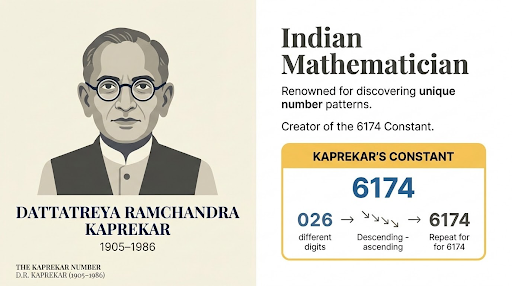
Dattatreya Ramchandra Kaprekar (1905–1986) was an Indian mathematician who discovered several number patterns.
About DATTATREYA RAMCHANDRA KAPREKAR (1905–1986)
Personal Background
Major Mathematical Contributions
Kaprekar's Constant (6174): Discovered in 1955 . It applies to four-digit numbers (where at least two digits are different).
Note: He also discovered a similar constant for three-digit numbers, which is 495.
Kaprekar Numbers: A positive integer is a "Kaprekar Number" if the digits of its square can be split into two parts that add up to the original number.
Self Numbers (Devlali Numbers): Kaprekar defined Self Numbers as integers that cannot be generated by adding any other integer to the sum of its own digits.
Harshad Numbers: Kaprekar named these numbers from the Sanskrit words harsha (joy) and da (give), meaning "joy-giver". These are numbers divisible by the sum of their own digits.
Demlo Numbers: Named after a train station called Demlo (now Dombivili) where he conceived the idea, these feature numbers like 1, 121, 12321, which are squares of repunits (1, 11, 111, etc.).
Global Recognition
Significance and Modern Applications
Source: TIMESOFINDIA
|
PRACTICE QUESTION Q. Consider the following statements regarding the Indian mathematician Dattatreya Ramchandra Kaprekar: 1. He discovered the constant 6174, which acts as a fixed point for four-digit numbers under a specific subtraction routine. 2. His research was funded by the Indian academic establishment, and he held a PhD from the University of Mumbai. Which of the statements given above is/are correct? A) 1 only B) 2 only C) Both 1 and 2 D) Neither 1 nor 2 Answer: A) 1 only. Explanation: Statement 1 is Correct: Dattatreya Ramchandra Kaprekar discovered the constant 6174 in 1949. It is known as a fixed point or "attractor" because applying a specific subtraction routine (Kaprekar's routine) to any four-digit number (with at least two distinct digits) will eventually converge to 6174 and repeat indefinitely. Statement 2 is Incorrect: Kaprekar was largely a self-taught recreational mathematician. He worked as a school teacher in Devlali, Maharashtra, and did not hold a PhD. |
D.R. Kaprekar (1905–1986) was an Indian mathematician and school teacher from Devlali, Maharashtra, known for his discoveries in recreational mathematics despite lacking formal postgraduate training.
Kaprekar's Constant refers to the number 6174. If you take any four-digit number with at least two distinct digits, arrange them in descending and ascending order, and subtract the smaller from the larger repeatedly, you will always reach 6174 within seven steps.
Defined by Kaprekar, Harshad numbers (or Niven numbers) are integers that are divisible by the sum of their digits. The name comes from Sanskrit meaning "joy-giver".




© 2026 iasgyan. All right reserved