The Baiga tribe faces severe contemporary challenges today. They suffer from forced land displacement due to mining and conservation projects detailed in the sources. Poverty, low literacy, and malnutrition make them highly vulnerable to child trafficking and bonded labor
Thirteen Baiga tribal children were rescued from forced labor in Chhattisgarh's Kabirdham district.
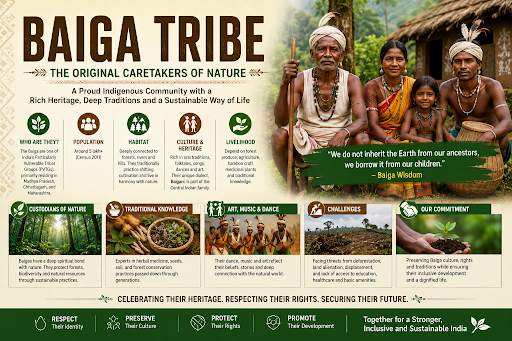
The Baiga tribe belongs to the highly marginalized Particularly Vulnerable Tribal Groups (PVTGs) in central India.
They inhabit the remote Satpura and Maikal hills across Madhya Pradesh (especially the Baiga-chuk region), Chhattisgarh, Uttar Pradesh, and Jharkhand.
They speak Baigani, an Indo-Aryan language that features influences from Gondi and Chhattisgarhi, while also using Hindi to communicate with outsiders.
The name Baiga translates to sorcerer or medicine man, highlighting their traditional role as spiritual guides and healers.
The community divides itself into specific sub-castes, including Bijhwar, Narotia, Bharotiya, Nahar, Rai Bhaina, and Kath Bhaina.
Economy & Livelihood
Baigas practice a traditional form of shifting cultivation known as Bewar or Dahiya on mountain slopes.
They strictly avoid using a plough because they believe ploughing scratches the breast of Mother Earth, treating it as a grave sin.
They sustain their families primarily by gathering minor forest produce, hunting small game, and fishing.
They trade forest products like honey, bamboo crafts, and medicinal herbs in weekly village markets to buy essential goods like salt and spices.
Culture & Society
Baiga women adorn their bodies with elaborate Godna (tattoos), believing these marks signify their cultural identity and uniquely accompany them into the afterlife.
They consume a staple diet of coarse grains like Kodo millet and Kutki, drink Pej (a liquid made from rice or maize), and heavily consume Mahua liquor as a traditional intoxicant.
They celebrate community festivals with folk dances like Karma, Dadaria, and Vilma Nach to the beat of Mandar drums.
They socially accept live-in relationships and follow a reverse dowry marriage system, where the groom compensates the bride's family with money or liquor.
They maintain strict social boundaries, historically viewing interaction with other tribes like the Gonds as a crime, and they abandon their house to build a new one immediately after a family member dies.
Current Issues & Challenges
Government bans on traditional shifting cultivation force the tribe to abandon their age-old practices, leading to massive livelihood losses and food insecurity.
Conservation projects (such as the Kanha Tiger Reserve) force Baiga families out of the forests, displacing them from their ancestral lands.
Human traffickers target their isolated communities. Authorities recently rescued 13 Baiga children forced into hazardous bonded labor in cattle-rearing units in Chhattisgarh.
They suffer from acute health and educational backwardness, facing severe malnutrition, high infant mortality, and an extremely low literacy rate of 40.6%.
Government Schemes
Chhattisgarh granted Habitat Rights to the Baiga PVTG (making them the second tribe in the state to receive this after the Kamar tribe).
The government grants forest rights under Section 3(1)(e) of the Forest Rights Act (FRA) 2006 to empower the community to govern their traditional territory, socio-cultural practices, and ecological knowledge.
The Union Cabinet launched the PM JANMAN (Pradhan Mantri Janjati Adivasi Nyaya Maha Abhiyan) to saturate PVTG habitations with safe housing, clean water, healthcare, and education by adopting a localized, tola-based (habitation) approach.
At state level the Baiga Development Agency (BDA) implements and coordinates tailored housing, skills training, and health interventions for the community.
Source: TIMESOFINDIA
|
PRACTICE QUESTION Q. Consider the following statements regarding the Baiga tribe:
Which of the statements given above are correct? A) 1 and 2 only B) 1 and 3 only C) 2 and 3 only D) 1, 2, and 3 Answer: B Explanation: Statement 1 is Correct: The Baiga tribe is officially recognized as one of the Particularly Vulnerable Tribal Groups (PVTGs) by the Government of India. They are one of the 75 PVTGs identified across the country. Statement 2 is Incorrect: The Baiga tribe was the second PVTG in Chhattisgarh to receive habitat rights under the Forest Rights Act (FRA), 2006. The Kamar tribe was the first PVTG in the state to be granted these rights. Statement 3 is Correct: The Baigas traditionally practice a distinct form of shifting cultivation known as 'Bewar'. They do not plough the land because they believe it is a sin to scratch the breast of Mother Earth; instead, they use slash-and-burn techniques. |
The Baiga tribe is an ethnic group in central India, designated as a Particularly Vulnerable Tribal Group (PVTG). The name translates to "sorcerer" or "medicine man," reflecting their traditional role as healers and spiritual guides.
They primarily inhabit Madhya Pradesh (especially the Baiga-chuk region) and Chhattisgarh (Kawardha and Bilaspur districts), with smaller populations scattered across Uttar Pradesh, Jharkhand, and Odisha.
Bewar is a traditional form of shifting (slash-and-burn) agriculture practiced by the Baigas. They practice it because of a deep spiritual belief that plowing the land is a sin, as it would "scratch the breast of Mother Earth".



© 2026 iasgyan. All right reserved