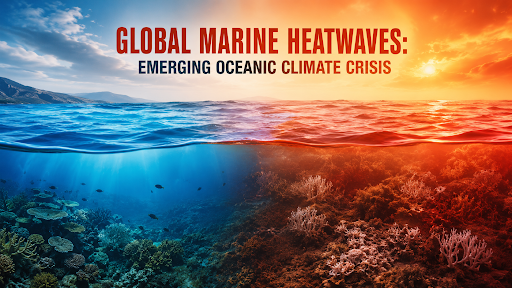
Scientists recently mapped 165,000 sq km of climate-resilient coral reefs globally and successfully bred adult corals for enhanced heat tolerance. These interventions, alongside drastic carbon emission cuts, are crucial for combating the 4th Global Coral Bleaching Event and saving marine ecosystems.
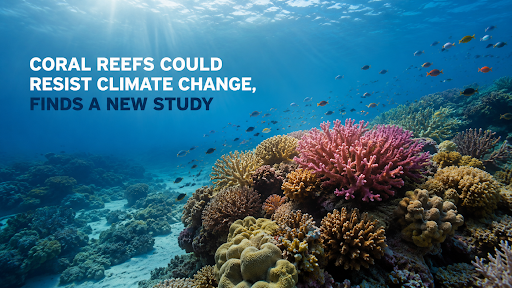
Researchers from the Wildlife Conservation Society (WCS) and Macquarie University, mapped approximately 166,000 square kilometres of climate-resilient coral reefs across 71 countries.
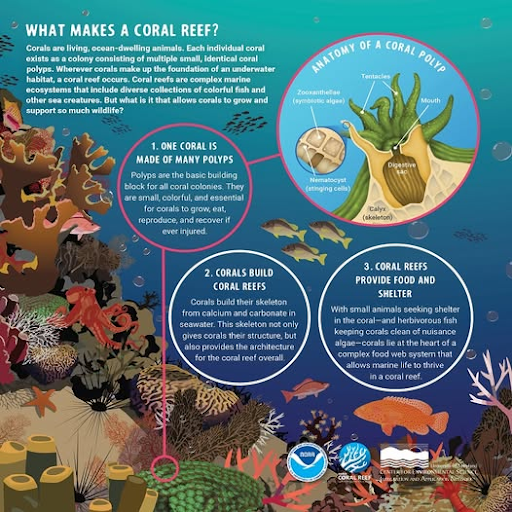
Biological Definition: Corals function as the "rainforests of the sea," occupying less than 1% of the ocean floor while supporting 25% of all marine life.
Coral Polyps: These living marine invertebrates extract calcium from seawater to secrete calcium carbonate (CaCO3) skeletons, forming massive limestone structures.
Symbiotic Relationship: Coral polyps maintain a mutualistic bond with zooxanthellae (microscopic algae). These algae provide up to 90% of the coral's energy through photosynthesis, while the coral provides essential nutrients and structural shelter.
|
Coral Reefs in India Gulf of Kachchh: This region maintains resilience despite high salinity and intense environmental stress. Gulf of Mannar: This biosphere reserve anchors the ecological stability of the southeastern coastline. Lakshadweep Islands: These pristine atolls provide essential coastal protection but face severe threats from El Niño-induced heatwaves. Andaman and Nicobar Islands: These archipelagos host untouched fringing reefs, serving as the primary focus for the National Coral Reef Research Institute (NCRRI). |
Importance of Coral Reefs
Marine Biodiversity: Reefs serve as vital nursery grounds for commercial fish species and act as a "medicinal treasure chest" for pharmaceutical discovery.
Coastal Protection: Reefs function as natural breakwaters, absorbing wave energy to mitigate storm damage. In the United States, they provide $2.6 billion in annual property flood protection benefits.
Economic Value: Nearly one billion people depend on reefs for food security. Furthermore, reefs generate over $3.4 billion annually for the U.S. economy alone.
Climate Change: The 4th Global Coral Bleaching Event exposes reefs to lethal heat stress levels between 12 to 20 Degree-Heating Weeks (DHWs).
Ocean Warming: Rising temperatures force corals to expel their zooxanthellae, leading to mass starvation, reproductive failure, and diseases like dark spot syndrome.
Ocean Acidification: Increased CO2 absorption lowers water pH, impairing the ability of polyps to build and repair their CaCO3 skeletons.
Pollution and Overfishing: Agricultural runoff and microplastics poison microbial communities, while the removal of herbivorous fish allows aggressive macroalgae to smother reefs.
Thermal Stress: When water temperatures rise by 1-2°C, the fragile symbiosis between coral and algae fractures.
Ecological Collapse: Bleached corals turn stark white and lose their primary energy source. Annual bleaching rates exceeding 7.9% trigger irreversible global degradation.
Bacterial Infections: Stressed corals become highly susceptible to lethal pathogens, including the Vibrionaceae family.
Resilience Mapping: A study by the Wildlife Conservation Society (WCS) and Macquarie University identifies 166,000 sq km of "climate-resilient" reefs across 71 countries, tripling previous survival estimates.
Assisted Evolution: Newcastle University researchers demonstrate that selective breeding increases heat tolerance by approximately 1°C-week in a single generation.
Symbiont Shuffling: Corals naturally adapt by shifting their internal algae populations from heat-sensitive Cladocopium species to heat-tolerant Durusdinium or Breviolum species.
Genetic Variance: Corals with high standing genetic variance (V=0.1) exhibit superior natural adaptation to warming trends.
Emission Mitigation: Securing the SSP1-2.6 low-emission pathway remains the absolute prerequisite for long-term reef survival.
Expanding Protection: Integrate the newly identified resilient reefs into national Marine Protected Area (MPA) networks to meet 30x30 conservation targets.
Advanced Restoration: Shift from simple outplanting to assisted evolution and Biorock technology to rebuild reef architecture.
Genetic Preservation: Prioritize the protection of standing genetic variance to maximize the natural evolutionary rescue of wild populations.
While mapping resilient refugia and breeding heat-tolerant corals are essential, they cannot replace immediate carbon emission reductions. To prevent total ecosystem collapse, nations must safeguard genetic diversity and legally protect resilient zones.
Source: NYTIMES
|
PRACTICE QUESTION Q. Which of the following best describes the ecological concept of a "Climate Refugia" in the context of global coral reefs? A) Artificial laboratories where scientists utilize genetic engineering to breed coral offspring. B) Specific marine areas that experience lower thermal stress or host genetically resilient species. C) Offshore regions dominated by macroalgae that permanently replace dead coral ecosystems. D) Mineral accretion zones created using Biorock technology to artificially restore structural reef boundaries. Answer: B Explanation: In the context of global coral reefs, climate refugia are localized marine areas or habitats that remain buffered from the harsh effects of climate change—such as ocean warming and acidification. These havens experience lower thermal stress due to unique oceanographic features (like localized upwelling or cloud cover) or host coral species with a genetic predisposition to withstand temperature spikes. |
Coral reefs are massive, underwater structures built by colonies of tiny marine invertebrates called polyps that secrete calcium carbonate to form protective limestone skeletons.
Coral bleaching is triggered when prolonged spikes in ocean temperatures caused by global warming force stressed corals to expel their colorful, food-producing symbiotic zooxanthellae algae.
Corals adapt by shuffling their internal algae to host heat-tolerant Symbiodiniaceae strains, while scientists accelerate natural selection using laboratory-bred, climate-resilient super corals.
Reefs are vital because they shelter 25% of all marine life, protect coastlines from destructive storm surges, and sustain multi-billion-dollar global fishing and tourism industries.



© 2026 iasgyan. All right reserved