India urgently demands equitable climate finance to bridge massive adaptation funding gaps. While the NCQG targets $300 billion annually, developing nations require $5-6 trillion by 2030. Achieving global climate justice necessitates transparent, grant-based capital and eliminating protectionist green trade barriers.
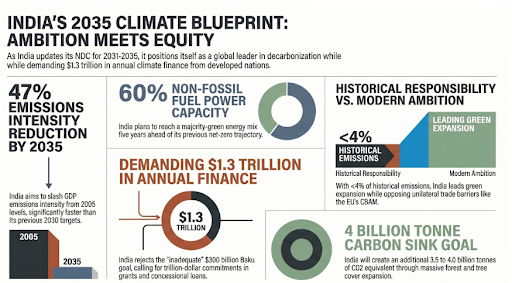
India demands dialogue on equitable climate finance and the widening adaptation funding gap at the Bonn Climate Meeting (SB64).
Climate finance refers to transnational, national, or local financing drawn from alternative, private, and public sources to support mitigation and adaptation actions against climate change.
Sources of Climate Finance
Agencies mobilize funds through Multilateral Development Banks (MDBs), sovereign wealth funds, green bonds, and specialized global entities like the Green Climate Fund (GCF).
Blended finance utilizes public or concessional capital to de-risk and attract massive private co-investments.
Public and Private Financing
Public financing provides essential concessionary grants and first-loss guarantees to shield poorer countries from high-interest commercial loans.
Private financing relies on market instruments like Sustainability-Linked Bonds to drive commercial low-carbon transitions.
Evolution of Climate Finance
UNFCCC Framework: The 1992 United Nations Framework Convention on Climate Change (UNFCCC) mandates developed countries to provide financial resources and technology to developing nations under Article 4.3.
Kyoto Protocol: The 1997 Kyoto Protocol linked loss and damage financing to the establishment of the Adaptation Fund to minimize the adverse impacts of climate change.
Paris Agreement: The 2015 Paris Agreement legally binds developed countries through Article 9.1 to provide financial resources for mitigation and adaptation.
Principle of Common but Differentiated Responsibilities
India anchors its climate policy in the Common But Differentiated Responsibilities and Respective Capabilities (CBDR-RC) principle, demanding that developed nations bear the primary financial burden.
Equity in Climate Action
India argues that the global carbon budget requires fair sharing, allowing developing nations the developmental space to eradicate poverty while pursuing sustainable development.
Historical Emissions Responsibility
Developed nations built their economies via high industrial emissions; therefore, they hold a moral and legal duty to fund green transitions in the Global South.
Funding Gap
India faces a massive climate financing gap, requiring $2.5 trillion by 2030 to meet its Nationally Determined Contributions (NDCs) and $10.1 trillion to reach Net Zero by 2070.
Accessibility of Funds
India calls for simplified administrative access criteria for institutional green funds like the Green Climate Fund (GCF) to assist vulnerable nations promptly.
Adaptation Financing
The United Nations estimates the adaptation finance gap is 10 to 18 times larger than current international public financial flows. India demands dedicated adaptation funding to protect coastal and agricultural ecosystems.
Technology Transfer
Developing nations urgently need low-cost clean technologies, joint R&D, and waivers on intellectual property rights (IPR) to achieve meaningful mitigation.
|
New Collective Quantified Goal (NCQG) Adopted at COP29 in Baku (2024), the New Collective Quantified Goal (NCQG) requires developed countries to mobilize $300 billion annually by 2035, replacing the missed $100 billion Paris target. Expectations of Developing Countries India and the G77 criticize the 300 billion figure as "woefully inadequate. "Developing nations require 5 trillion to $6 trillion cumulatively by 2030 and expect a baseline of at least $1.3 trillion annually in grants. Challenges in Implementation Wealthy nations constantly resist placing financial transfer mandates prominently on the UNFCCC agenda and avoid strict, transparent delivery metrics. |
Insufficient Commitments
Developed nations systematically failed to deliver the promised $100 billion annually by 2020, destroying trust and creating a massive mitigation ambition gap.
Debt Burden
Currently, institutions disburse most climate finance as loans rather than grants, forcing poorer countries into extreme debt traps to recover from climate disasters.
Transparency Issues
The lack of a unified global Climate Finance Taxonomy leads to rampant greenwashing. In India, 83% of sustainable debt lacks a domestic legal verification standard, threatening market integrity.
Increased Contributions by Developed Countries
Developed nations must shift from vague pledges to transparent, grant-equivalent public capital transfers under the post-2025 NCQG framework.
Strengthening Multilateral Mechanisms
Global institutions must simplify funding processes. Domestically, India must enact Climate Finance Taxonomy and establish a State Climate Finance Facility to directly access green debt markets.
Climate Justice Framework
The international community must uphold Historical Climate Justice, challenge unilateral protectionist levies like the EU's Carbon Border Adjustment Mechanism (CBAM), and ensure equitable technology sharing.
To achieve global climate goals, developed nations must honor their historical responsibilities by delivering transparent, grant-based, and adequate climate finance to empower the developing world's sustainable transition.
Source: THEHINDU
|
PRACTICE QUESTION Q. Differentiate between Climate Mitigation and Climate Adaptation finance. Examine why adaptation financing remains severely underfunded globally despite escalating extreme weather events. 150 Words |
Climate finance refers to local, national, or transnational funding—drawn from public, private, and alternative sources—that is explicitly directed toward supporting climate change mitigation and adaptation actions globally.
The New Collective Quantified Goal (NCQG) is the new global climate finance target being negotiated to replace the outdated $100 billion annual commitment with a vastly scaled-up, needs-based financial framework post-2025.
India advocates for climate justice to ensure that developed nations bear the historical economic responsibility for global emissions, thereby shielding developing countries from unfair financial burdens while protecting their right to growth.
The primary bottlenecks include wealthy nations failing to meet promised funding targets, an over-reliance on debt-creating commercial loans rather than public grants, and a severe global shortage of funds dedicated specifically to climate adaptation.


© 2026 iasgyan. All right reserved