The Citizenship Amendment Act, 2019 fast-tracks citizenship for select non-Muslim migrants. While projected as humanitarian, critics argue it violates Article 14, weakens secularism, clashes with the Assam Accord, and heightens fears of exclusion when linked with a nationwide NRC.
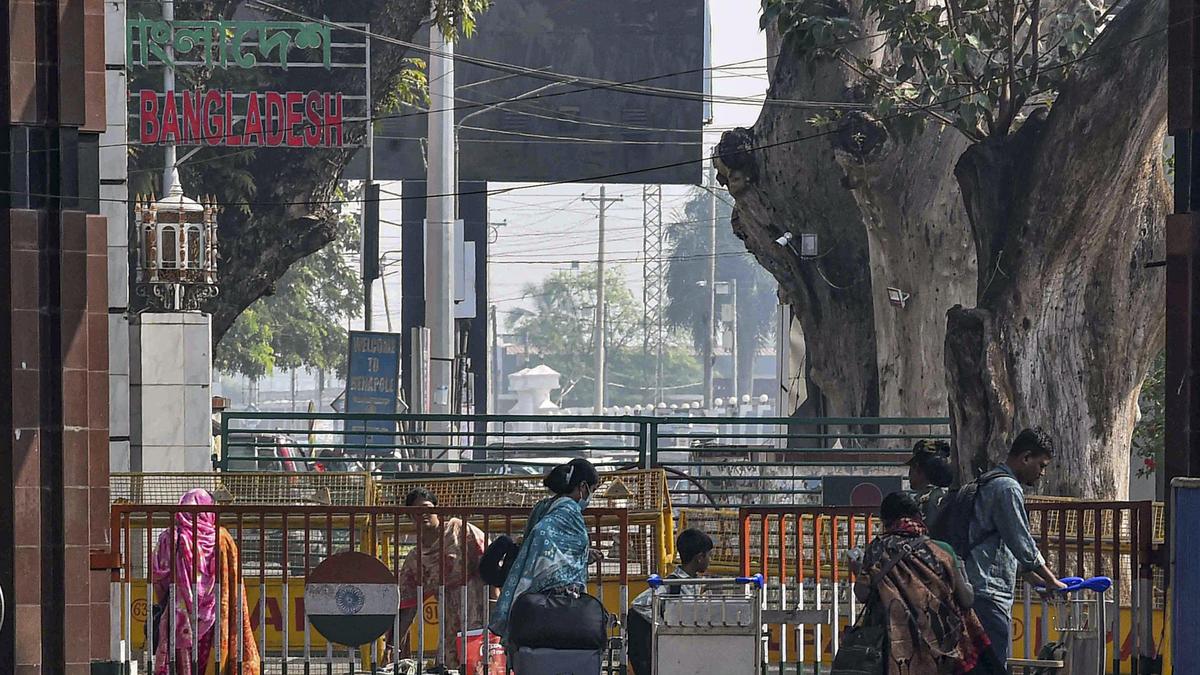
Copyright infringement not intended
Picture Courtesy: THE HINDU
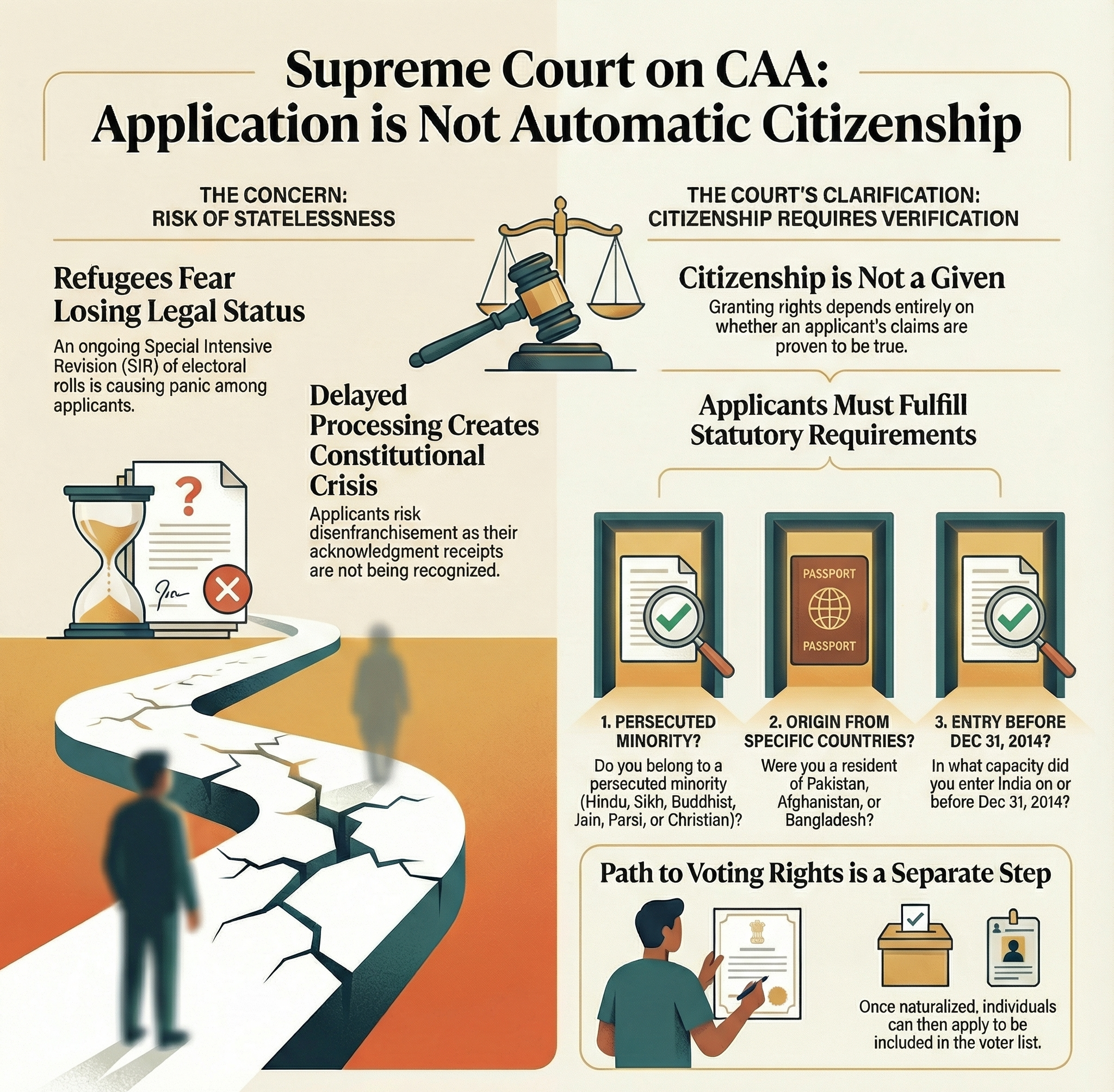
The Supreme Court ruled that Indian citizenship, under the Citizenship (Amendment) Act for self-proclaimed religious minorities fleeing persecution from Pakistan, Afghanistan, and Bangladesh, depends entirely on the verification of their claims.
The 2019 Act amends the Citizenship Act of 1955, to provide an expedited pathway to Indian citizenship for specific religious minorities who have faced persecution in the neighbouring countries.
Key Provisions of the Citizenship (Amendment) Act 2019
Eligible Communities: The Act applies to individuals belonging to Hindu, Sikh, Buddhist, Jain, Parsi, and Christian communities. It excludes Muslims.
Specified Countries: It is applicable only to migrants who have come from three specific neighbouring countries: Pakistan, Bangladesh, and Afghanistan.
Cut-off Date: The benefit of the Act is for those who entered India on or before December 31, 2014.
Exemption from Legal Proceedings: The Act protects the beneficiaries from legal proceedings under the Foreigners Act, 1946, and the Passport (Entry into India) Act, 1920. Upon receiving citizenship, any pending cases against them regarding illegal migration will be nullified.
Exceptions to Applicability: The provisions of the CAA do not apply to:
CAA's Amendment to the Citizenship Act, 1955
|
Provision |
Citizenship Act, 1955 |
Citizenship (Amendment) Act, 2019 |
|
Basis for Citizenship |
Citizenship primarily by birth (jus soli), descent, registration, or naturalisation. Religion was not a criterion. |
Introduces religion as a specific criterion for eligibility for a defined group of migrants. |
|
Residency for Naturalisation |
Required the applicant to have resided in India for at least 11 years out of the last 14 years. |
Reduces the residency requirement to 5 years for the six specified communities from the three specified countries. |
|
Status of Illegal Migrants |
An illegal migrant (as defined in the 1955 Act) could not apply for Indian citizenship. |
Makes illegal migrants from the specified communities and countries eligible for citizenship, provided they meet the criteria. |
Addressing Religious Persecution: Grant a dignified life to minorities who have faced religious persecution in neighbouring Islamic-majority countries.
Fulfilling Historical Obligation: India's moral duty towards minorities left in Pakistan and Bangladesh post-Partition, under the Liaquat-Nehru Pact of 1950 which was violated by those nations.
Violation of Article 14 (Right to Equality)
Critics argue the CAA is discriminatory, violating the right to equality for all "persons" by using religion as a basis for citizenship. They claim this "unreasonable classification" fails the Supreme Court's two-pronged test.
Undermining Secularism
Opponents argue the Act, by linking citizenship to religion, violates the Constitution's secular "basic structure" (from the Kesavananda Bharati case, 1973) and deviates from foundational ethos.
Exclusion of Other Persecuted Groups
The law's selectivity is criticized for omitting other persecuted groups from neighboring countries, notably Rohingya Muslims from Myanmar and Tamil Hindus from Sri Lanka, a concern also raised by the UNHCR.
Fears over a Nationwide NRC
Concerns exist that the CAA, paired with a potential nationwide National Register of Citizens (NRC), could target undocumented Muslims. Non-Muslims excluded from the NRC could use the CAA as a safety net, an option denied to Muslims.
Contradiction with the Assam Accord (1985)
The CAA's cut-off date of December 31, 2014, is in direct conflict with the Assam Accord's cut-off date of March 24, 1971, as the Accord mandates the detection and deportation of all migrants who entered after the 1971 date, irrespective of religion.
Threat to Indigenous Identity
Regional groups are concerned that the CAA will legitimize many Bengali-speaking Hindu migrants from Bangladesh, thus changing the state's demographics and threatening the language, culture, and political power of indigenous communities.
Online Application: Applicants must submit their applications through a dedicated MHA portal: indiancitizenshiponline.nic.in.
Document Submission: Applicants must upload documents proving they are from Pakistan, Bangladesh, or Afghanistan, entered India on or before December 31, 2014, and provide a religious eligibility certificate from a local community institution.
Verification Process:
In December 2025, the Supreme court stated that CAA citizenship is not automatic; authorities must thoroughly verify each applicant's claim against statutory conditions. Rights like voting are acquired only after citizenship is formally conferred, not upon application.
 Conclusion
The Citizenship (Amendment) Act, 2019 (CAA) is viewed by the government as humanitarian aid for persecuted minorities but is criticized as unconstitutional and a threat to India's secularism, with its final constitutional validity now awaiting a decision by the Supreme Court.
Source: THE HINDU
|
PRACTICE QUESTION Q. With reference to the Citizenship (Amendment) Act, 2019, consider the following statements: 1. It grants eligibility for citizenship to individuals from six religious communities who have migrated from Pakistan, Bangladesh, and Sri Lanka. 2. The cut-off date for entry into India to be eligible under this Act is December 31, 2014. 3. The Act reduces the residency requirement for naturalisation from eleven years to five years for the specified communities. Which of the statements given above is/are correct? (a) 1 and 2 only (b) 2 and 3 only (c) 1 and 3 only (d) 1, 2 and 3 Answer: (b) Explanation: Statement 1 is incorrect: The Act covers six religious communities (Hindus, Sikhs, Buddhists, Jains, Parsis, and Christians) who migrated from Pakistan, Bangladesh, and Afghanistan. It does not include migrants from Sri Lanka. Statement 2 is correct: The Act grants eligibility for citizenship to individuals from the specified communities who entered India on or before December 31, 2014. Statement 3 is correct: The Act relaxes the residency requirement for naturalization for the specified communities, reducing it from the standard eleven years to five years. |
The CAA is an amendment to the Indian Citizenship Act of 1955. It provides a fast-track route to Indian citizenship for undocumented migrants from six religious communities (Hindu, Sikh, Buddhist, Jain, Parsi, and Christian) who fled religious persecution from Pakistan, Bangladesh, and Afghanistan and entered India on or before December 31, 2014.
To be eligible, an applicant must belong to one of the six specified religious communities from the three specified countries and must have entered India on or before December 31, 2014. The Act also reduces their required period of residency in India for naturalisation from 11 years to 5 years.
Critics argue that by making religion a criterion for citizenship, the CAA violates Article 14 of the Constitution, which guarantees the right to equality to all "persons," not just citizens. Over 200 petitions in the Supreme Court contend that this classification is discriminatory as it excludes other persecuted minorities, like Rohingya Muslims from Myanmar.






© 2026 iasgyan. All right reserved