Growing at 18%, India’s $195.3B bioeconomy targets $1T by 2047. Success requires bridging funding gaps, streamlining regulations, and leveraging BioE3 policies. By evolving GCCs into R&D powerhouses and adopting public procurement mandates, India can lead global biotechnology and sustainable innovation.
Copyright infringement not intended
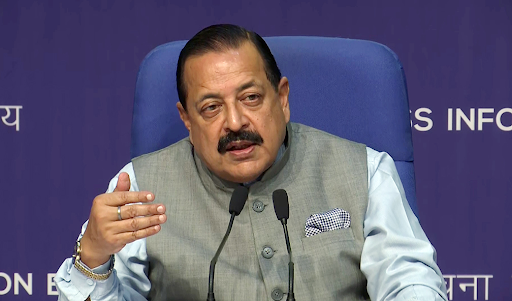
Picture Courtesy: DDNEWS
Why In News?
The Union Minister of Science and Technology said India’s bioeconomy has increased from around $10 billion in 2014 to over $195 billion in 2025.
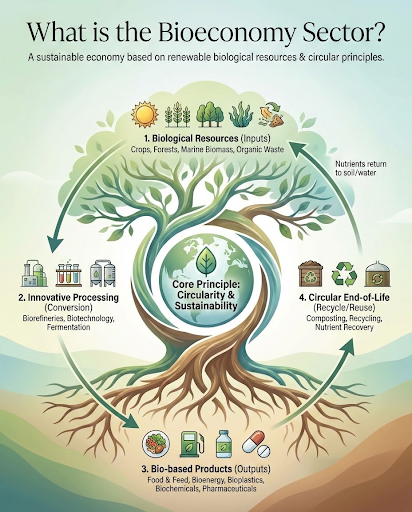
What is Bioeconomy Sector?
The bioeconomy sector refers to an economic model that utilizes renewable biological resources—such as plants, animals, microorganisms, and biomass—to produce food, energy, and sustainable industrial products.
It integrates biotechnology and bioengineering to create a circular economy, reducing reliance on fossil fuels
Current Status of India’s Bioeconomy
Exponential Financial Growth
The bioeconomy surged from $10 billion in 2014 to an estimated $195.3 billion in 2025, with an 18% annual growth rate in the past year. (Source: India BioEconomy Report)
|
Sectoral Contribution Breakdown |
|
|
Sector |
Market Value (2025) |
|
BioIndustrial |
$90.2 billion |
|
BioPharma |
$64.5 billion |
|
BioServices |
$26 billion |
|
BioAgri |
$14.6 billion |
Rising GDP Contribution
Its contribution to the national GDP has increased to 4.8%. India aims for a $300 billion bioeconomy by 2030 and a $1 trillion bioeconomy by 2047. (Source: India BioEconomy Report)
Robust Ecosystem
The country hosts over 11,855 registered biotech startups and more than 150 healthcare and life sciences Global Capability Centres (GCCs), employing over 300,000 professionals. (Source: India BioEconomy Report)
Importance of the Bioeconomy for India
Healthcare Accessibility
When major global drug patents expire, Indian firms can produce affordable biosimilars and peptides, enhancing access to life-saving medicines for its population and strengthening its position as the 'pharmacy of the world'.
Climate-Resilient Agriculture
The BioAgri sector is crucial for food security. Biotechnology helps develop climate-resilient crops and smart proteins, aligning with the recommendations of the M.S. Swaminathan Committee on Farmers to integrate technology for higher yields.
Industrial Sustainability
The large BioIndustrial segment promotes a shift from fossil fuels to biomanufacturing and bio-based chemicals, which is critical for meeting Net Zero emission targets by 2070.
High-Value Job Creation
By evolving Global Capability Centers (GCCs) from support centers to innovation hubs for bioinformatics and digital health, the sector creates specialized, high-income jobs, promoting a knowledge-based economy and reducing brain drain.
Key Policies to Support the Sector
Biotechnology Industry Research Assistance Council (BIRAC)
BIRAC plays a pivotal role by bridging the gap between academic research and commercial application. It offers targeted funding and mentorship to help startups scale up.
Other Supporting Policies
The BioE3 Policy: The 'Biotechnology for Economy, Environment, and Employment' policy aims to promote high-performance biomanufacturing in areas like precision biotherapeutics and carbon capture.
RDI Fund: A ₹1 lakh crore Research, Development, and Innovation (RDI) Fund was announced to provide long-term, interest-free capital to support deep-tech ventures with long gestation periods.
SIGHT Program: The Strategic Interventions for Green Hydrogen Transition program incentivizes electrolyzer manufacturing, which indirectly supports the infrastructure for the BioIndustrial sector.
Major Challenges Hindering Full Potential
High Capital Intensity & 'Valley of Death'
Biotech startups require significant, long-term investment. Many fail during late-stage clinical trials due to a lack of sustained venture capital, a phase known as the 'Valley of Death'.
Intellectual Property (IP) Barriers
Indian biosimilar manufacturers face challenges from "patent thickets" and litigation strategies employed by multinational corporations, which delay their entry into lucrative Western markets.
Regulatory Complexity
Advanced fields like gene editing require agile and clear regulatory frameworks. While guidelines exist (e.g., National Guidelines for Gene Therapy, 2019), navigating multi-agency approvals remains a bottleneck for startups.
Sectoral Imbalance
The BioAgri segment ($14.6 billion) is underdeveloped compared to the BioIndustrial segment ($90.2 billion), indicating slow adoption of biotechnology in traditional agriculture.
Way Forward
Strengthening the Bio-Manufacturing Ecosystem
Bio-Foundries and Hubs: Establishing integrated Bio-foundries and high-performance biomanufacturing hubs across Tier-2 and Tier-3 cities to decentralise production and reduce logistical costs.
Standardisation: Implementing global quality standards and harmonised regulatory frameworks for bio-based products to ensure they are competitive in international markets.
Boosting Research and Development (R&D)
Deep-Tech Financing: Effectively utilizing the ₹1 lakh crore RDI Fund to provide long-term, low-interest capital for high-risk, high-reward biotech ventures.
Public-Private Partnerships (PPP): Encouraging greater collaboration between academic institutions and private industries to accelerate the transition of lab-scale innovations to commercial products.
Sustainable Agriculture and Bio-Energy
Climate-Resilient Crops: Accelerating the development of genetically modified (GM) and gene-edited crops that are resistant to pests and climate-induced stress to ensure food security.
Advanced Biofuels: Moving beyond 1G ethanol to 2G and 3G biofuels produced from agricultural waste and algae to further reduce crude oil import dependency.
Human Capital and Skill Development
Specialised Training: Vocational and higher education programmes in synthetic biology, bioinformatics, and bioprocess engineering to bridge the current skill gap in high-end biotech.
Entrepreneurship Support: Expanding the reach of BIRAC’s incubation centres to provide mentorship and infrastructure to early-stage entrepreneurs in regional language hubs.
Policy and Public Awareness
Full Implementation of BioE3: Ensuring the swift execution of the BioE3 Policy to facilitate "green manufacturing" and regenerative economic models across all states.
Public Trust: Awareness campaigns to educate the public on the safety and benefits of bio-based products, such as bioplastics and fortified bio-crops.
Learn from Global Best Practices
Mandatory Public Procurement (USA): The US government's "BioPreferred Program" requires federal agencies to buy bio-based products.
Harmonized Regulatory Sandboxes (EU): The EU uses a "Regulators and Innovators’ Forum" to fast-track risk assessments for new products.
Conclusion
To reach a $1 trillion bioeconomy by 2047, India must bridge the startup 'Valley of Death' with dedicated funding, mandate green procurement, streamline regulations, and evolve its GCCs from back-office hubs into strategic R&D powerhouses while defending IP interests globally.
Source: DDNEWS
|
PRACTICE QUESTION Q. The transition to a bioeconomy is critical for India to achieve its Net Zero emission targets and ensure socio-economic development. Discuss. 150 words |
The BioIndustrial segment is the largest, valued at $90.2 billion. It is followed by the BioPharma segment at $64.5 billion, BioServices at $26 billion, and BioAgri at $14.6 billion.
The BioE3 (Biotechnology for Economy, Environment, and Employment) policy is a key government initiative promoting high-performance biomanufacturing. It drives innovation in precision biotherapeutics, bio-based chemicals, and carbon capture technologies.
The 'Valley of Death' refers to the critical phase in a startup's lifecycle where it runs out of funding. In biotech, this often occurs during expensive, late-stage clinical trials, leading to the collapse of the venture before the product reaches the market.


© 2026 iasgyan. All right reserved