Global Capability Centres have become a cornerstone of India’s modern growth strategy, evolving from low-cost support units into global hubs for innovation, engineering, and strategic functions. Supported by skilled talent, strong digital infrastructure, and enabling government policies, GCCs contribute significantly to high-value exports, quality employment, and technological advancement. Their expansion is deepening India’s integration into global value chains and reinforcing its position as a leading knowledge and innovation-driven economy.
Copyright infringement not intended
Picture Courtesy: PIB
Context:
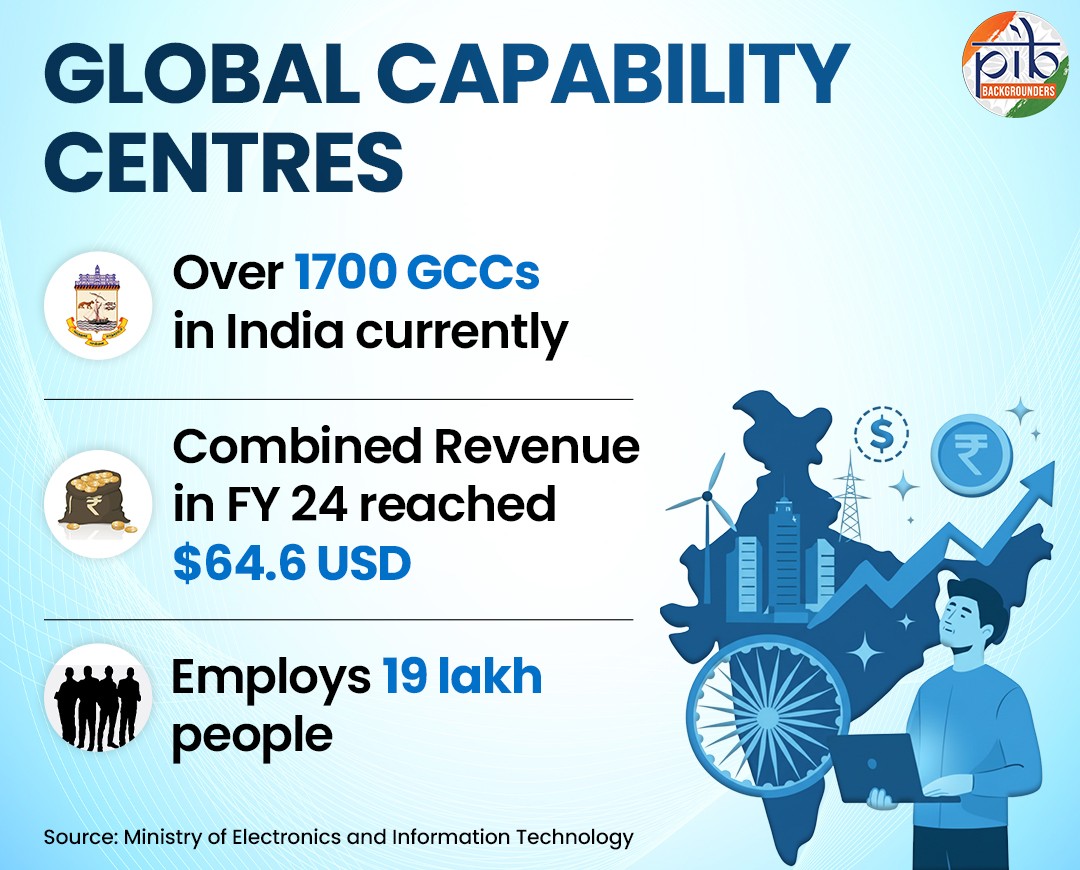
India is emerging as a central pillar in the global enterprise ecosystem as talent and technology converge through Global Capability Centres (GCCs). India hosts more than 1,700 GCCs, which together have become engines of digital transformation and enterprise innovation.
|
Must Read: GLOBAL CAPABILITY CENTRES (GCCS): EXPLAINED | |
What are Global Capability Centres?
Global Capability Centres are offshore entities established by multinational corporations to deliver specialised services to their parent organisations. These services span information technology, engineering research and development, analytics, customer experience management, and core business operations. Over time, GCCs have evolved into integral components of global corporate value chains, offering both operational efficiency and innovation-led growth.
Current Status of GCCs:
Importance of Global Capability Centres (GCCs) for India:
Engine of economic growth and export earnings: GCCs have emerged as a critical driver of India’s services-led growth and foreign exchange earnings. GCC revenues increased from USD 40.4 billion (FY19) to USD 64.6 billion (FY24), growing at nearly 10% CAGR. They are projected to touch USD 105 billion by 2030. This steady expansion strengthens India’s current account through high-value service exports, reducing dependence on volatile merchandise trade.
Employment generation and human capital upgradation: GCCs are among the largest creators of high-quality, knowledge-intensive jobs in India. Over 1.9 million professionals are currently employed in GCCs; employment is expected to rise to 2.8 million by 2030. Roles increasingly involve product architecture, system design, AI modelling, and global leadership rather than routine support functions.
Shift from back-office to innovation and R&D Hub: A key importance of GCCs lies in transforming India’s position in global value chains—from execution to innovation. Engineering and R&D-focused GCCs are growing 1.3 times faster than overall GCC growth.
Technological leadership: GCCs play a pivotal role in adopting and scaling frontier technologies. India contributes 28% of the global STEM workforce and 23% of global software engineering talent, making it a natural destination for technology-intensive GCCs.
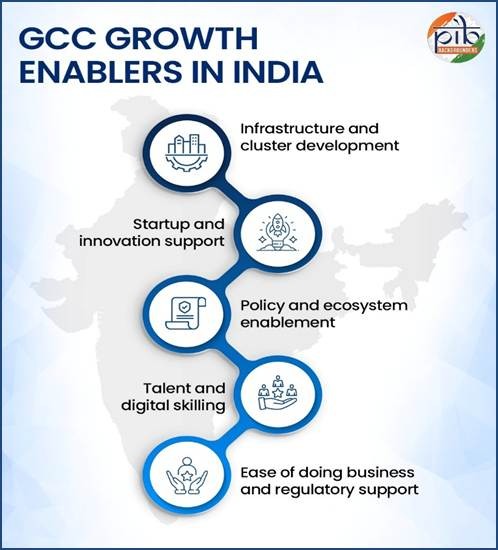
Government Initiatives for GCC growth in India:
Infrastructure and Cluster Development: To support large-scale technology and electronics ecosystems, the Government of India has focused on building plug-and-play industrial infrastructure.
The Modified Electronics Manufacturing Clusters (EMC) Scheme, implemented by the Ministry of Electronics and Information Technology (MeitY), aims to create globally competitive infrastructure for electronics and IT-based industries. By providing ready-built factory units and scalable plug-and-play facilities, the scheme enables GCCs to commence operations rapidly without high initial capital expenditure. This approach also encourages global manufacturers and their supply-chain partners to co-locate in India, strengthening industrial clustering and ecosystem efficiency.
Startup and Innovation Support: India’s GCC ecosystem is increasingly interlinked with its startup landscape, fostering innovation-driven collaboration.
The GENESIS (Gen-Next Support for Innovative Startups) programme, launched by MeitY with a financial outlay of ₹490 crore, focuses on nurturing technology startups in Tier-II and Tier-III cities. By expanding innovation beyond major metros, the programme builds a decentralised talent and idea pipeline for GCCs. It also promotes co-creation between startups and global enterprises, particularly in areas such as digital transformation, automation, and emerging technologies.
Policy and Ecosystem Enablement: A strong startup ecosystem acts as a critical support layer for GCC operations.
Through initiatives such as Startup India and DPIIT recognition, India has emerged as the world’s third-largest startup ecosystem, with over 1.97 lakh recognised startups. These enterprises supply GCCs with specialised solutions in AI, machine learning, cloud services, and digital platforms. Complemented by regulatory reforms and expanding digital public infrastructure, this environment enhances ease of collaboration between global firms and domestic innovators.
Digital Skilling: Human capital remains India’s strongest comparative advantage in the GCC landscape.
National programmes such as Skill India, Digital India, and Future Skills Prime—implemented jointly by MeitY and NASSCOM—are designed to equip the workforce with next-generation digital competencies. These initiatives focus on high-demand areas including cybersecurity, cloud computing, data analytics, artificial intelligence, and advanced engineering, ensuring a continuous supply of industry-ready professionals for GCCs.
Ease of Doing Business and Regulatory Support: India’s regulatory reforms have significantly improved its attractiveness for global enterprises.
Consistent progress in ease of doing business, coupled with liberalised FDI norms, has simplified the establishment and expansion of GCCs. Further support is provided through SEZ reforms, targeted tax incentives, and single-window clearance mechanisms, which reduce compliance burdens and operational delays. Together, these measures enhance investor confidence and support long-term GCC commitments in India.
Picture Courtesy: PIB
Conclusion:
Global Capability Centres have emerged as strategic pillars of India’s knowledge economy, evolving from cost-driven support units into global hubs for innovation, engineering, and decision-making. Backed by a skilled workforce, robust digital infrastructure, and supportive policy reforms, GCCs are strengthening India’s integration into global value chains while generating high-quality employment and technology-led growth. Their continued expansion positions India not merely as a service destination, but as a key architect of the global digital and innovation ecosystem.
Source: PIB
|
Practice Question With reference to Global Capability Centres (GCCs) in India, consider the following statements: 1. GCCs in India have evolved from primarily back-office support units to strategic hubs for research, innovation, and engineering design. 2. India hosts a significant share of the global STEM and software engineering workforce, which has contributed to the rapid expansion of GCCs. 3. Government initiatives such as Skill India and Digital India aim to provide digital skills exclusively for employees working in GCCs. Which of the statements given above is/are correct? A. 1 and 2 only Answer: A Explanation: · Statement 1 is correct: GCCs in India have transitioned into centres for R&D, innovation, and strategic functions. · Statement 2 is correct: India contributes a substantial proportion of the global STEM and software engineering talent, supporting GCC growth. · Statement 3 is incorrect: Skill India and Digital India are broad-based national programmes and are not limited exclusively to GCC employees. |
A Global Capability Centre is an offshore unit established by a multinational company to deliver specialised services such as IT, engineering R&D, analytics, finance, and customer operations for its global business. Unlike outsourcing vendors, GCCs function as an integral part of the parent organisation.
Traditional outsourcing focuses mainly on cost efficiency and routine tasks, whereas GCCs handle high-value activities such as product development, innovation, strategic planning, and global decision support.
India offers a large pool of skilled STEM talent, cost competitiveness, strong digital infrastructure, supportive government policies, and a vibrant startup ecosystem, making it an attractive location for global enterprises.






© 2026 iasgyan. All right reserved