India’s ‘Make in India’ defence initiative promotes self-reliance through indigenous production, achieving record outputs of ₹1.54 lakh crore in FY 2024-25. Despite soaring exports, overcoming critical technology dependencies and boosting R&D investments remain key challenges.
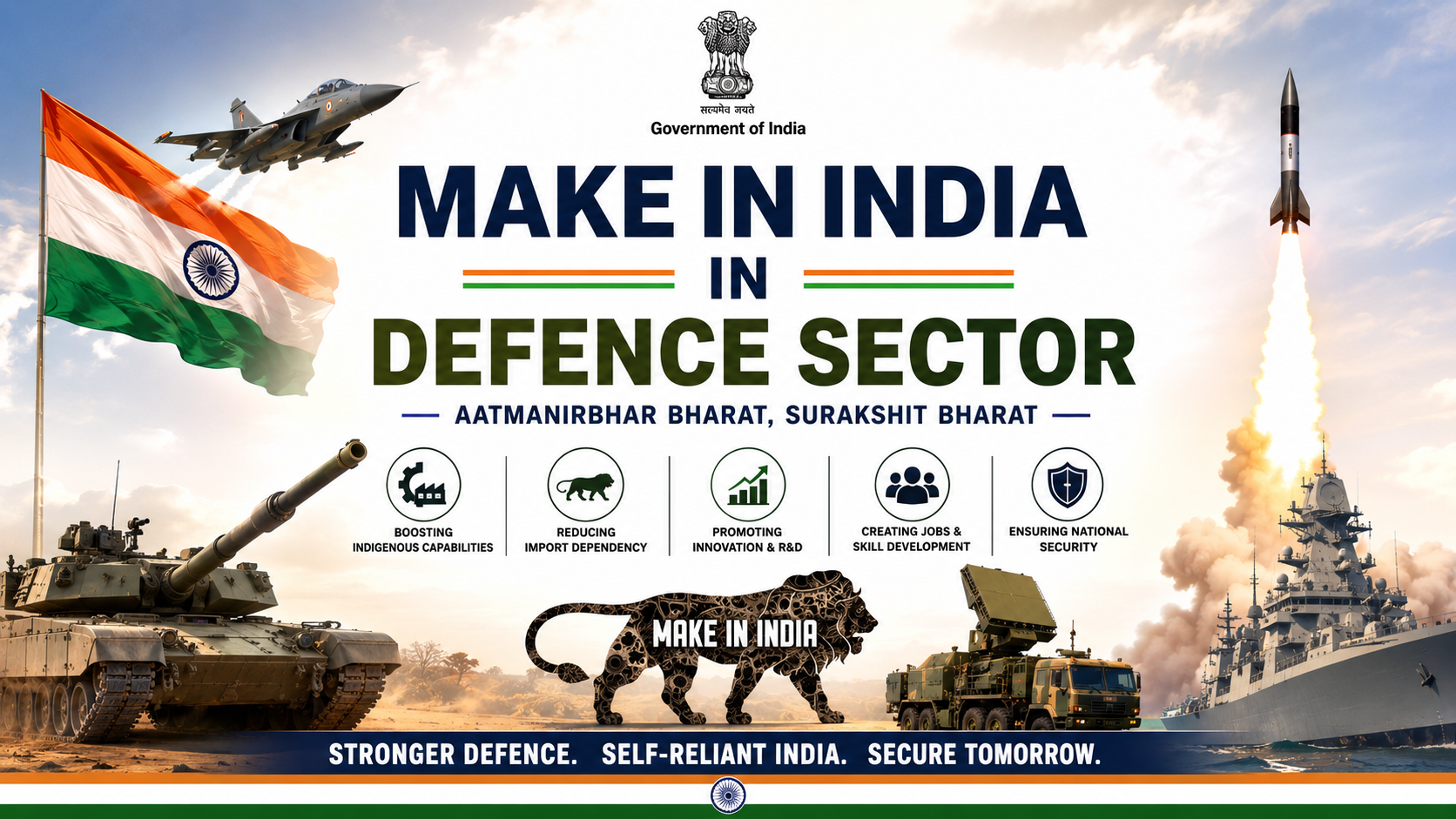
The "Make in India" initiative in the defense sector faces operational hurdles, including over-centralized acquisition processes, project delays, and the dominance of public sector undertakings (DPSUs).
Strategic Transformation
Government launched this policy to achieve Aatmanirbharta (Self-Reliance), reduce strategic import dependency, and shield India from global supply chain disruptions.
Domestic Capability Building
The initiative prioritizes the indigenous design, development, and manufacturing of modern defence equipment.
Ecosystem Integration
It fosters a robust defence ecosystem that integrates private industries, startups, and Micro, Small and Medium Enterprises (MSMEs) alongside traditional public sector units.
Record Production: India achieves its highest-ever indigenous defence production of ₹1.54 lakh crore in FY 2024-25, and aims for ₹3 lakh crore by 2029. (Source: PIB)
Increasing Exports: Defence exports hit an all-time high of ₹38,424 crore in FY 2025-26, and the government targets ₹50,000 crore by 2029. (Source: PIB)
Domestic Sourcing Mandates: Ministry of Defence earmarks 75% of the capital acquisition budget for domestic procurement in FY 2025-26. (Source: PIB)
Industrial Base Expansion: Ecosystem integrates 16 Defence Public Sector Undertakings (DPSUs), over 430 licensed private companies, and 16,000 MSMEs. (Source: PIB)
Defence Acquisition Procedure (DAP) 2020: Prioritizes the ‘Buy (Indian-IDDM)’ category (Indigenously Designed, Developed, and Manufactured), which mandates a minimum of 50% Indigenous Content.
Defence Procurement Manual (DPM) 2025: Streamline revenue procurement, ease working capital issues, and relax Liquidated Damages (penalties) for genuine suppliers.
Positive Indigenisation Lists (PILs): Enforces import restriction on over 5,500 items across multiple lists to guarantee domestic market demand.
Foreign Direct Investment (FDI) Liberalisation: Raises the FDI limit to 74% under the automatic route and allows up to 100% via the government route to attract foreign capital and technology.
Defence Industrial Corridors (DICs): Established two dedicated corridors in Uttar Pradesh (UPDIC) and Tamil Nadu (TNDIC).
Innovation & Start-up Push: The Innovations for Defence Excellence (iDEX) provides prototype grants, and the newly launched ADITI scheme grants up to ₹25 crore to startups developing critical deep-tech capabilities.
OFB Corporatisation: Restructures the legacy Ordnance Factory Board (OFB) into seven new corporate DPSUs to improve operational efficiency and accountability.
SRIJAN Portal Integration: The Ministry of Defence launches the SRIJAN portal for import substitution, where domestic manufacturers have indigenised over 14,000 items out of 38,000 listed items.
Critical Technology Dependency: Despite local assembly progress, India is still the world's 2nd largest arms importer (after Ukraine), sourcing 36% of its defence needs externally (Source: SIPRI 2026).
Stagnant R&D Investment: India allocates a mere 0.70% of its GDP to overall R&D, and defence research accounts for less than 1% of GDP, crippling basic research and original concept development. (Source: NITI Aayog)
The "Assembly vs Design" Paradox: Domestic industry suffers from white-labelling, where companies import components and assemble them domestically without acquiring genuine design authority or intellectual property rights.
Fragmented Testing Infrastructure: Manufacturers, especially MSMEs, lack access to military-grade testing and certification facilities, increasing research costs and delaying indigenous material development.
Boost R&D Funding: Raise the defence R&D allocation to of the total defence budget to fund basic research, deep-tech, and original intellectual property creation.
Deploy Fiscal Incentives: Introduce targeted fiscal incentives, tax rebates, and expand Production Linked Incentive (PLI) schemes specifically for high-risk defence technologies and critical materials.
Develop Dual-Use Technologies: Develop dual-use products (applicable in both military and civilian sectors like agriculture or disaster management) to sustain long gestation periods and maintain cash flow between defence contracts.
Scale Testing Infrastructure: Expand the Defence Testing Infrastructure Scheme (DTIS) to provide shared, subsidized access to environmental, ballistic, and electronic testing facilities for private manufacturers.
Reform Procurement: Reform procurement bureaucracies by decentralizing decision-making, offering long-term order visibility, and penalizing delays to encourage risk-taking and innovation.
India must transition from licensed assembly to an R&D-driven defense ecosystem by fostering domestic design authority and deep private-sector integration to become an autonomous global defense hub.
Source: INDIANEXPRESS
|
PRACTICE QUESTION Q. The 'SRIJAN' portal, often seen in the news, is associated with which of the following? A) A dedicated portal for fast-tracking FDI approvals in the defence sector. B) A centralized database to invite domestic manufacturers for import substitution. C) An innovation challenge platform for MSMEs to develop deep-tech technologies. D) A digital monitoring dashboard for tracking revenue procurement at all stages. Answer: B Explanation: The SRIJAN portal is an indigenization platform launched by the Ministry of Defence where Defence Public Sector Undertakings (DPSUs) and the Armed Forces list imported items, inviting Indian domestic manufacturers and MSMEs to indigenise these components through import substitution. |
The SRIJAN portal is an indigenization platform launched by the Ministry of Defence where DPSUs list imported items to invite domestic manufacturers, including MSMEs, for import substitution.
Foreign Direct Investment (FDI) in the defence sector is permitted up to 74% under the automatic route, and up to 100% via the government route for access to modern technology.
They are two dedicated corridors established in Uttar Pradesh (UPDIC) and Tamil Nadu (TNDIC) to attract investments and create specialized defence manufacturing clusters to boost the 'Make in India' initiative.

© 2026 iasgyan. All right reserved