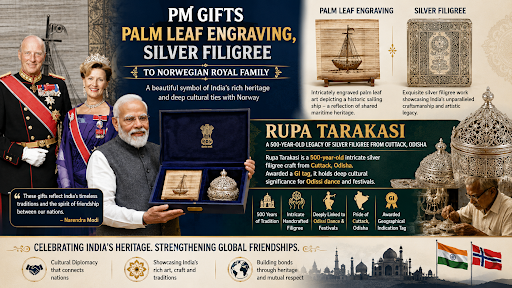
Rupa Tarakasi is a 500-year-old intricate silver filigree craft from Cuttack, Odisha. Awarded a GI tag, it holds deep cultural significance for Odissi dance and festivals, though artisans face severe challenges from rising silver prices and modernization.
Why In News?
Prime Minister Narendra Modi gifted a handcrafted Tarakasi silver sailboat to King Harald V of Norway to showcase India's maritime and artistic heritage
About Tarakasi Silver Filigree Art
The word Tarakasi derives from the Odia words ‘Tara’ (wire) and ‘Kasi’ (to weave or twist).
It is an indigenous handicraft where artisans twist and weave ultra-thin silver wires into intricate, lace-like patterns to create jewelry, decorative pieces, and utilitarian objects.
The craft thrives in Cuttack, often referred to as the "Silver City" of Odisha.
The Chennai-based Geographical Indication (GI) Registry under the Ministry of Commerce and Industry granted the GI tag to Cuttack's silver filigree, known as Rupa Tarakasi.
The majority of workers belong to the Vaisya Bania caste, classified as a Socially and Educationally Backward Class (SEBC).
Features of Tarakasi Art
Material Purity: Artisans use high-purity silver, ranging from 90% to 99.9% pure.
Three-Dimensional Nature: Unlike other silver clusters, Cuttack's filigree is distinguished by its three-dimensional nature, fine foils, and snowy glaze.
The Dama Chain: This is a unique, intricate mesh-like feature woven into an infinite loop; uniquely, the Dama chain is produced only by women.
Artistic Motifs: Designs feature the Peacock (Mayura), Lotus (Padma), Konark Sun Wheel, and scenes from the Mahabharata, such as Lord Krishna driving Arjuna's chariot.
Technical Processes
Drawing: Silver is pulled through a Jantri (steel plate with holes) to create wires thinner than human hair.
Annealing: Artisans periodically heat the wire to restore its malleability.
Soldering: Separate pieces are fused using a mixture of borax powder and water under a precise flame.
Enhancements: Modern techniques include platinum polishing for lasting shine and granulation to heighten aesthetic effects.
Historical Significance
Antiquity: Historians prove silver craftsmen existed in Cuttack as far back as the 12th century.
Evolutionary Roots: Some scholars suggest the craft reached the Indian sub-continent through ancient trade links with Persia and Indonesia.
Mughal Patronage: The art received patronage during the Mughal era, which introduced elaborate motifs and influenced the production of utilitarian articles like spectacle cases and rose-water sprinklers.
Bhoi Dynasty: Growth in artisanal and temple-based craftsmanship occurred in the mid-16th century under the Bhoi Dynasty.
Cultural Connections
Odissi Dance: Tarakasi jewelry is an essential part of the Odissi costume, including the Matha Patti (forehead), Padaka Tilaka (long necklace), and Benga-patia (waist belt).
Durga Puja (Chandi Medha): Cuttack is famous for Chandi Medha, which are massive silver filigree backdrops (tableaus) for Goddess Durga.
Maritime Heritage: The Boita (traditional boat) design is a popular Tarakasi motif inspired by the Sadhaba traders who sailed to Southeast Asia.
Comparative Craft: While Cuttack's filigree dates back centuries, the silver filigree of Karimnagar (Telangana)—which also holds a GI tag.
Source: TIMESOFINDIA
|
PRACTICE QUESTION Q. The 'Boita' or 'Banijya Nauka', a motif commonly replicated in Indian handicrafts and recently in the news, represents: (a) The ancient palm leaf engravings of Kerala. (b) The maritime heritage and ancient seafaring traditions of Odisha. (c) The traditional agricultural practices of the Kalinga Empire. (d) A specific geographical indication product from Telangana. Answer: (b) Explanation: The 'Boita' or 'Banijya Nauka' motif represents (b) The maritime heritage and ancient seafaring traditions of Odisha. It symbolizes the ancient oceanic trade voyages undertaken by merchants (Sadhabas) from the ancient Kalinga kingdom (modern-day Odisha) who sailed in large vessels to Southeast Asian countries like Java, Sumatra, and Bali. This legacy is celebrated during the traditional Boita Bandana festival on Kartika Purnima. |
Rupa Tarakasi is a 500-year-old traditional silver filigree craft originating from Cuttack, Odisha, where artisans draw highly pure silver into extremely fine wires and twist them into intricate, lace-like patterns.
Artisans use fine silver of very high purity (typically 99.5% to 99.9%) instead of standard sterling silver, because high-purity silver is highly malleable and can be drawn into hair-thin wires without breaking.
It is deeply woven into the local culture, serving as essential traditional jewelry for classical Odissi dancers, elaborate decorative backdrops (Chaandi Medha) for deities during Durga Puja, and auspicious bridal wear.

© 2026 iasgyan. All right reserved