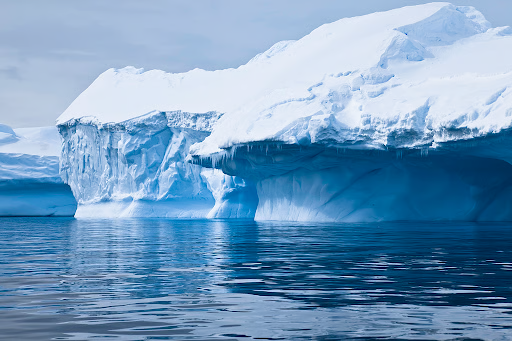
A Nature Climate Change study indicates the Antarctic Ice Sheet has multiple tipping points: irreversible loss in West Antarctica (including Thwaites Glacier) risks starting at 1.3°C warming, and East Antarctica destabilizes beyond 2°C, which poses a threat to India’s coastline and monsoon, stressing the need for action under the Indian Antarctic Act, 2022.
Copyright infringement not intended
Picture Courtesy: DOWNTOEARTH
Context
A Nature Climate Change study challenges the single-tipping-point view of the Antarctic Ice Sheet (AIS), revealing multiple, interconnected tipping systems.
What are the Key Findings of the New Study?
Multiple Tipping Systems
Instead of a single collapse threshold, Antarctic drainage basins have varying temperature tipping points. The collapse of one can create a domino effect, destabilizing adjacent basins.
West Antarctica - The Weak Link
The West Antarctic Ice Sheet (WAIS) is the most vulnerable region, with the Amundsen Sea basin likely already on a path of irreversible ice loss at current warming levels.
East Antarctica - The Sleeping Giant
The stable East Antarctic Ice Sheet (EAIS) is also vulnerable; regions like the Wilkes Basin risk a tipping point if global warming is sustained between 2°C and 5°C. The EAIS contains over 50 meters of sea-level rise potential.
Irreversibility
After a tipping point, melting becomes self-sustaining and will persist for centuries or millennia, even if global temperatures stabilize.
|
Case Study: Thwaites 'Doomsday' Glacier
|
What are the Global Implications of these Tipping Points?
Existential Sea-Level Rise
The complete melting of Antarctica would raise global sea levels by approximately 58-60 meters, threatening the existence of coastal cities and Small Island Developing States (SIDS) like the Maldives. (Source: NASA)
Albedo Feedback Loop
As reflective white ice melts, it exposes dark ocean water, which absorbs more solar radiation. This increases warming, which in turn melts more ice, creating a dangerous positive feedback loop.
Disruption of Ocean Circulation
The massive influx of freshwater from melting ice can disrupt the Southern Ocean Overturning Circulation. This can alter global weather patterns, marine ecosystems, and nutrient distribution.
How Vulnerable is India to Antarctic Melting?
With a 7,516 km coastline and a rapidly warming Indian Ocean, India is highly vulnerable to the impacts of Antarctic melting.
Threat to Coastal Megacities
Mumbai, Kolkata, and Chennai face severe risks from rising sea levels. A 2024 CEEW report projected chronic flooding in parts of these cities by 2050, affecting millions
Economic Impact
Rising sea levels threaten India's "Blue Economy," including fisheries, tourism, and port infrastructure. Coastal ecosystems like mangroves, which act as natural barriers, are also at risk.
Monsoon Variability
Changes in the Southern Ocean could influence pressure gradients that drive the Indian Summer Monsoon, potentially leading to more erratic rainfall and impacting national food security.
Policy Framework
The Indian Antarctic Act, 2022: Extends Indian domestic laws to its research stations, regulates tourism, and prohibits mining and other unauthorized activities, aligning with the Madrid Protocol.
Research Stations: India operates two active stations, Maitri and Bharati
Nodal Agency: The National Centre for Polar and Ocean Research (NCPOR) in Goa leads India's polar research programs.
Way Forward
Urgent Mitigation: The primary goal must be to limit global warming to 1.5°C (Paris Agreement) to prevent crossing tipping points in the Antarctic Ice Sheet.
Coastal Adaptation: India must accelerate the implementation of adaptation strategies, including building climate-resilient infrastructure, protecting and restoring mangroves ("Blue Carbon"), and developing early warning systems for coastal hazards.
Enhanced Monitoring: Increase investment in polar research to understand ice sheet instability, improve sea-level rise projections, and inform effective coastal planning.
Conclusion
Antarctica's melting ice threatens irreversible global tipping points, demanding immediate, drastic global decarbonization to prevent the collapse of Antarctica.
Source: DOWNTOEARTH
|
PRACTICE QUESTION Q. Which of the following best describes the 'Albedo Feedback Loop' in the context of polar melting? A) The release of methane from permafrost accelerates warming. B) Melting ice exposes darker ocean water, which absorbs more heat, accelerating melting. C) Cold freshwater from melting ice slows down ocean currents. D) Increased cloud cover over the poles reflects more sunlight, cooling the region. Answer: B Explanation: The Albedo Feedback Loop is a self-reinforcing climate process. Melting ice (high albedo/reflectivity) is replaced by dark ocean water (low albedo/reflectivity). The dark water absorbs more solar energy and heat, leading to further warming and increased ice melt, thereby accelerating global warming. |
It is nicknamed the "Doomsday Glacier" because its collapse alone could raise global sea levels by 65 cm. More importantly, it acts as a "cork," holding back the rest of the West Antarctic Ice Sheet. If Thwaites collapses, it could trigger a domino effect leading to a sea-level rise of up to 3 meters.
Melting Antarctic ice releases massive amounts of fresh water into the Southern Ocean, altering ocean circulation and temperature gradients. These changes can disrupt the atmospheric pressure systems that drive the Indian Summer Monsoon, potentially leading to erratic rainfall patterns affecting agriculture.
The Act extends Indian domestic law to its Antarctic stations, regulates Indian expeditions (including tourism), establishes a permit system, prohibits mining and nuclear testing, and sets up a fund for Antarctic research. It ensures India's compliance with the Antarctic Treaty System.



© 2026 iasgyan. All right reserved