The World Day to Combat Desertification and Drought (17 June) highlights the urgent need for sustainable land management. India, facing 97.85 million hectares of land degradation, actively targets restoring 26 million hectares by 2030 through watershed development, the Green India Mission, and the Aravalli Green Wall.
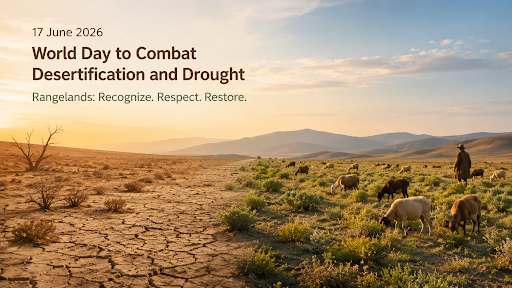
On 17 June 2026, the world observed the World Day to Combat Desertification and Drought under the theme "Rangelands: Recognize. Respect. Restore."
The United Nations General Assembly established this observance in 1994, to highlight the immediate threats posed by desertification, land degradation, and drought.
2026 Theme Focus: The theme emphasizes the vital role of rangelands and grasslands in maintaining biodiversity, facilitating carbon sequestration, and building climate resilience.
Global Framework: The day aligns with the United Nations Convention to Combat Desertification (UNCCD), the sole legally binding international agreement linking environment and development to sustainable land management.
Definition: It refers to the severe degradation of land in arid, semi-arid, and dry sub-humid areas (collectively termed drylands) caused by climatic variations and human activities.
Primary Drivers: In India, water erosion (11.01%), vegetation degradation (9.15%), and wind erosion (5.46%) serve as the leading causes of land degradation. (Source: ISRO)
Anthropogenic Pressures: Activities such as rapid urbanization, open-cast mining, over-irrigation, and deforestation accelerate topsoil loss.
Impact on Ecosystems: Desertification disrupts nutrient cycling and soil conservation, forcing forest-dependent communities into cycles of poverty and forced migration
|
What is Drought? Meteorological Drought: Regions experience prolonged periods of significantly below-average precipitation, leading to water shortages. Agricultural Drought: Declining soil moisture impairs crop growth, threatening the food security of agrarian economies. Hydrological Drought: Surface and subsurface water levels in lakes, reservoirs, and aquifers fall below statistical norms, halting essential ecosystem services. |
Major Causes of Desertification
Deforestation: Clearing tropical forests removes root systems that anchor soil, increasing vulnerability to water erosion and solar radiation.
Overgrazing: Excessive livestock pressure compacts soil, preventing rainwater infiltration and natural groundwater recharge.
Unsustainable Agriculture: The overuse of chemical fertilizers and canal irrigation disrupts soil pH, causing salinity and alkalinity. Globally, agriculture accounts for 80% of deforestation and 70% of freshwater consumption. (Source: UNCCD)
Climate Change: Rising temperatures act as a threat multiplier; 77.6% of Earth’s land has experienced drier conditions since the 1990s, expanding drylands by 4.3 million square kilometers. (Source: UNCCD)
Consequences of Desertification
Loss of Biodiversity: Degradation fractures ecological corridors in hotspots like the Western Ghats and the Himalayas.
Declining Agricultural Productivity: The world loses 24 billion tonnes of fertile soil annually, converting 12 million hectares of productive land into deserts. (Source: UNCCD)
Food Insecurity: The collapse of yields threatens the livelihoods of 2 billion people living in global drylands. (Source: Food and Agriculture Organization)
Water Scarcity: Degraded lands lose water-retention capacity, triggering increased surface runoff and permanent groundwater depletion.
Land Degradation Challenges: The Desertification and Land Degradation Atlas of India reports that 97.85 million hectares (29.77% of India's land) is undergoing degradation.
Economic Cost: Land degradation costs India Rs. 3,177.39 billion annually, or roughly 2.54% of its GDP. (Source: The Energy and Resources Institute)
Dryland Dominance: Approximately 70% of India is classified as vulnerable dryland. States including Jharkhand, Rajasthan, Delhi, Gujarat, and Goa report over 50% of their area under active degradation.
National Commitments:
Government Initiatives
National Action Programme (NAP): The Ministry of Environment, Forest and Climate Change updated the NAP in 2022 to adopt an ecosystem-based "landscape approach."
Green India Mission: This NAPCC component has restored forest cover across 1.7 lakh hectares over the last five years.
Watershed Development (WDC-PMKSY 2.0): This program utilizes check dams and percolation tanks to treat over 27 million hectares of degraded land.
Soil Health Card Scheme: This initiative reduced chemical fertilizer use by 8-10% and increased crop productivity by 5-6%.
Aravalli Green Wall Project: India must complete this 1,400 km ecological corridor to restore 1.50 million hectares and block the expansion of the Thar Desert.
Sustainable Agriculture: Promote Trees Outside Forests (TOF) through Agrisilviculture and Silvipastoral systems.
Community Participation: Strengthen Joint Forest Management Committees (JFMCs) to ensure sustainable local resource governance.
Climate-Resilient Monitoring: Operationalize the International Drought Resilience Observatory (IDRO) to leverage Artificial Intelligence for drought management
Private Sector Finance: Governments must mandate ESG investments under the Business4Land framework, as the private sector currently provides only 6% of restoration financing.
By aggressively scaling up sustainable land management, empowering local communities, and fulfilling the ambitious 26 million hectare restoration target, India can successfully achieve Land Degradation Neutrality and secure its socio-ecological future by 2030.
Source: NEWSONAIR
|
PRACTICE QUESTION Q. Consider the following statements regarding the United Nations Convention to Combat Desertification (UNCCD):
Which of the statements given above is/are correct? A) 1 and 2 only B) 1 and 3 only C) 2 and 3 only D) 1, 2, and 3 Answer: B Explanation: Statement 1 is correct: The 1994 United Nations Convention to Combat Desertification (UNCCD) is explicitly recognized as the only legally binding international agreement that links environment and development directly to sustainable land management. Statement 2 is incorrect: The concept of Land Degradation Neutrality (LDN) is not embedded in SDG 13 (which covers Climate Action). Instead, it is explicitly target-bound under Sustainable Development Goal (SDG) 15.3, which focuses on protecting terrestrial ecosystems and achieving a land degradation-neutral world. Statement 3 is correct: At the UNCCD COP16 held in Riyadh, Saudi Arabia in December 2024, nations and the UNCCD Secretariat formally advanced and mandated private sector mobilization under the Business4Land (B4L) initiative to catalyze private and sustainable finance for global land restoration. |
Observed annually on June 17, this UN-mandated day raises global awareness about land degradation, and the newly announced 2026 theme: "Rangelands: Recognize. Respect. Restore."
Desertification is the persistent degradation of land in arid, semi-arid, and dry sub-humid areas caused primarily by human overexploitation and climate variations, rather than the natural expansion of existing deserts.
Rising global temperatures disrupt natural rainfall patterns and increase soil evaporation rates, making droughts significantly more frequent, intense, and prolonged across vulnerable regions.
India has pledged to achieve Land Degradation Neutrality (LDN) by restoring 26 million hectares of degraded land by 2030, having already successfully restored 21.76 million hectares as of 2026.



© 2026 iasgyan. All right reserved