The post-2026 delimitation of constituencies risks straining India’s federal balance. Population-based reallocation may sharply boost northern states’ representation while reducing that of southern states that controlled population growth. This shift could penalize policy success, distort fiscal federalism, and intensify north–south political tensions.
Copyright infringement not intended
Picture Courtesy: THEHINDU
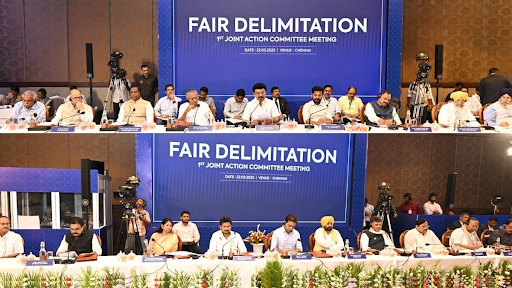
The freeze on the number of electoral seats, mandated for revision after 2026, is causing a political debate due to its potential to redistribute power between northern and southern states.
|
Read all about: Delimitation of Constituencies l The issue with delimitation's population-based process l Southern States About Delimitation |
Delimitation is the process of redrawing the boundaries of Lok Sabha and State Assembly constituencies.
Its primary goal is to uphold the democratic principle of "One Vote, One Value" by ensuring that constituencies have, as far as practicable, an equal population.
Constitutional Foundation
Article 82: It directs the Parliament to enact a Delimitation Act after every Census. Following this, the Union government sets up a Delimitation Commission to readjust Lok Sabha constituencies.
Article 170: It provides for the delimitation of constituencies for State Legislative Assemblies as per the Delimitation Act after each Census.
Article 330 & 332: These articles mandate the reservation of seats for Scheduled Castes (SCs) and Scheduled Tribes (STs) in the Lok Sabha and State Assemblies, respectively, based on their population proportion.
Article 329(a): The law relating to delimitation or seat allotment cannot be challenged in court, making the Delimitation Commission's orders final and legally binding.
History of Delimitation & The "Freeze"
|
Delimitation Commission |
Basis (Census Year) |
Key Outcome |
|
1952 |
1951 Census |
First exercise to draw boundaries for a newly independent India. |
|
1963 |
1961 Census |
Regular readjustment based on population changes. |
|
1973 |
1971 Census |
Readjustment based on the 1971 population figures. |
|
2002 |
2001 Census |
Only redrew boundaries of existing constituencies without changing the total number of seats in each state. |
The First Freeze (42nd Amendment Act, 1976)
The number of Lok Sabha and State Assembly seats was frozen based on the 1971 Census until 2000 to encourage states to pursue population control measures without losing political representation.
The Extended Freeze (84th Amendment Act, 2001)
The freeze on the total number of seats was extended until the first Census after the year 2026, though the 2002 Delimitation Commission redrew boundaries based on the 2001 Census.
It is a high-powered, independent statutory body appointed by the President of India to redraw the boundaries of Lok Sabha and State Assembly constituencies.
Composition of the Commission
Guiding Principles and Procedure
The process involves preparing draft proposals, holding public sittings to hear objections and suggestions, and then publishing the final orders in the Gazette of India.
North-South Representational Divide
States that successfully implemented population control policies (mostly in the South) face the prospect of losing seats in Parliament, while states with higher population growth (mostly in the North) are set to gain.
The Dilemma: A strict population-based delimitation could "penalize" southern states for their effective family planning programs, undermining the spirit of cooperative federalism.
Potential Impact: Projections suggest that a delimitation based on the next census population could lead to a shift in political power towards the northern states.
The "Frozen" Conundrum and Unequal Representation
Using the 1971 Census to fix the number of seats has created massive disparities in the size of constituencies today, violating the "One Vote, One Value" principle.
Gerrymandering and Political Influence
While the independent nature of the Delimitation Commission is a strong safeguard against gerrymandering (manipulating boundaries for political advantage), the process is not immune to allegations of political bias.
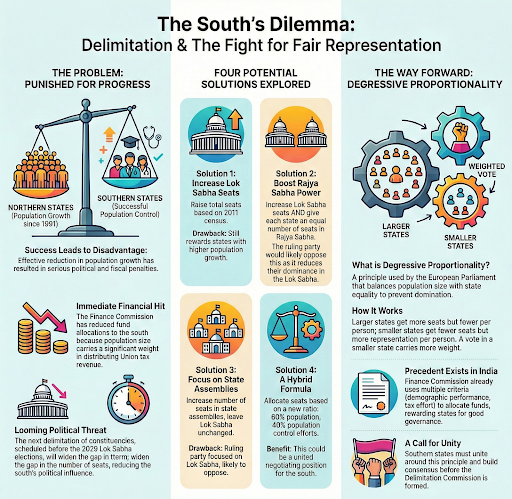
Successfully managing upcoming delimitation challenges requires balancing constitutional norms, federal cooperation, and equitable democracy, making a broad political consensus crucial.
Alternative Criteria
Some experts suggest moving beyond population as the sole criterion. A potential formula could give 50% weightage to population and 50% to other factors like state area, development indicators, or even fiscal discipline.
Gradual Implementation
Instead of a drastic one-time change, the increase/decrease in seats could be phased in over several elections to mitigate political shocks.
Strengthening Federalism
Empower the Rajya Sabha to better represent the interests of the states, to act as a counterbalance to the population-based representation in the Lok Sabha.
Leveraging Technology
Using modern tools like Geographic Information System (GIS) and AI can help create more scientific, transparent, and less contentious constituency boundaries.
Delimitation, essential for Indian democracy, faces a defining moment after the 2026 freeze ends, demanding a national dialogue to resolve representational distortions and ensure a fair outcome for Indian federalism.
Source: THEHINDU
|
PRACTICE QUESTION Q. "The upcoming delimitation exercise is not merely a technical readjustment of boundaries but a test of India's federal soul." Critically analyze. 250 words |
Delimitation is the process of redrawing the boundaries of Lok Sabha and State Assembly constituencies to ensure that each constituency has a roughly equal population. This upholds the democratic principle of "One Person, One Vote, One Value."
The 42nd Amendment Act of 1976 froze the number of seats to encourage states to implement family planning and population control measures. The intent was to ensure that states with successful programs would not be "penalized" by losing political representation in Parliament.
The main controversy is the potential for a massive shift in political power from the southern states to the northern states. Southern states have been more successful in controlling population growth, so a purely population-based delimitation would reduce their share of seats in the Lok Sabha relative to northern states.




© 2026 iasgyan. All right reserved