The ECMS transitions India from assembly to deep-tech manufacturing with a ₹40,000 crore outlay. By boosting Domestic Value Addition to 40% and creating 90,000 jobs, it ensures technological sovereignty, national security, and resilience against global supply chain vulnerabilities.
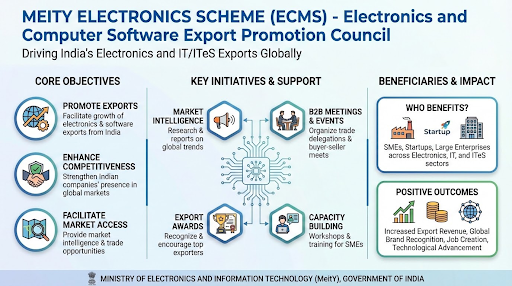
The Ministry of Electronics and Information Technology (MeitY) approved 29 applications under the Electronics Component Manufacturing Scheme (ECMS).
The Electronics Component Manufacturing Scheme (ECMS) is a demand-driven, incentive-based scheme designed to offset the "cost disabilities" (such as lack of infrastructure, high finance costs, and logistics gaps) faced by component manufacturers in India compared to global competitors.
Nodal Ministry: Ministry of Electronics and Information Technology (MeitY).
Launch: Notified in April 2025; active implementation underway in FY 2026-27.
Total Outlay: Originally ₹22,919 crore, expanded to ₹40,000 crore by Union Budget 2026-27, to accommodate industry interest,
Primary Goal: To catalyze the domestic manufacturing of electronic components, sub-assemblies, and capital equipment, thereby feeding into the downstream PLI sectors (Mobile, IT Hardware, Automotive).
Unlike previous "one-size-fits-all" schemes, ECMS introduces a sophisticated, tiered incentive structure tailored to the complexity of the component.
The Three Types of Incentives
Employment
A unique feature of ECMS is its social conditionality. A specific portion of the payout is linked to employment generation targets. This ensures that the scheme creates "jobs," not just "factories".
Target Segments
|
Segment |
Description |
Key Components |
Strategic Importance |
|
A. Sub-Assemblies |
Intermediate parts that go into the final device. |
Camera Modules, Display Modules, Optical Transceivers. |
High value; currently 80% imported. Localizing these boosts DVA significantly. |
|
B. Bare Components |
Fundamental building blocks of electronics. |
Multi-layer PCBs, Connectors, Li-ion Cells, Capacitors, Resistors. |
These are the "nuts and bolts." Without them, no device can function. |
|
C. Strategic/Selected Components |
High-tech, niche components. |
HDI PCBs, MSAP PCBs, Advanced Sensors. |
Critical for 5G, Defense, and Space applications. |
|
D. Ecosystem & Capital Goods |
The machinery and raw materials supply chain. |
Solder paste, Laminates (CCL), Pick-and-Place machines. |
Reduces dependency on imported machinery, ensuring long-term resilience. |
|
E. Telecom Sub-Assemblies |
Specific to the 5G/6G stack. |
Antennas, Base Station components. |
Vital for national security and the telecom rollout. |
Infrastructure Gaps: Component manufacturing (especially PCBs) requires ultra-pure water and uninterrupted power, which are still inconsistent in many industrial clusters.
Raw Material Dependency: India may make the PCB, but still import the Copper Clad Laminate (CCL) and Glass Epoxy. ECMS attempts to address this (Segment D), but the upstream chemical ecosystem is weak.
Global Competition: Vietnam and Thailand offer aggressive tax holidays. While ECMS offers fiscal support, India's logistics cost (13-14% of GDP) is still higher than global peers (8%).
Technological Obsolescence: In electronics, technology changes every 2 years. A 6-year scheme must remain flexible to include new components (e.g., AI-specific sensors).
Cluster-Based Approach: Strengthening Electronics Manufacturing Clusters (EMC 2.0) to provide "Plug-and-Play" infrastructure specifically for component makers (e.g., common effluent treatment plants for PCB units).
Skilling: The Electronics Sector Skills Council of India (ESSCI) must align its curriculum with the high-precision needs of component manufacturing (e.g., surface mount technology).
Export Orientation: The ecosystem shouldn't just serve India; it must target global exports to achieve economies of scale, similar to how China dominates the world market.
The Electronics Component Manufacturing Scheme (ECMS) marks a strategic shift from simple assembly to technological sovereignty by incentivizing the high-value "upstream" components (like PCBs and sensors) that form the core of modern electronics, thereby reducing critical import dependencies and enhancing National Security.
Source: ANINEWS
|
PRACTICE QUESTION Q. Consider the following statements regarding the Electronic Components Manufacturing Scheme (ECMS): 1. It is a direct successor to the Production Linked Incentive (PLI) scheme for finished goods. 2. It adopts a hybrid financial approach rewarding both capital investment and turnover. 3. The scheme aims to increase Domestic Value Addition (DVA) in smartphone manufacturing to 35-40%. Which of the statements given above are correct? a) 1 and 2 only b) 2 and 3 only c) 1 and 3 only d) 1, 2, and 3 Answer: b Explanation: Statement 1 is Incorrect: The ECMS is not a successor to the PLI scheme for finished goods; rather, it is a complementary upstream scheme. It is actually the strategic successor to the Scheme for Promotion of Manufacturing of Electronic Components and Semiconductors (SPECS). Statement 2 is Correct: Unlike the pure production-linked model of PLI, the ECMS utilizes a hybrid incentive structure. It offers Capex-based incentives (reimbursing a percentage of upfront investment in plant and machinery) and Turnover-linked incentives (based on incremental sales), along with performance-linked payouts for employment generation. Statement 3 is Correct: A primary strategic objective of ECMS is to increase Domestic Value Addition (DVA). Currently, DVA in Indian smartphone manufacturing is approximately 18–20%. By localizing high-value components like PCBs and camera modules, the scheme aims to push this to 35–40% by 2030. |
ECMS is India's flagship ₹40,000 crore incentive framework designed to promote the domestic manufacturing of electronic components, sub-assemblies, and capital equipment, aiming to reduce the 8-10% cost disability Indian manufacturers face globally.
Unlike previous "one-size-fits-all" models, ECMS adopts a hybrid financial approach. It provides Capex-based incentives to offset heavy upfront machinery costs and Turnover-Linked incentives to reward actual incremental production and market share growth.
Currently, India mostly executes the final assembly of electronics, keeping DVA low at 15-20%. By manufacturing bare components locally through ECMS, India aims to push DVA to 35-40%, ensuring more wealth, technology, and jobs stay within the country.




© 2026 iasgyan. All right reserved