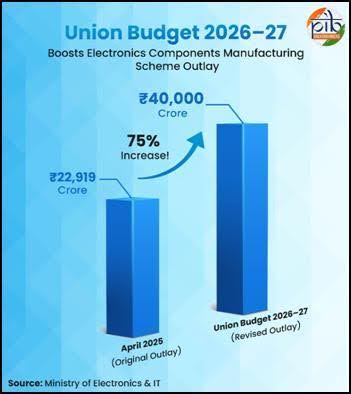
The Electronics Components Manufacturing Scheme (ECMS) is a Government of India initiative aimed at strengthening domestic production of electronic components and sub-assemblies to reduce import dependence and increase value addition within the country. With its outlay enhanced to ₹40,000 crore in the Union Budget 2026–27, the scheme supports investment, technology adoption, and integration into global value chains while complementing broader initiatives like the India Semiconductor Mission. By promoting high-value manufacturing and job creation, ECMS plays a key role in India’s ambition to become a global hub for electronics manufacturing.
Copyright infringement not intended
Picture Courtesy: PIB
Context:
Union Budget 2026 – 27 increased the outlay for the Electronics components manufacturing scheme to Rs. 40000 crores.
|
Must Read: ELECTRONICS COMPONENTS MANUFACTURING SCHEME | INDIA’S ELECTRONIC SECTOR | |
Electronics components manufacturing scheme:
The Electronics Components Manufacturing Scheme is a Government of India initiative notified on 8 April 2025 to strengthen domestic manufacturing of electronic components, deepen value addition, and integrate India into global electronics value chains.
Objective: ECMS seeks to build a self-sustaining electronics component ecosystem in India by reducing import dependence, increasing domestic value addition, and integrating Indian industry into global value chains.
Incentive Structure: The scheme provides financial incentives to manufacturers of electronic components, sub-assemblies, and related materials to encourage large-scale investment, higher domestic value addition, and technology-led manufacturing.
Tenure: ECMS has a duration of six years with an optional one-year gestation period for project implementation.
Target Segments: The scheme supports manufacturing of multi-layer PCBs, camera modules, connectors, oscillators, optical transceivers, enclosures for mobile and IT hardware, and other key electronic components and sub-assemblies.
Employment generation: The scheme is projected to create 1,41,801 direct jobs, in addition to a large number of indirect employment opportunities across the electronics value chain.
Linkages with other schemes: ECMS functions alongside the Production Linked Incentive Scheme, the Modified Electronics Manufacturing Clusters, the Scheme for Promotion of Manufacturing of Electronic Components and Semiconductors, and the National Policy on Electronics to create a comprehensive electronics manufacturing ecosystem
Current Status of Electronics Components Manufacturing Scheme (ECMS):
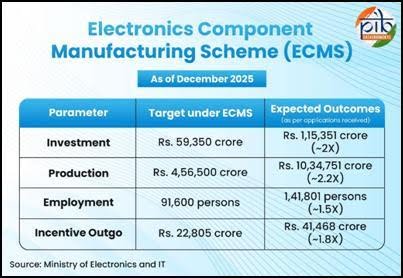
Picture Courtesy: PIB
Significance of the Electronics Components Manufacturing Scheme (ECMS):
Conclusion:
The Electronics Components Manufacturing Scheme marks a strategic shift toward deeper domestic value addition in India’s electronics sector by strengthening component manufacturing, reducing import dependence, and enhancing integration with global value chains, thereby supporting long-term industrial growth and the vision of India emerging as a global electronics manufacturing hub.
Source: PIB
|
Practice Question Q. India’s electronics growth now depends more on component-level depth than assembly-scale expansion. Discuss. (250 words) |
ECMS is a Government of India scheme launched in April 2025 to promote domestic manufacturing of electronic components and sub-assemblies, with the aim of strengthening India’s electronics supply chain and reducing import dependence.
The scheme is implemented by the Ministry of Electronics and Information Technology (MeitY), which oversees policy support and incentive disbursement.
By incentivising domestic production of critical components that were previously imported, the scheme strengthens supply chain resilience and lowers reliance on foreign suppliers.



© 2026 iasgyan. All right reserved