The SUJALAM BHARAT initiative seeks water security through integrated water and wastewater management. By converging major missions, it promotes community-led, circular water practices. Its success depends on fixing infrastructure gaps, improving maintenance, strengthening local governance and ensuring effective inter-departmental coordination.
Copyright infringement not intended
Picture Courtesy: PIB
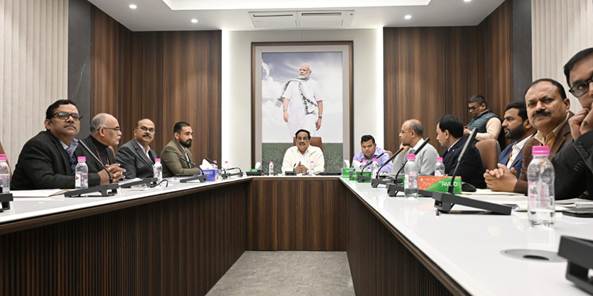
The Union Minister of Jal Shakti launched the Sujalam Bharat App, a digital initiative providing real-time information for improved rural drinking water governance to citizens and institutions.
It is an e-governance tool designed to digitize and monitor rural water supply systems under the Jal Jeevan Mission.
It aims to create a unified digital identity, the 'Sujal Gaon ID', for each village’s water scheme, detailing the water source, infrastructure health, supply reliability.
Key Features
Integrated Database: A centralized database consolidating asset inventories, operational records, water quality reports, and community feedback.
Geo-Spatial Mapping: Integrated with the PM Gati Shakti GIS platform for precise mapping of water assets (pipelines, pumps, treatment units), enabling efficient planning and maintenance.
Accountability Mechanism: Future fund releases for JJM require states to onboard rural water schemes onto the Sujal Gaon ID platform for strict compliance.
It is a strategic national initiative by the Ministry of Jal Shakti to create a unified framework for water security and sustainable wastewater management.
It adopts a 'whole-of-government' and 'whole-of-society' approach to address complex water challenges, aiming to transform the country into a 'Sujalam' (water-abundant) nation.
Six Pillars of SUJALAM BHARAT
Rejuvenation of Water Bodies: Restoring the health and natural flow of rivers and springs.
Greywater Management: Focusing on the treatment and reuse of wastewater from domestic sources (kitchens, bathing).
Technology-Driven Management: Using modern technology for efficient monitoring, planning, and management of water resources.
Water Conservation: Promoting practices like rainwater harvesting and efficient irrigation.
Sustainable Drinking Water Supply: Ensuring the long-term availability of safe drinking water for all citizens.
Deep Community Engagement: Empowering local communities (Jan Andolan) to lead water management efforts.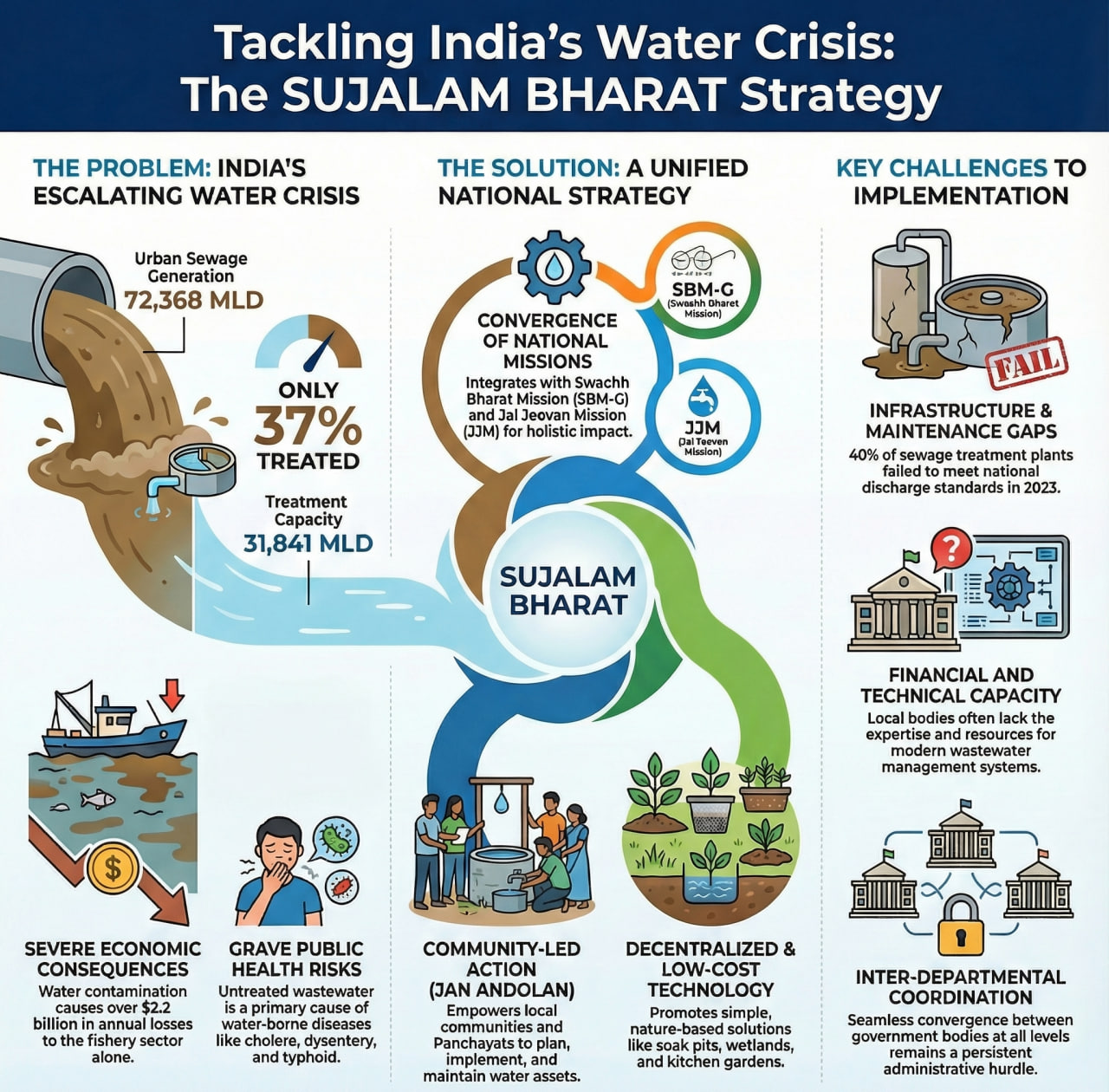
Source: PIB
|
PRACTICE QUESTION Q. Consider the following statements about the Sujalam Bharat App:
Which of the statements given above is/are correct? (a) 1 and 2 only (b) 3 only (c) 1 and 3 only (d) 1, 2, and 3 Answer: B Explanation: Statement 1 is incorrect. The app was developed with the support of the Bhaskaracharya National Institute for Space Applications and Geo-informatics (BISAG-N). Its focus is on rural drinking water supply systems under the Jal Jeevan Mission, not urban water bodies. Statement 2 is incorrect. The Sujal Gaon ID provides a unique digital profile for every habitation, which includes details about the drinking water source, infrastructure condition, supply reliability, operation & maintenance arrangements, and water quality test reports. It is not limited to only water quality test reports. Statement 3 is correct. The platform is indeed integrated with the PM Gati Shakti GIS platform to support the precise geospatial mapping of rural water networks, asset inventories, and aid in future planning, repair, and expansion. |
SUJALAM BHARAT is a national vision by the Ministry of Jal Shakti to create a water-secure India. It provides a unified framework for managing water and wastewater by integrating various government missions, promoting technology, and emphasizing deep community engagement.
It works in convergence. JJM provides tap water, which increases greywater generation. SUJALAM BHARAT provides the framework to manage this greywater, thereby helping villages achieve the liquid waste management component required for the ODF Plus status under SBM-G Phase II.
The key challenges include poorly designed infrastructure, gaps in long-term operation and maintenance (O&M) of assets, lack of financial and technical capacity at the local level, and persistent hurdles in achieving seamless inter-departmental coordination.





© 2026 iasgyan. All right reserved