Seagrass meadows, vital blue carbon sinks and ecosystem engineers, are declining globally by 7% annually. In India, pollution, destructive fishing, and climate change threaten them. Successful models like Palk Bay need scaling through stronger policy, restoration technology, community stewardship, and climate recognition.
Copyright infringement not intended
Picture Courtesy: DOWNTOEARTH
Istanbul University initiated a project utilizing AI-supported satellite imagery and drones to monitor and enhance the protection of endangered seagrass meadows and fragile coastal ecosystems.
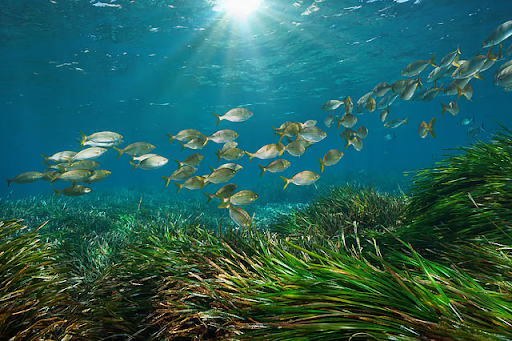
Often called the 'lungs of the sea', seagrasses are underwater flowering plants that form vast meadows in coastal areas.
Recent studies highlight their rapid decline, with an estimated 7% of this vital habitat being lost globally each year — a rate equivalent to losing a football field every 30 minutes (Source: UNEP).
Decline impacts marine biodiversity and human well-being, as these critical ecosystems support climate mitigation, coastal protection, and economic livelihoods.
Seagrass in India
Area and Species: India is home to 16 known seagrass species, covering an area of approximately 517 sq. km. (Source: National Centre for Sustainable Coastal Management)
Major Locations: The most extensive seagrass meadows are found in:
Economic Value: Total Economic Value (TEV) of seagrass in India is estimated at ₹25.9 lakhs per hectare per year, contributing a total of approximately ₹13,444 crores annually to the national economy through various ecosystem services (Source: Asian Journal of Geographical Research).
Seagrasses are termed 'Ecosystem Engineers' because they shape their environment, creating conditions that support a multitude of other species and provide invaluable services.
Biodiversity Hotspots
They serve as nursery grounds for over one-fifth of the world's largest 25 fisheries and provide food for endangered species like the Dugong (sea cow) and green sea turtles (Source: UNEP).
Powerful 'Blue Carbon' Sinks
Despite covering only 0.1% of the ocean floor, they are responsible for storing up to 18% of the world's oceanic carbon. They can sequester carbon up to 35 times faster than tropical rainforests (Source: WWF).
Coastal Protection
Their dense root and leaf systems absorb wave energy, reduce coastal erosion, and act as a natural buffer against storms and floods, protecting coastal communities.
Water Purifiers
Seagrasses improve water quality by filtering sediments and absorbing excess nutrients, which prevents algal blooms and reduces disease-causing marine bacteria, benefiting both marine life and human health.
Livelihood Support
By supporting healthy fish stocks, they ensure the food security and economic stability of millions of people in coastal fishing communities.
Anthropogenic (Human-led) Pressures
Pollution: Runoff from industries and agriculture introduces excess nutrients and chemicals, leading to eutrophication which clouds water and blocks sunlight.
Destructive Fishing: Practices like bottom trawling physically uproot and destroy entire meadows.
Coastal Development: Dredging for ports, aquaculture, and urban expansion leads to direct habitat destruction.
Climate Change Impacts
Ocean Warming: Rising sea temperatures put physiological stress on seagrasses, hindering their growth.
Extreme Weather: Increased frequency and intensity of storms cause physical damage and erosion of the meadows.
Integrate into National Policy
Seagrass conservation must be included in Blue Economy policy and National Biodiversity Action Plan to ensure dedicated funding and focus.
Strengthen Enforcement
Strict enforcement of Coastal Regulation Zone (CRZ) norms and a crackdown on destructive fishing practices like bottom trawling are crucial.
Scale-Up Restoration
Use modern technologies like acoustic surveys and satellite mapping to identify priority areas for restoration, making efforts more efficient and targeted.
Empower Local Communities
Incentivize the participation of coastal communities in monitoring and restoration. Their traditional knowledge and stewardship are invaluable for long-term success.
Recognize in Climate Strategy
Formally recognize the role of seagrasses as 'Blue Carbon' sinks in Nationally Determined Contributions (NDCs) under the Paris Agreement.
Protecting and restoring seagrass meadows is a vital strategy to combat biodiversity loss and climate change, simultaneously strengthening coastal economies. Success depends on strong policy, scientific progress, and community-led action.
Source: DOWNTOEARTH
|
PRACTICE QUESTION Q. Consider the following statements about seagrasses: 1. They are non-vascular plants belonging to the Kingdom Protista. 2. They possess true roots, stems, and leaves, unlike seaweeds. 3. They reproduce exclusively through asexual methods. 4. They can perform photosynthesis even when fully submerged underwater. Which of the statements given above are correct? A) 1 and 3 only B) 2 and 4 only C) 1, 2 and 3 only D) 2, 3 and 4 only Answer: B Explanation: Statement 1 is incorrect: Seagrasses are vascular plants belonging to the Kingdom Plantae, not the Kingdom Protista. Statement 2 is correct: Seagrasses are vascular plants and possess true roots, stems (rhizomes), and leaves, which are structural features that distinguish them from seaweeds (algae). Statement 3 is incorrect: While seagrasses reproduce predominantly through asexual methods (vegetative propagation via rhizomes), they also reproduce sexually by producing flowers and seeds that are pollinated underwater. Statement 4 is correct: As plants, seagrasses perform photosynthesis to produce oxygen and energy, and they are fully adapted to life submerged in saltwater. |
Seagrasses are marine flowering plants, not algae. Unlike seaweeds (which are algae), they have a true root system (rhizomes), stems, and leaves, and they reproduce through pollination. They form vast underwater meadows in shallow coastal waters.
They are called 'Ecosystem Engineers' because they actively modify their physical environment. Their dense root systems stabilize the seabed, preventing erosion. Their leaves slow down water currents, improving water clarity, and they create a complex habitat that provides food and shelter for thousands of marine species.
'Blue Carbon' refers to the carbon captured and stored by coastal and marine ecosystems like mangroves, tidal marshes, and seagrass meadows. Seagrasses are incredibly efficient at this, capturing carbon up to 35 times faster than tropical rainforests and storing it in the seabed for thousands of years, making them vital allies in mitigating climate change.



© 2026 iasgyan. All right reserved