The proposed U.S. “Sanctioning Russia Act of 2025” threatens secondary sanctions and 500% tariffs on buyers of Russian energy, targeting India. It forces New Delhi to balance energy security, economic risks, and U.S. ties while safeguarding strategic autonomy through diplomacy and alternative mechanisms.
Copyright infringement not intended
Picture Courtesy: INDIANEXPRESS
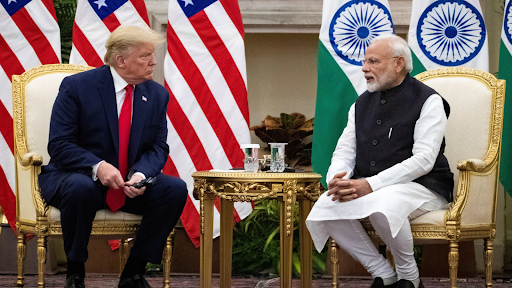
The "Sanctioning Russia Act of 2025," approved by US President Trump, threatens India and China with up to 500% tariffs for buying Russian energy, straining India's strategic balance between energy security, Russia, and the U.S.
The "Sanctioning Russia Act of 2025," through which the US imposes secondary sanctions on countries trading with Russia, poses a major geoeconomic challenge for India, threatening energy security, economic stability, and strategic autonomy.
Secondary Sanctions vs Primary Sanctions
|
Type of Sanction |
Definition & Mechanism |
Example |
|
Primary Sanctions |
These are restrictions imposed by one country (e.g., the US) directly on another country (e.g., Russia). They prohibit individuals and companies within the sanctioning country from doing business with the targeted nation. |
The US government freezing the assets of Russian banks held in the US or banning American companies from exporting technology to Russia. |
|
Secondary Sanctions |
They are imposed by one country (e.g., the US) on a third party (e.g., India or China) for engaging in significant transactions with the primary target (e.g., Russia). |
The US threatening to penalize Indian financial institutions for facilitating payments for Russian oil, thereby discouraging India-Russia trade. |
The sanctions severely test India's ability to navigate a polarized global landscape while upholding its national interests.
Challenge to Strategic Autonomy: India has historically balanced its relationships, participating in Western-led groupings like the Quad while also being a key member of the SCO and BRICS alongside Russia and China.
Sovereign Decision-Making: India maintains that its energy procurement is a sovereign decision dictated by the need to provide affordable energy to its 1.4 billion citizens. External pressure is viewed as a violation on this right.
De-Dollarisation Trend
Such coercive measures could accelerate India's push towards non-dollar trade settlement mechanisms and strengthen its engagement with platforms like BRICS, which are exploring alternatives to the dollar-dominated global financial system.
|
|
Current Status |
Potential Impact of Sanctions |
|
India-US Trade |
The US is India's largest trading partner. Bilateral trade stood at $132 billion in FY 2024-25, with Indian exports to the US valued at $86.5 billion. |
Punitive tariffs would make Indian goods (textiles, gems, pharma) uncompetitive, risking a major export shock and job losses. |
|
India-Russia Trade (Energy Focus) |
Bilateral trade hit a record $68.7 billion in FY 2023-24, with Russia becoming India's 4th largest trading partner. This surge is driven by oil. |
India would be forced to seek expensive alternatives, increasing its import bill and stoking domestic inflation. |
|
Russian Crude Oil Imports |
Russia is India's top crude oil supplier, accounting for approximately 35% of India's total oil imports in FY 2024-25. |
Losing access to discounted Russian oil could increase India's import bill by an estimated $9-11 billion annually, widening the Current Account Deficit (CAD). |
|
Macroeconomic Stability |
India's CAD and the Rupee value are sensitive to global oil prices. Discounted Russian oil has provided a crucial buffer. |
A simultaneous export shock and import bill spike would put severe pressure on the Rupee, potentially leading to its depreciation and imported inflation. |
Strengthening Non-Dollar Payment Mechanisms
To bypass the US financial system, India has focused on alternative payment routes. The Rupee-Rouble mechanism is a key example.
|
Rupee-Rouble Trade Mechanism |
|
|
How it Works |
Russian banks open Special Rupee Vostro Accounts (SRVAs) in Indian banks. Indian importers pay for goods (like oil) in Rupees into these accounts. Russian exporters can then use these funds to pay for their imports from India. |
|
The Core Challenge |
Trade imbalance. India's imports from Russia (mainly oil) far exceed its exports. This has led to billions of surplus Rupees accumulating in Russian Vostro accounts, which Moscow finds difficult to repatriate or use. |
|
Proposed Solutions |
The RBI has permitted Russia to invest these surplus Rupees in Indian government securities (G-secs), corporate bonds, and infrastructure projects. Additionally, Indian refiners have at times used other currencies like the UAE Dirham and Chinese Yuan for payments. |
Leveraging Strategic Connectivity Projects
Investing in alternative trade routes is crucial to bypass geopolitical chokepoints and reduce dependence on Western-controlled sea lanes.
India must use robust diplomacy for US waivers while aggressively diversifying energy, institutionalizing non-dollar payments, and operationalizing INSTC to counter the threat of US secondary sanctions and preserve strategic autonomy.
Source: INDIANEXPRESS
|
PRACTICE QUESTION Q. Analyze the potential impact of a 500% US import tariff on India’s labor-intensive export sectors and the broader trade balance. (250 words) |


© 2026 iasgyan. All right reserved