India has revised royalty rates for graphite, caesium, rubidium and zirconium to stimulate domestic exploration and reduce dependence on imported critical minerals vital for clean energy, electronics and strategic sectors. The shift to ad valorem royalties and the lowering of high default rates aim to attract more bidders and improve mining viability. However, despite these reforms, India continues to face deeper challenges such as weak exploration capacity, limited processing infrastructure, low private participation and heavy reliance on global supply chains. Royalty rationalisation is a step forward, but comprehensive reforms across mining, processing and technology ecosystems are essential for true mineral self-reliance.
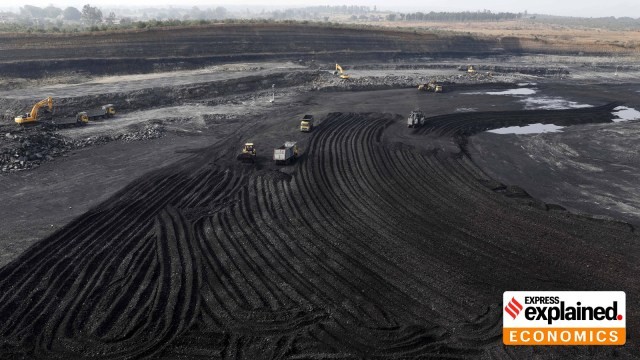
Copyright infringement not intended
Picture Courtesy: Indian Express
The Union Government has revised royalty rates for four critical minerals—graphite, caesium, rubidium, and zirconium—to boost domestic exploration, reduce import dependency, and mitigate supply-chain risks. These minerals are essential for green technologies, including EVs, solar, batteries, electronics, and advanced manufacturing.
A legally fixed charge paid by miners to the government for each unit or value of mineral extracted.
It is part of the Mineral Concession Rules under the Mines and Minerals (Development and Regulation) Act (MMDR Act).
Types of Royalty Rates:
Ad Valorem Royalty (Percentage-based)
Specific (Per-tonne) Royalty
Geological uncertainty & limited exploration
High upfront costs
Environmental and Social Clearance Bottlenecks: Land acquisition, forest clearance, and community consent remain time-consuming and contentious.
Limited domestic refining and processing capacity: India depends heavily on foreign refining, especially China, for lithium, graphite, REEs, and tungsten.
Global supply chain dominance by few countries: China controls 60–90% of global processing for many critical minerals. This creates price volatility, export restrictions and geopolitical vulnerabilities.
While the revision of royalty rates marks an important step toward unlocking India’s critical mineral potential, it is only a partial solution to a deeply complex ecosystem. Royalty reforms may attract more bidders and improve mining economics, but India’s core challenges—limited exploration, weak processing capacity, technological dependence, regulatory delays, and global supply-chain vulnerabilities—remain largely unaddressed. For true mineral self-reliance, India must complement royalty rationalisation with deeper reforms across exploration, refining, R&D, environmental governance, and strategic partnerships, ensuring that mining translates into real industrial and strategic capability.
Source: Indian Express
|
Practice Question Q. “India’s revision of royalty rates for critical minerals is necessary but insufficient to resolve its mineral supply-chain vulnerabilities.” Discuss. (150 words) |
Critical minerals are resources essential for economic growth, green technologies, and national security, but their supply is vulnerable due to limited availability or concentrated global production. India needs them for EV batteries, solar panels, semiconductors, defence systems, and advanced electronics.
Royalty rationalisation aims to attract more bidders, make mining commercially viable, and reduce import dependence at a time when global supply chains are disrupted — especially due to China’s export controls and dominance in processing.
Ad valorem royalty is calculated as a percentage of the mineral’s sale price, making it responsive to market fluctuations. Earlier, minerals like graphite were charged a fixed per-tonne rate, which made mining unviable during price downturns.






© 2026 iasgyan. All right reserved