Scientists recently discovered Pseudocapritermes novus, a new soil-dwelling snapping termite in West Bengal. Using unique asymmetrical mandibles, it produces a clicking alarm mechanism to warn its colony of danger. It acts as an ecosystem engineer, improving soil fertility.
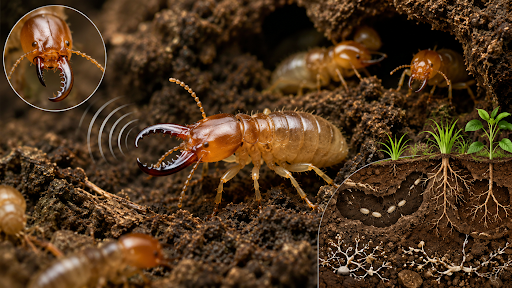
Researchers discover Pseudocapritermes novus, a new "snapping" termite species with a unique clicking alarm mechanism, in West Bengal's Chapramari Wildlife Sanctuary.
Physical Characteristics: This soil-dwelling termite features a sub-rectangular yellow head capsule, a translucent labrum, and highly asymmetrical mandibles where the left mandible exhibits a strong twist and the right mandible remains flat and blade-like.
Body Armour: The insect possesses unique body armour and prominent, strong spurs on its front legs to navigate its habitat.
Snapping Mechanism: Soldier termites utilize their lopsided, twisting jaws to perform a rapid flipping behavior, producing a sharp, loud clicking noise that functions as a physical alarm.
Alarm and Defence: The termite triggers this snapping mechanism as an aggressive defence strategy, generating a vibrational alarm signal through soil and wood to alert the colony.
Ecological Importance of Termites
Nutrient Recycling: Unlike destructive pest termites, Pseudocapritermes novus strictly consumes soil and decayed plant matter, aggressively recycling organic material in natural ecosystems.
Soil Formation: Constant movement through the earth directly enhances soil aeration and porosity, while salivary secretions enrich soil nutrition and boost natural fertility.
Ecosystem Engineering: The genus Pseudocapritermes establishes nutrient-rich hotspots around mounds to increase local plant and animal diversity, serving as an excellent ecological bio-indicator of soil quality.
Source: TIMESOFINDIA
|
PRACTICE QUESTION Q. Consider the following statements regarding the recently discovered Pseudocapritermes novus:
Which of the statements given above is/are correct? A) 1 and 2 only B) 2 and 3 only C) 1 and 3 only D) 1, 2, and 3 Answer: B Explanation: Statement 1 is incorrect: Pseudocapritermes novus is a soil-dwelling and soil-feeding termite, discovered in the forested habitat of the Chapramari Wildlife Sanctuary in West Bengal. It is completely non-destructive and does not act as a household or urban pest that destroys wooden infrastructure. Statement 2 is correct: It belongs to a specialized group known as "snapping termites". This species uses its unique, asymmetrical mandibles (jaws) to snap rapidly, producing a loud clicking sound utilized for defense and alarm signaling. Statement 3 is correct: Because these termites feed entirely on soil and humus, they play a critical ecological role in recycling organic nutrients, forming soil, and enhancing earth fertility. Consequently, they serve as excellent biological indicators of overall ecosystem soil health and quality. |
Pseudocapritermes novus is a newly discovered species of soil-dwelling termite identified in West Bengal's Chapramari Wildlife Sanctuary by a collaborative team of Indian scientists.
It is called a snapping termite because it belongs to a specialized group possessing highly asymmetrical, spring-loaded mandibles that forcefully slam together to emit a loud clicking sound used for active self-defense and threat signaling.
Soil-feeding termites act as critical ecological engineers that decompose dead organic humus, recycle vital subterranean nutrients, aerate hard ground layers, and directly enhance localized soil fertility.
Uncovering new organisms is essential to map hidden forest biodiversity, track baseline ecosystem health, resolve complex evolutionary lineages through DNA barcoding, and prioritize zones for targeted environmental conservation.





© 2026 iasgyan. All right reserved