The PM E-DRIVE extension transitions India from subsidies to a self-reliant EV ecosystem by 2028. Aligning with COP26 and Atmanirbhar Bharat, its success depends on securing mineral supply chains, enhancing grid resilience, and implementing robust battery recycling and swapping policies.
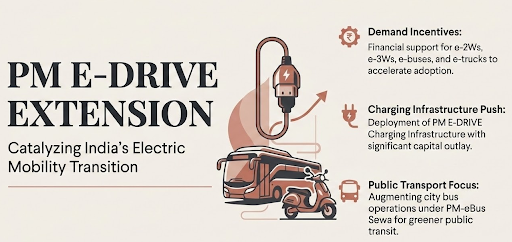
The Ministry of Heavy Industries (MHI) has extended the subsidy timelines under the PM E-DRIVE scheme: Electric two-wheelers (e-2Ws) until 31 July 2026, and electric rickshaws/e-carts until 31 March 2028.
The Union Cabinet approved the PM E-DRIVE Scheme, which officially came into effect on October 1, 2024, with a total outlay of ₹10,900 crore.
The EV policy framework has transitioned from the National Electric Mobility Mission Plan (NEMMP) 2020 to the FAME-I & II phases.
PM E-DRIVE (2024): Unlike FAME-II, which had broader targets, PM E-DRIVE focused heavily on the e-2W (Electric 2-Wheelers) and e-3W (Electric 3-Wheelers) segments, recognizing them as the primary drivers of mass adoption in India. .
Subsidies (Demand Incentives)
This component provides upfront incentives to reduce the purchase price of EVs, aiming for price parity with internal combustion engine (ICE) vehicles.
Grants for Creation of Capital Assets
Governance Framework and Implementation
Inter-Ministerial Oversight: The scheme is overseen by the Project Implementation and Sanctioning Committee (PISC), chaired by the Secretary of Heavy Industries.
PISC Authority: The committee monitors progress, addresses challenges, and has the power to revise incentives or approve guidelines for testing agencies.
State-Level Integration: States are encouraged to provide complementary fiscal and non-fiscal incentives, such as road tax waivers, reduced toll/parking fees, and permit exemptions.
Energy Security and Fiscal Health
India imports over 85% of its crude oil. A successful transition to EVs is estimated to significantly reduce the Current Account Deficit (CAD) and save billions in foreign exchange.
Atmanirbhar Bharat and PMP
To qualify for incentives, vehicles must be registered under the Central Motor Vehicle Rules (CMVR) and utilize advanced battery technology. The Phased Manufacturing Programme (PMP) ensures high domestic value addition, fostering a local manufacturing hub.
Climate Commitments (Panchamrit)
The scheme is a primary tool for meeting India’s COP26 targets, specifically reducing total projected carbon emissions by one billion tonnes by 2030.
Critical Mineral Supply: India remains dependent on imports for Lithium and Cobalt. Dependence on China or the "Lithium Triangle" remains a strategic risk.
Grid Resilience: The Central Electricity Authority (CEA) warns that uncontrolled EV charging could lead to local transformer overloads, necessitating "Smart Grid" protocols.
Circular Economy: India currently lacks large-scale facilities for battery recycling. Implementing the Battery Waste Management Rules, 2022 is crucial.
The extensions until 2026 and 2028 should be viewed as a "transition phase." The government must:
The PM E-DRIVE scheme is a blueprint for India’s industrial and environmental future. By providing a clear roadmap through 2026 and 2028, it aligns with India’s global commitments under the Paris Agreement and the Sustainable Development Goals (SDG 11 - Sustainable Cities and SDG 13 - Climate Action).
Source: MSN
|
PRACTICE QUESTION Q. Consider the following statements regarding the PM E-DRIVE Scheme: 1. It replaces the FAME-II initiative to drive mass EV adoption in India. 2. It provides equal subsidy extension timelines for both private electric two-wheelers and commercial electric buses until 2028. 3. It utilizes an Aadhaar-authenticated e-voucher system to prevent subsidy leakage. Which of the statements given above are correct? a) 1 and 2 only b) 2 and 3 only c) 1 and 3 only d) 1, 2, and 3 Answer: c Explanation: Statement 1 is Correct: The PM E-DRIVE (Prime Minister’s Electric Drive Revolution in Innovative Vehicle Enhancement) scheme was officially launched in October 2024 to replace the FAME-II (Faster Adoption and Manufacturing of Electric Vehicles) initiative, which concluded in early 2024. Its goal is to build on previous momentum and accelerate the transition to electric mobility. Statement 2 is Incorrect: The scheme does not provide equal subsidy timelines for all vehicle categories. In a strategic update by the Ministry of Heavy Industries, subsidies for electric two-wheelers (e-2Ws) have been extended until 31 July 2026, whereas subsidies for electric rickshaws and electric carts have a longer extension until 31 March 2028. Statement 3 is Correct: To ensure transparency and ease of governance, the scheme uses Aadhaar-authenticated e-vouchers. This digital mechanism ensures that the subsidy is linked directly to a verified buyer at the time of purchase, preventing "ghost beneficiaries" or duplicate claims. |
The PM E-DRIVE (Prime Minister Electric Drive Revolution in Innovative Vehicle Enhancement) is a ₹10,900 crore government initiative that replaces the FAME-II scheme. It aims to accelerate mass electric vehicle (EV) adoption and transition India toward a self-reliant, globally competitive EV manufacturing ecosystem.
To prevent "ghost beneficiaries" and administrative bottlenecks, the scheme introduces Aadhaar-authenticated e-vouchers. Buyers receive a digitally signed e-voucher generated on the VAHAN portal at the point of purchase, ensuring subsidies are linked directly to verified citizens.
India is heavily dependent on imports for critical EV battery minerals like Lithium, Cobalt, and Nickel. Despite exploration efforts by KABIL in countries like Argentina, the lack of large-scale domestic processing facilities makes the supply chain vulnerable to global shocks.



© 2026 iasgyan. All right reserved