The PROG Act, 2025 shifts online gaming from self-regulation to strict statutory oversight via the OGAI. By banning Real Money Gaming and promoting Esports, it prioritizes public safety and financial integrity over unregulated digital markets, despite potential constitutional legal challenges.
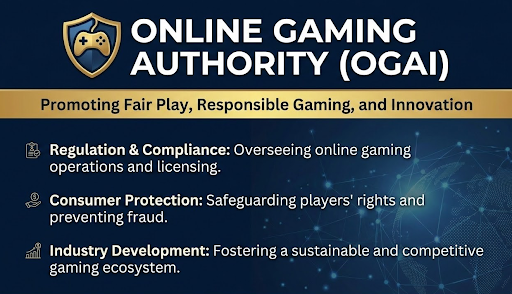
The Ministry of Electronics and Information Technology (MeitY) notified the Promotion and Regulation of Online Gaming Rules, 2026 to establish the Online Gaming Authority of India (OGAI) as the central statutory regulator.
|
Read all about: ONLINE GAMING REGULATION IN INDIA l REGULATION OF ONLINE REAL MONEY GAMING IN INDIA |
The OGAI is a statutory regulatory body established to oversee the online gaming sector, ensure user safety, and distinguish between permissible gaming and prohibited gambling.
Nodal Ministry: Ministry of Electronics and Information Technology (MeitY).
Headquarters: National Capital Region (NCR) of Delhi.
Legal Basis: Established under Section 19 of the Promotion and Regulation of Online Gaming Act, 2025.
Nature: It is a digital-first office, capable of conducting proceedings virtually.
Why a Centralized Statutory Framework Necessary?The government's shift from "light-touch regulation" to "active oversight" stems from several critical issues:
|
The OGAI holds powers akin to a civil court for inquiries and enforcement. Its primary mandates include:
The 2025 Act and 2026 Rules create a rigid distinction between game types:
|
Category |
Definition |
Regulatory Status |
|
Online Money Games (OMG) |
Games involving staking money/deposits with an expectation of winning money. Includes poker, rummy, and fantasy sports with wagering. |
BANNED (Source: PROG Act, 2025) |
|
Online Social Games |
Casual games for entertainment/education with no money involvement (e.g., Candy Crush, Ludo without bets). |
Permitted (Subject to Registration) |
|
Esports |
Competitive digital sports (skill-based) recognized under the National Sports Governance Act, 2025. |
Promoted & Regulated |
The establishment of OGAI represents a decisive "pivot to safety" in digital governance. The success of OGAI will depend on its ability to foster the permitted "Esports" ecosystem while effectively dismantling the financial networks of prohibited gambling apps.
Source: MONEYCONTROL
|
PRACTICE QUESTION Q.With reference to the Online Gaming Authority of India (OGAI), consider the following statements:
Which of the statements given above is/are correct? A) 1 and 2 only B) 2 only C) 2 and 3 only D) 1, 2, and 3 Answer: B Explanation: Statement 1 is Incorrect: The Online Gaming Authority of India (OGAI) is not a self-regulatory body. It is a statutory regulatory body established by the central government under Section 19 of the Promotion and Regulation of Online Gaming Act, 2025. Statement 2 is Correct: The OGAI functions as an attached digital office under the administrative control of the Ministry of Electronics and Information Technology (MeitY). It is chaired by an officer of the rank of Additional Secretary from MeitY and includes Joint Secretary-level members from other ministries like Home Affairs, Finance, and Sports. Statement 3 is Incorrect: The OGAI does not have a mandate to promote Real Money Gaming (RMG). The Promotion and Regulation of Online Gaming Act, 2025 explicitly prohibits and bans "Online Money Games" (games involving wagering or staking money). The Authority's mandate is to promote and regulate "Esports" and "Online Social Games" while identifying and banning platforms that offer real-money wagering. |
These are statutory rules notified by MeitY to regulate India's digital gaming sector. They enforce the PROG Act, 2025, by moving away from self-regulation to a strict statutory oversight model, primarily focusing on banning Real Money Gaming and promoting user safety.
The OGAI is a central statutory watchdog established under the PROG Act, 2025. Operating under MeitY as a digital-first office, it possesses civil court powers to oversee digital gaming, ensure user safety, maintain a "Negative List" of banned games, and block prohibited platforms.
The ban was introduced to address severe socio-economic crises. This includes the WHO-recognized "Gaming Disorder," rising suicide rates due to financial ruin (as documented by the Justice Chandru Committee), and massive hawala/money laundering operations utilizing gaming apps (like the Mahadev Book syndicate).




© 2026 iasgyan. All right reserved