The partial rollout of the National Sports Governance Act signals a shift toward transparent, athlete-centric sports administration. By creating the National Sports Board, National Sports Tribunal, and National Sports Election Panel, and mandating athlete representation in NSFs, it aims to replace personality-driven control with professional, accountable governance.

Copyright infringement not intended
Picture Courtesy: THE HINDU
The Central Government has partially enforced the National Sports Governance Act, 2025, activating key provisions for establishing and structuring national sports bodies.
Enacted to provide a statutory backbone to sports governance, the Act, replaces the ad-hoc arrangements of the 2011 Code.
The Act was notified in August 2025, and came into effect partially on January 1, 2026, to professionalize the administration of sports in the country.
Key Provisions of the Act
Statutory Framework: It establishes a legal framework for the recognition, governance, and oversight of the National Olympic Committee, National Paralympic Committee, and National Sports Federations (NSFs).
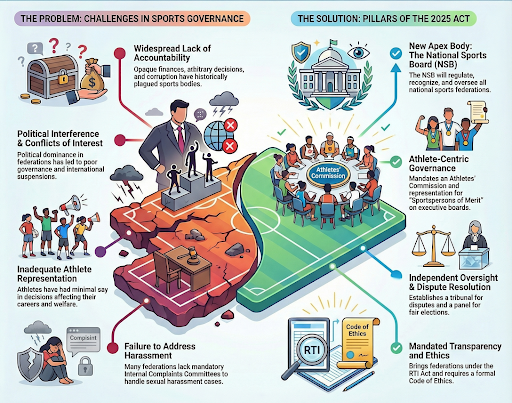
National Sports Board (NSB): The Act creates the NSB as the apex regulatory body to grant, suspend, or cancel the recognition of sports federations. Only NSB-affiliated bodies are eligible for government funding.
National Sports Tribunal (NST): An independent appellate tribunal will be established to handle sports-related disputes, ensuring timely and effective resolution.
Athlete-Centric Approach: The Act mandates the formation of an Athletes' Commission and ensures that Executive Committees of NSFs include at least two 'Sportspersons of Merit' (SOMs).
Transparency and RTI: Recognised sports federations are explicitly classified as public authorities under the Right to Information (RTI) Act, 2005.
Fair Elections: A National Sports Election Panel (NSEP) will be created to oversee free and fair elections within sports bodies.
Code of Ethics: Every National Sports Body is required to formulate and adhere to a Code of Ethics and a Safe Sports Policy, aligning with international standards.
Sports governance is a state subject under the 7th Schedule of the Constitution. However, the Union Government provides support in national and international policy, funding, and coordination.
|
Pillar |
Key Bodies |
Primary Role |
|
Government Bodies |
Ministry of Youth Affairs & Sports (MYAS), Sports Authority of India (SAI) |
Policy formulation, infrastructure development, funding, and implementation of schemes like Khelo India. |
|
Autonomous Bodies |
Indian Olympic Association (IOA), National Sports Federations (NSFs), State Olympic Associations (SOAs) |
Managing and regulating specific sports, selecting national teams, and functioning autonomously as per the Olympic Charter. |
Lack of Accountability: Opaque financial dealings, arbitrary decision-making, and alleged corruption have plagued several sports bodies. The 2010 Commonwealth Games scam is a prominent example.
Political Interference & Autonomy: Political dominance in NSFs often creates conflicts of interest and impairs fair governance, leading to suspensions by international bodies, such as FIFA's suspension of the AIFF for "third-party interference."
Unclear Division of Roles: The line between governance and management within federations is often blurred, leading to a lack of professionalization and strategic planning.
Inadequate Athlete Representation: Athletes have had minimal say in decision-making processes that directly affect their careers and welfare.
Structural and Policy Issues: Challenges include the lack of a standardized legal framework (which the new Act aims to fix), duplication of government schemes, and insufficient grassroots infrastructure.
Sexual Harassment: A critical issue highlighted by the Mary Kom Committee is the frequent absence of a mandated Internal Complaints Committee (ICC) in sports federations as per the PoSH Act, 2013.
The National Sports Governance Act, 2025, is a foundational step. However, sustained reforms are essential for India to become a global sporting powerhouse.
Strengthening Institutional Capacity: Task force led by Olympic champion Abhinav Bindra highlighted the need for NSFs to adopt a "competency-based leadership model" and separate governance from operations.
Professionalization of Administration: Create a cadre of trained sports administrators to set mandatory standards for sports administration professionals.
An Enforceable Athletes' Bill of Rights: Though the new Act aids athlete representation, experts advocate for a codified Bill of Rights to grant players legally enforceable protections for contracts, well-being, and grievance resolution.
Grassroots Integration: Effective governance must extend beyond national federations to schools, universities, and state-level bodies to nurture talent from the ground up.
Learning from Global Best Practices: The UK and Australia offer successful models, with clear separation of powers, independent oversight, and strong athlete representation, which India can use to improve governance structures.
The National Sports Governance Act, 2025 transitions Indian sports from the 2011 Code to a statutory basis for transparency, accountability, and athlete-centric policies, aiming for a more professional, ethical, and globally respected sporting nation through effective implementation.
Source: THE HINDU
|
PRACTICE QUESTION Q. "The National Sports Governance Act, 2025 marks a shift from 'Rule by Executive' to 'Rule of Law' in Indian sports." Critically analyze. (250 words) |
The National Sports Governance Act, 2025, is a new law aimed at reforming the administration of sports in India. It introduces a legally binding framework to ensure transparency, accountability, and professionalism in National Sports Federations (NSFs) and other sports bodies.
The National Sports Board (NSB) will act as the principal regulatory body for sports. Its functions include granting official recognition to NSFs (which is necessary for government funding), monitoring their financial operations, and imposing penalties for irregularities.
The National Sports Tribunal (NST) is a specialized judicial body created to provide speedy and expert resolution of sports-related disputes. Its jurisdiction covers issues like anti-doping violations, selection disputes, and challenges to election results, reducing the burden on regular courts



© 2026 iasgyan. All right reserved